
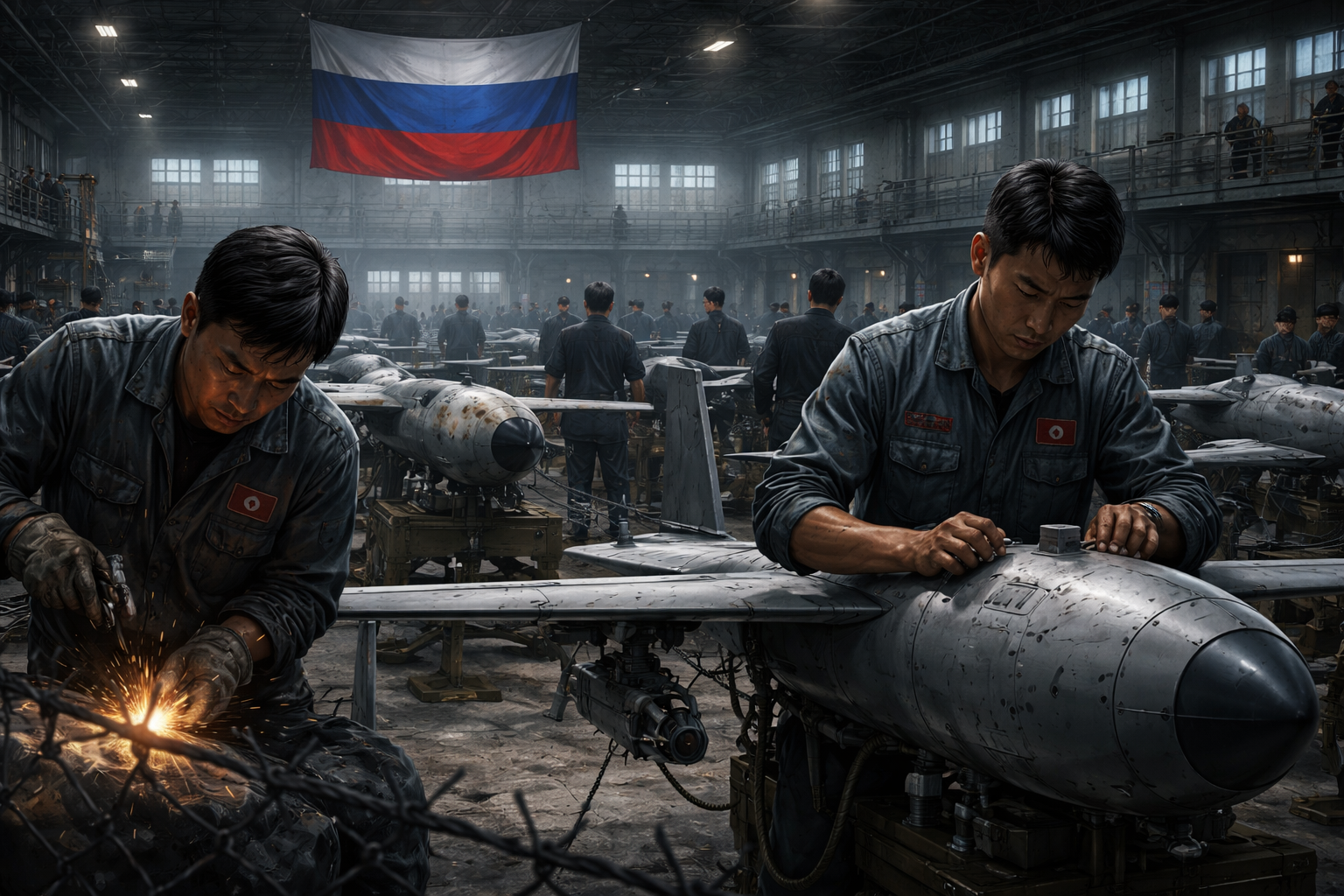
A new report highlights serious human rights abuses involving up to 12,000 North Korean workers employed at a drone manufacturing plant in Yelabuga, Russia. According to a joint analysis by the Center for Strategic and International Studies (CSIS) and the George W. Bush Institute, these workers face forced labor conditions, including the confiscation of up to 90% of their wages.
The Yelabuga plant in Tatarstan is a key production site where Russia assembles drones used in its ongoing war in Ukraine. The report details how Russia obtains over 5,500 drones monthly, while China supplies critical dual-use components like batteries and navigation systems. Iran has also contributed Shahed drones, enabling Russia to develop upgraded variants.
Forced Labor Violates UN Resolution
The report states that Russia and North Korea are violating United Nations Security Council Resolution 2397, which mandates that North Korean workers abroad must be repatriated within two years. However, North Korea continues to exploit its citizens through a government-controlled labor export system that restricts workers’ freedom and retains most of their earned wages. Experts describe this as forced labor or slavery.
Song Young-Chae, a human rights activist based in Seoul, emphasized that North Korean labor exploitation extends beyond Yelabuga, also including forced labor in occupied Ukrainian territories and other industries. He stresses the severity of the situation where workers have almost no freedom and receive only a fraction of their pay.
Challenges to Accountability and Enforcement
The report notes the geographic proximity of Russia, China, North Korea, and Iran hampers international intervention or enforcement of sanctions. Both Russia and China, permanent members of the UN Security Council, have ignored resolutions addressing the issue, limiting global efforts to end the exploitation and related military advancements. The report calls for increased multinational coordination to disrupt human trafficking networks and hold perpetrators accountable.
According to Dan Pinkston, a professor of international relations, the ongoing disregard for UN sanctions regarding North Korean workers and weapons proliferation signals a weakening of the international order governing human rights and arms control.
Implications for Regional Security and Drone Technology
Through their involvement in the conflict in Ukraine, Russia and North Korea have gained valuable insights into modern drone warfare, with North Korea actively developing its own drone capabilities based on this experience. This dynamic presents serious security concerns for neighboring countries like South Korea, which must adapt to emerging threats from advanced unmanned aerial vehicles.
The report urges the US State Department and the UN to take stronger actions, including investigating the Yelabuga plant abuses, protecting victims, sanctioning responsible parties, and pressuring foreign companies operating in the special economic zone to withdraw.