
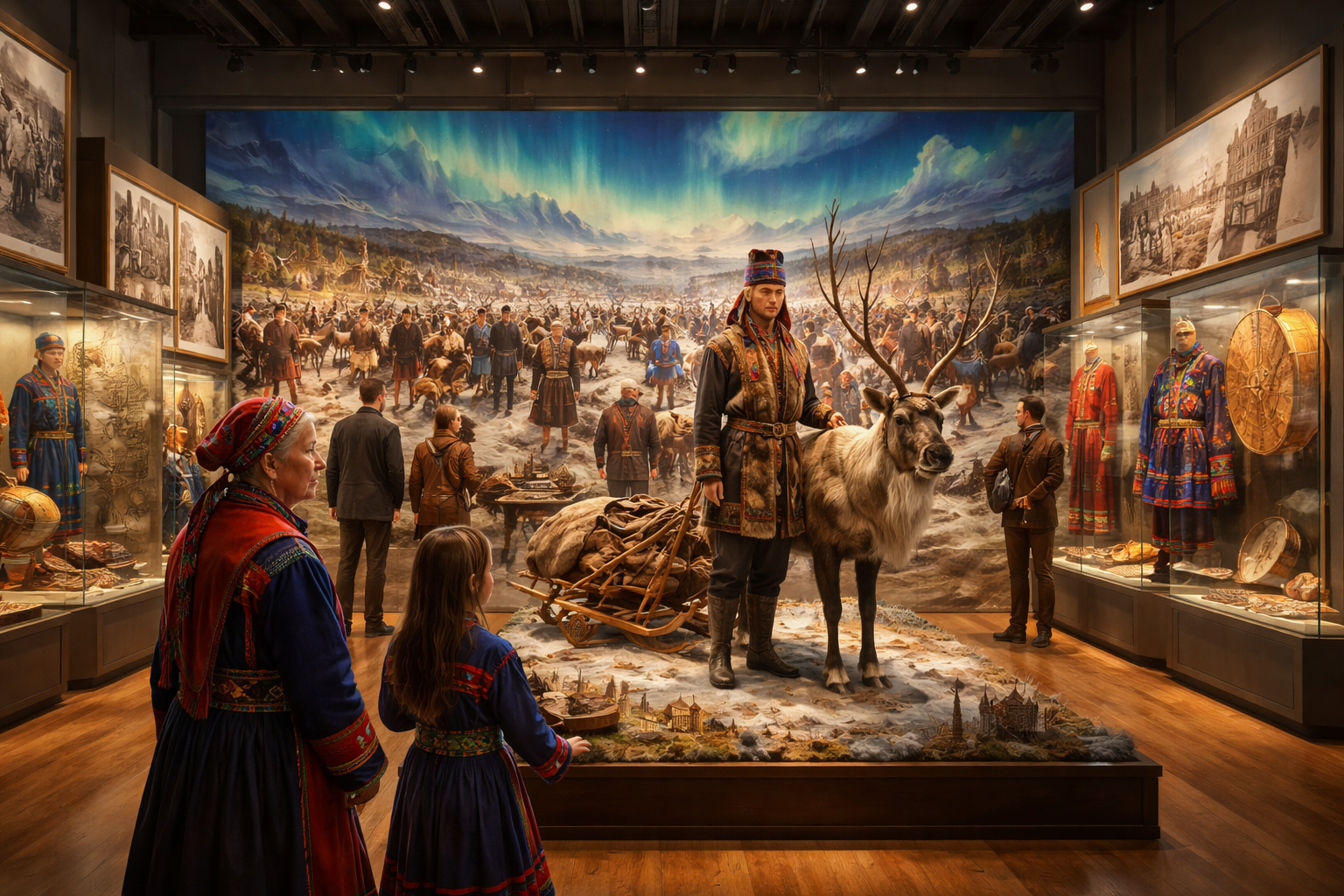
An exhibition at the Kin Museum in Kiruna, northern Sweden, brings renewed attention to the lives and challenges of the Sami people, Europe’s only recognized Indigenous group. The showcase centers on the 1910 book An Account of the Sami by Johan Turi, who documented Sami culture and daily struggles from his perspective over a century ago.
This event coincides with the official handover of a comprehensive report by Sweden’s Truth Commission for the Sami People, detailing historical abuses committed by the state against the Sami community. The report aims to facilitate discussions on reparations and reconciliation.
Johan Turi’s Enduring Legacy
Born in the Norwegian part of Sápmi in 1854, Johan Turi was a reindeer herder who moved with his family to Kiruna amid growing national border restrictions. His book, initially published in Sami and Danish, and later translated into Swedish, was written to help Swedish society understand the hardships facing the Sami during a time of racial discrimination, land disputes, and expanding industrial activity, including mining and railway construction.
Turi’s detailed drawings, writings on belief systems, and traditional handicrafts (Duodji) offer a rare insight into Sami life in the early 20th century. Despite the challenges, he wanted his book read by Swedish authorities, hoping it would spark change.
Contemporary Sami Voices and Ongoing Struggles
The exhibition, titled On the Ugly and the Beautiful, references Turi’s belief that all aspects of Sami life—both positive and negative—should be acknowledged. It features work by contemporary Sami artists Outi Pieski and Johanna Minde, connecting past and present cultural expressions.
Pieski, who grew up familiar with Turi’s works, emphasizes the authentic Sami view of the land as the foundation of life, contrasting Western perceptions of landscape as a distant view. She also highlights efforts to revive traditional Sami women’s hats (lájdogahpir), now recognized as symbols of decolonial feminism.
Despite progress symbolized by the Truth Commission’s report, the contemporary Sami community still faces threats from industrial expansion, including rare earth mineral extraction and wind energy projects, as well as a rise in anti-Sami rhetoric from political leaders, mirroring challenges from Turi’s era.
Truth Commission and Reconciliation Efforts
The report presented at Mid Sweden University in Staare is a critical step toward acknowledging and addressing the state’s past abuses against the Sami. The Kin Museum hosted a special tour of the exhibition alongside a reading of Sami testimonies, seeking to deepen awareness and support for Sami rights.
Maria Lind, museum director, noted that Turi’s work captures both the external and inner dimensions of Sami life, making it relevant today more than ever. The shared struggles across a century highlight the enduring nature of Sami resilience and the ongoing fight for recognition and justice.