
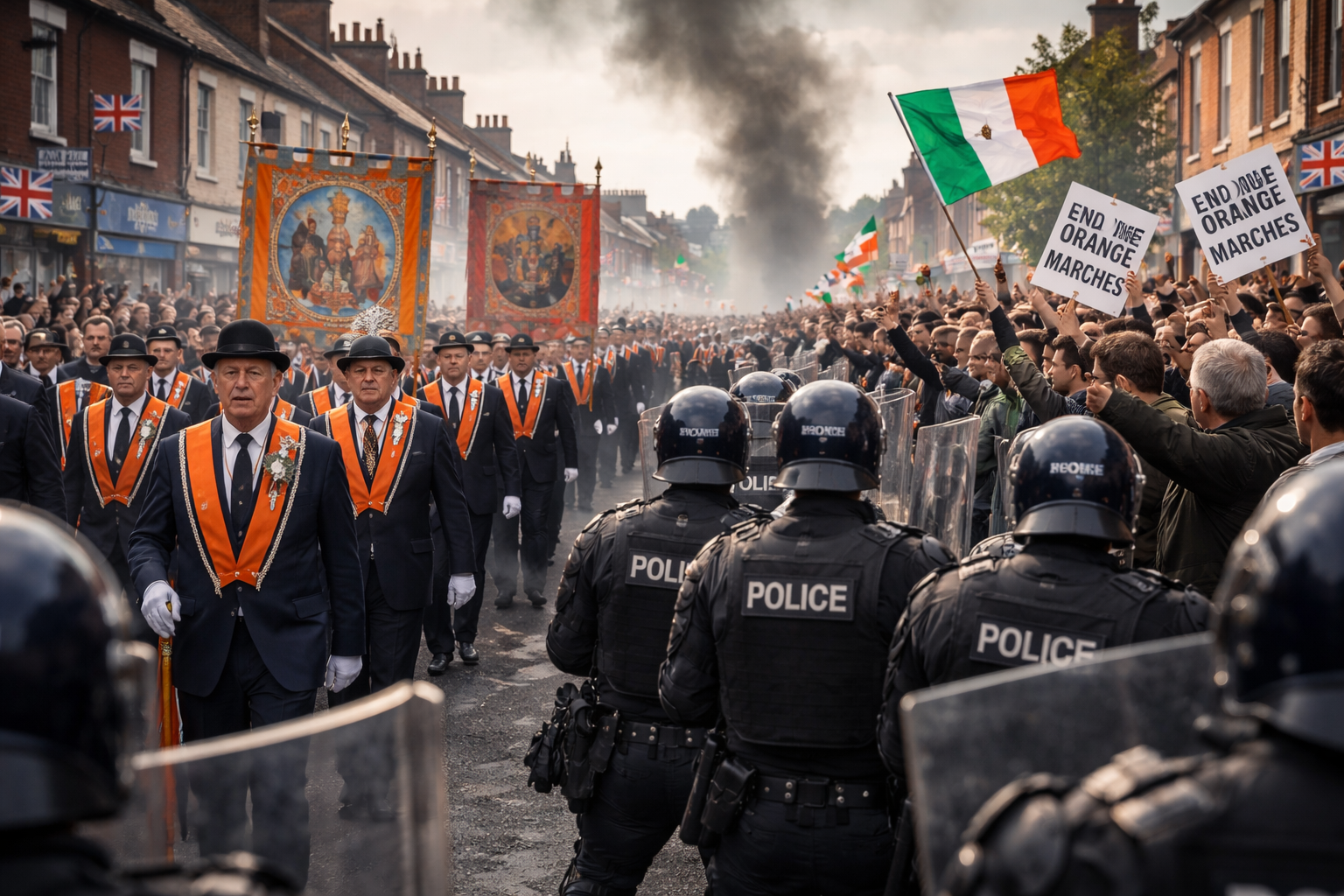
The longstanding dispute over the Orange Order’s Drumcree parade through the predominantly Catholic Garvaghy Road in Portadown, Northern Ireland, remains unresolved as key parties continue negotiations. The parade, set for Sunday morning after decades of legal battles, was stalled by protesters blocking the route and police preventing marchers from proceeding due to safety concerns.
Members of the Orange Order, a Protestant pro-British organization, have sought to resume their march along Garvaghy Road for the first time in 30 years. The area is largely inhabited by Catholic residents who are mainly pro-Irish nationalists and have strongly opposed the parade.
Stalemate and Police Intervention
Following weekend protests, police maintained a significant public safety operation on Garvaghy Road and denied the Orange Order the right to begin their parade, citing an ongoing unnotified illegal protest. Despite attempts by Orangemen to initiate the march early Monday morning, police Land Rovers blocked their path to prevent escalation.
Assistant Chief Constable Ryan Henderson acknowledged the complexity, noting that removing around 1,000 protesters—including vulnerable groups—would have required excessive force, potentially leading to significant disorder and injuries. This assessment formed the basis for police restraint, a stance supported by the Police Federation for Northern Ireland.
Negotiations and Political Responses
High-level talks took place Monday at Hillsborough Castle involving the two senior members of the Portadown Orange Order and Northern Ireland Secretary Sir Chris Bryant. The discussions were described as constructive but left the parade’s future uncertain. The Orange Order insists the law must be applied fairly, while the Garvaghy Road Residents Coalition has suggested alternative routes for the parade’s return journey, expressing a willingness to consider mediation despite mistrust of the Orange Order.
Political leaders remain divided. Sinn Féin’s First Minister Michelle O’Neill participated in the protests, drawing criticism from the Democratic Unionist Party (DUP), which accused her of unlawful conduct and called for police enforcement to allow the parade. DUP leader Gavin Robinson indicated plans to pursue formal complaints through Stormont’s standards commissioner but stopped short of advocating institutional collapse. Other parties urged calm and cautioned against escalating tensions.
Historical Context and Broader Impact
The Drumcree dispute dates back to the mid-1990s when nationalist protests against the Orange Order’s march sparked serious violence and social unrest across Northern Ireland. The Parades Commission barred the march until a recent court ruling granted permission with restrictions. Despite the legal clearance, the parade has reignited sectarian tensions once again.
The ongoing dispute has had tangible community effects, including the temporary closure of two local schools due to safety concerns. Religious leaders from both Catholic and Church of Ireland have appealed for peaceful dialogue, emphasizing the high stakes for the community’s future stability.