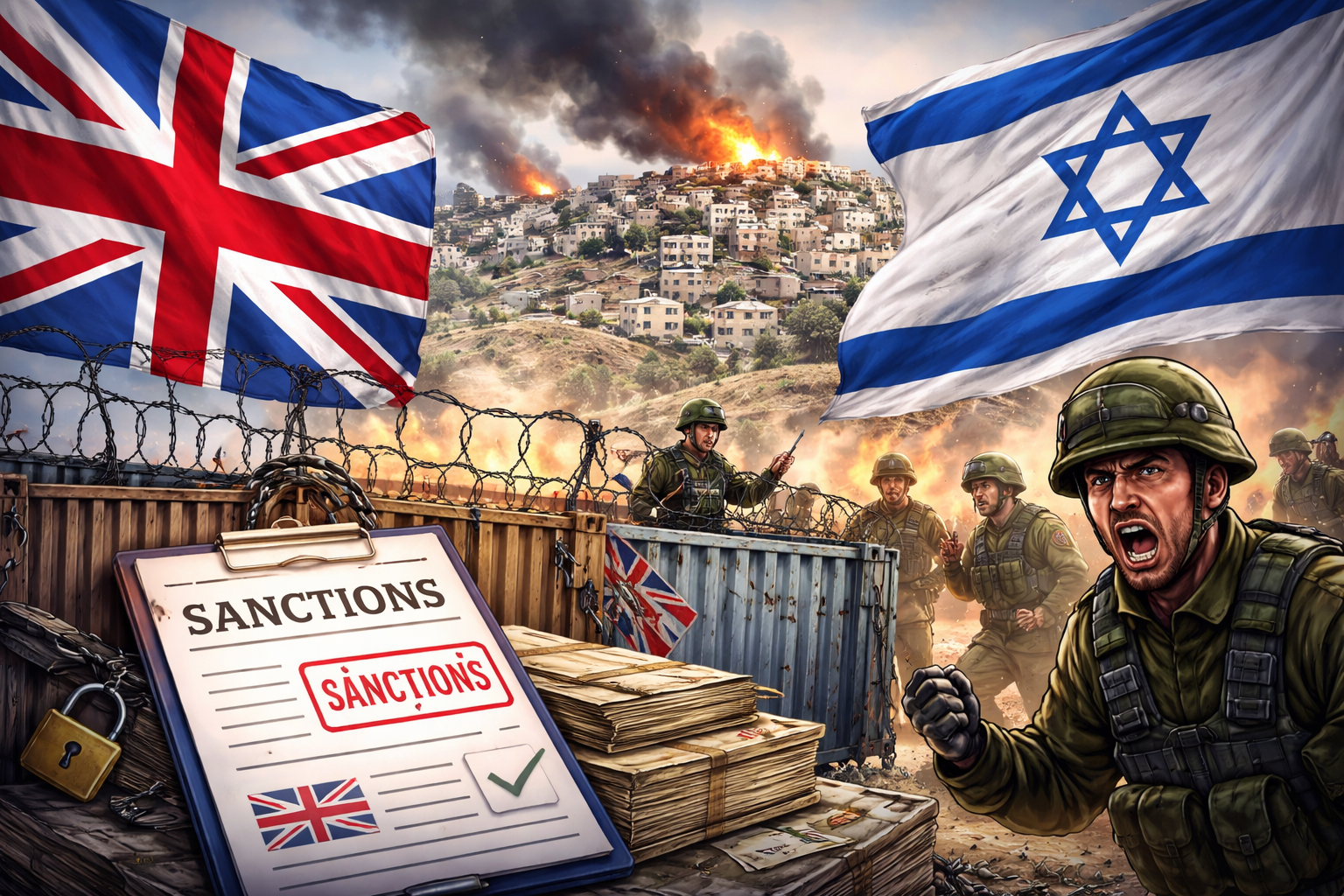
The United Kingdom has announced a new sanctions regime targeting illegal Israeli settlements in the occupied West Bank, accusing Israel’s government of ignoring what it described as “ethnic cleansing” of Palestinians by settlers. The decision marks a shift in the UK’s approach to the Israeli-Palestinian conflict and has immediately provoked a furious response from Israeli officials.
UK Foreign Secretary Ed Miliband stated that the sanctions represent the “beginning of a new approach” intending to confront injustice and suffering in the region. The sanctions include bans on settlement goods and penalties against companies and individuals enabling settlement expansion. The UK also announced measures to prohibit advertising West Bank settlements within Britain.
Reactions and Israeli Countermeasures
Israel’s Foreign Minister Gideon Saar condemned the UK move as spreading “outrageous lies” and responded by ordering the closure of the UK’s consulate in East Jerusalem, which handles affairs in Jerusalem, the West Bank, and Gaza. Saar further announced bans on entry to Israel for 11 UK Members of Parliament, including Jeremy Corbyn, Diane Abbott, and all sitting Green Party MPs, citing their “antisemitic and anti-Israel activity.” Additionally, the UK’s presence at the International Gaza Support Center in southern Israel was terminated, alongside the end of UK training programs for Palestinian Authority forces in Judea and Samaria (the Israeli term for the West Bank).
International and Domestic Responses
The UK acted in coordination with France and Canada, issuing a joint statement emphasizing a commitment to protecting the two-state solution through national or European measures restricting trade linked to West Bank settlements. The Palestinian presidency welcomed the UK’s stance as a significant step against Israel’s policies towards Palestinians.
Domestically, the UK’s Chief Rabbi Sir Ephraim Mirvis described the sanctions as “a dark day for British Jews,” criticizing them as political gestures that could foment hatred against Jews. The Board of Deputies of British Jews expressed regret, urging both governments to prioritize national interests over party politics. Conservative opposition criticized the UK government’s approach as overly simplistic and unlikely to succeed.
Context and Implications
Miliband emphasized that the UK’s official position is that the Israeli occupation of the West Bank is unlawful, citing the expansion of illegal settlements and plans to build 1,200 new homes in the strategically sensitive E1 area east of Jerusalem. Miliband warned that such developments threaten to make a two-state solution impossible by dividing Palestinian territory.
The Foreign Secretary also highlighted concerns regarding alleged war crimes in Gaza following the Hamas-led attack on Israel in October 2023 and expressed support for legal processes to examine these issues. Meanwhile, Israeli leaders have consistently rejected claims of genocide and war crimes, asserting adherence to international law.
The UK’s sanctions come alongside new measures targeting Hezbollah’s financing wing in Lebanon and Iran, aligning with U.S. and European Union policies. The move follows the UK government’s formal recognition of a Palestinian state in the previous year and its stated commitment to supporting peace between Israelis and Palestinians.
Looking Ahead
The UK government plans to implement the sanctions regime over the next six to nine months, focusing specifically on illegal settlements and not on Israel as a whole. Israel’s leadership called on foreign governments to pursue dialogue rather than sanctions, warning that the UK’s actions may harm Palestinians and interfere in Israeli democratic processes.
The United States declined to follow suit, with Secretary of State Marco Rubio saying the White House had no comment and would not adopt similar measures. However, some U.S. officials hinted at possible retaliatory actions against British business interests.