

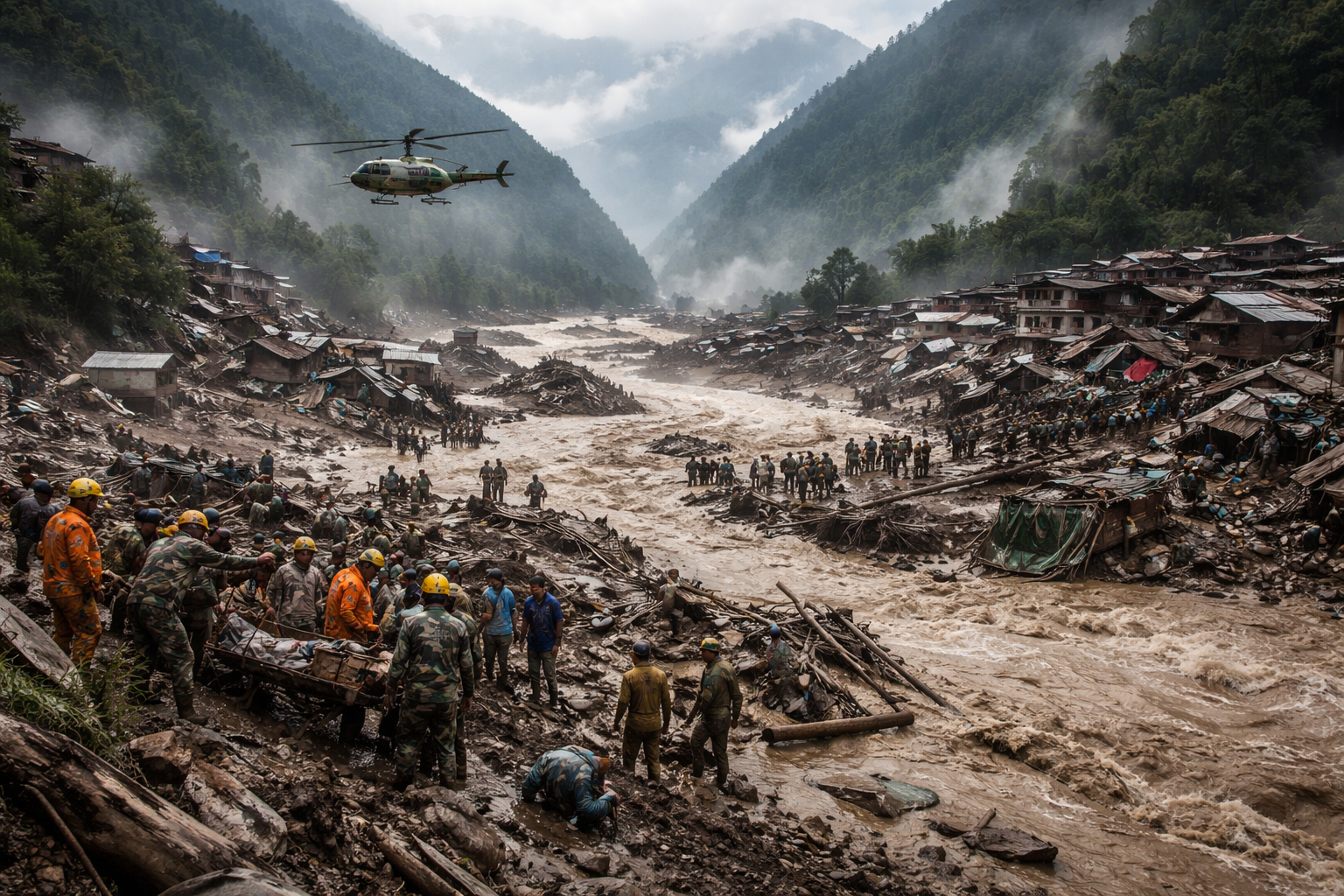
The death toll from the flash floods triggered by a glacial collapse on the Nepal-Tibet border has risen to over 600, with rescue teams continuing their search for nearly 3,000 missing individuals. According to Nepal’s disaster agency, 675 deaths have been confirmed on the Nepal side, while China’s Xinhua news agency reports seven fatalities in Tibet and 554 missing people.
The floods swept through regions near the China-Nepal border on Wednesday, devastating towns, damaging hydropower plants, and carrying debris as far downstream as India.
Challenges in Rescue Operations
Rescue efforts in Nepal remain hampered by rainy weather, which has forced a halt to helicopter operations as conditions are unfavorable for landing and takeoff amid thick mud layers. The Nepal Army has been working to rescue over 100 people trapped inside a mud-filled tunnel at the Trishuli 3A hydropower project in Rasuwa District. Specialized rescue teams from India have arrived to assist, focusing on technical tunnel rescue operations.
Some survivors have already been evacuated from the tunnel, despite difficulties locating its entry points. Authorities also report that the bodies of flood victims have been discovered dozens of kilometers from the disaster zone, including in Nepal’s Chitwan District bordering India. Indian officials have recovered seven bodies believed to be victims swept downstream by the floodwaters.
Technical and Logistical Needs Highlighted
Nepal’s Foreign Minister emphasized the country’s need for technical assistance in areas such as tunnel rescue expertise, equipment, restoring transportation and communication lines where infrastructure was destroyed, and managing identification and storage of bodies. Although Nepal has declined international involvement in search and rescue efforts, aid for specialized services remains under request.
The financial impact of the disaster is significant, with Nepal’s Finance Minister estimating reconstruction costs between $4 billion to $5 billion, roughly one-tenth of Nepal’s economy. This estimate is considerably lower than the cost of rebuilding after the 2015 earthquake, Nepal’s worst recorded disaster.
Situation and Response in Tibet
In Tibet’s Gyirong area, rescue efforts were temporarily suspended due to risks of further flooding but have since resumed after officials determined the immediate danger had decreased. Two villagers have been rescued so far. The glacial collapse also created a barrier lake upstream, and recent satellite images show the lake’s surface area shrinking as debris dams begin to give way.
Authorities have identified a larger, deeper body of water at the base of the collapse but the depth remains unknown. Officials warn that flood risks persist until these lakes fully drain.