

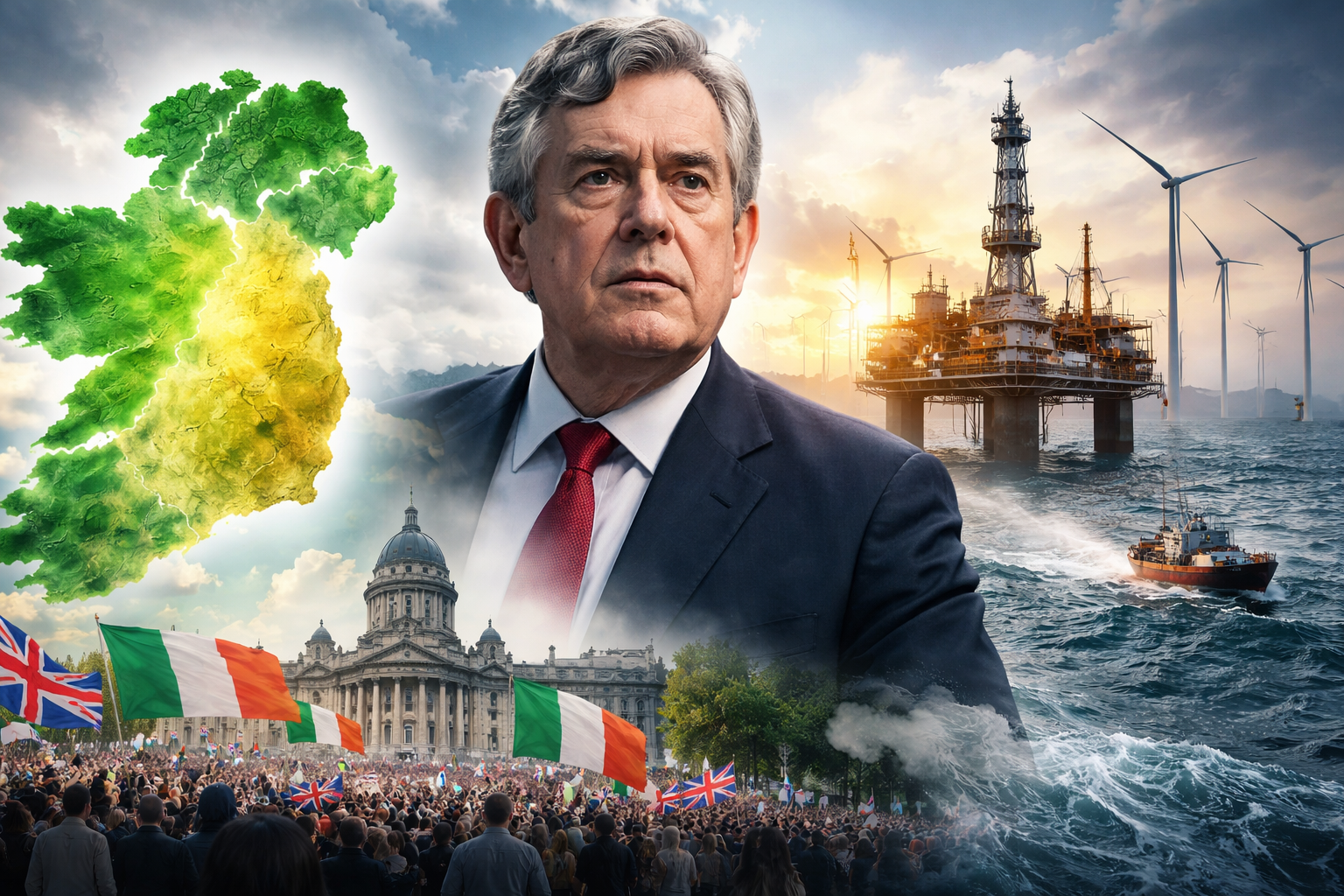
Gordon Brown foresees a united Ireland in the long run but remains firm against Scottish independence, emphasizing cooperation within the UK and a strategic North Sea energy transition
In a revealing interview with The Guardian, former UK Prime Minister Gordon Brown expressed his belief that Ireland will eventually become united. While acknowledging this would be a slow and consensual process, Brown’s position highlights a nuanced view on UK unity, balancing decades of peace efforts in Northern Ireland with his opposition to Scottish independence.
Brown, who was Chancellor during the 1998 Good Friday Agreement and Prime Minister when policing and justice powers were devolved to Northern Ireland in 2010, stressed the complexity of regional ties within the UK. His comments not only underscore his vision for reconciliation but also his support for a continued, cooperative United Kingdom.
Alongside political unity discussions, Brown also weighed in on the future of energy policy in the UK, advocating for a balanced transition in the North Sea that integrates both fossil fuels and renewables as part of a broader European collaboration. These insights form part of his new book, The Future Starts With Us. These views were shared according to information published by The Guardian.
Long-Term Vision for Irish Unity
Gordon Brown drew a clear distinction between Northern Ireland and Scotland’s futures within the UK. While firmly opposing Scotland’s move toward independence, he sees the geographical and cultural proximity of Northern Ireland to the Republic of Ireland as a factor making unification inevitable. He stated, “Yes. Well, of course, in the long term, Ireland will be united.”
However, he was careful to frame this as “a long process where people have got to come together and find a way of agreeing”, highlighting the need for mutual consent and dialogue. This perspective reflects Brown’s enduring commitment to peace and stability in Northern Ireland, leveraging his historical role in the peace process.
Opposition to Scottish Independence and Emphasis on UK Cooperation
When addressing the ongoing debate over Scottish independence, Brown emphasized the interconnectedness of Scotland with the broader UK in several ways—geographically, economically, socially, and culturally. He argued that independence would disrupt this relationship and is not the right path forward.
Brown articulated the importance of the UK nations “living in cooperation with other countries,” underlining his belief in a united Britain encompassing England, Wales, Scotland, and parts of Ireland. This outlook underscores his vision of a union fortified by collaboration rather than separation.
North Sea Energy and the Transition to Renewables
Beyond matters of unity, Brown addressed critical energy policy challenges facing the UK, particularly in the North Sea. He criticized portrayals suggesting a binary choice between fossil fuels and renewable energy. Instead, he advocated for a transition strategy that enlists existing oil and gas infrastructure and expertise to support emerging renewable sectors such as wind, hydrogen, and carbon capture.
Brown proposed that this transition could be managed through a “European consortium” involving Norway, Germany, the Netherlands, Belgium, and Denmark, envisioning a cooperative approach to energy innovation. He said, “The way to make that happen is to keep the infrastructure and skills that you have in the development of the North Sea for oil and gas.”
This approach reflects the evolving nature of energy investment, where environmental policies should be perceived as “a benefit and not just a cost.” Brown highlighted the decreasing cost of renewables, noting that twenty years ago coal, oil, and gas were cheaper to produce, but today solar and wind power offer significant financial advantages.
Political Reflections and Future Directions
In discussing his role in contemporary politics, Brown expressed a desire not to micromanage current leaders such as Andy Burnham, who faces critical decisions on North Sea oil and gas drilling amid environmental concerns. Brown’s cautionary stance suggests a balance between political engagement and respect for current leadership autonomy.
Overall, Brown’s statements conveyed a vision of gradual change—whether in UK territorial arrangements or the energy sector—rooted in cooperation, dialogue, and pragmatic transition strategies that honor historical context and future sustainability.