

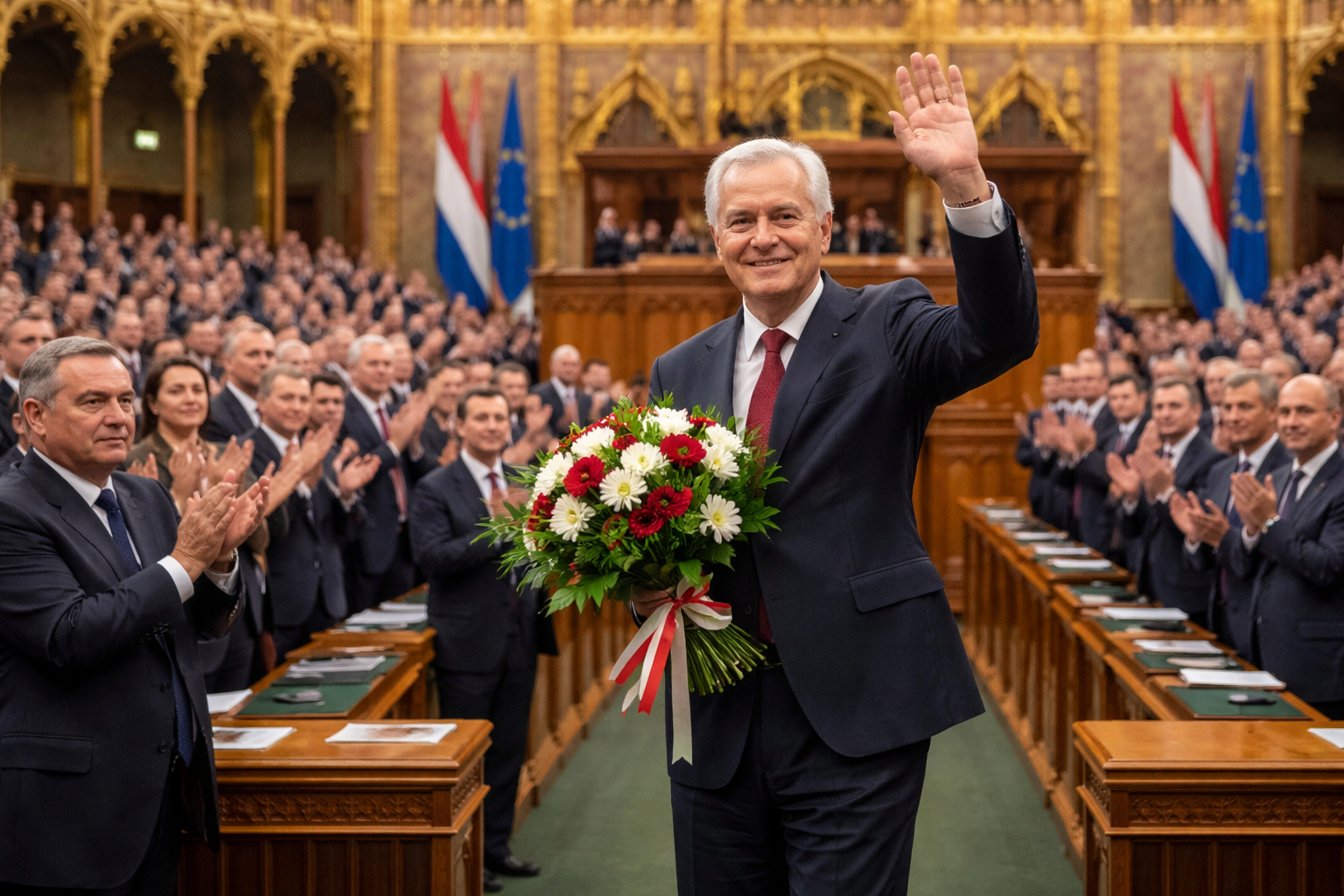
Andras Baka, who formerly led Hungary’s Supreme Court and was a vocal critic of Viktor Orban, was elected president by the Hungarian parliament on Tuesday. The vote comes as part of a broader effort by Prime Minister Peter Magyar to reverse Orban-era policies following his party’s decisive win in April’s general elections.
Baka will succeed Tamas Sulyok, an Orban appointee whose term was cut short through a parliamentary constitutional amendment to make way for the new leadership. The vote largely went along party lines, with Magyar’s conservative TISZA party holding an overwhelming majority in the chamber.
The right-wing Fidesz party led by Orban boycotted the vote, condemning the process as illegitimate but unable to block Baka’s appointment.
Background on Andras Baka
Andras Baka, now 73, has a long background in law and politics, having briefly served as a member of parliament in the early 1990s. He was a judge at the European Court of Human Rights for nearly two decades before returning to become Hungary’s Supreme Court president in 2009.
His term was cut short in 2011, soon after Orban returned to power, amid criticism that his removal undermined judicial independence. Baka’s experience has since been cited by Magyar as emblematic of a commitment to restoring constitutional governance under the rule of law in Hungary.
Constitutional Changes and Political Context
Magyar utilized his two-thirds parliamentary majority to amend the constitution, effectively shortening the term of Baka’s predecessor, Tamas Sulyok, who was considered an Orban ally. This move has faced criticism from Fidesz representatives and some rights groups who likened it to the previous government’s controversial practices.
Despite initial consideration of chess champion Judit Polgar as a presidential candidate, she declined the role, citing the challenge of uniting the nation, although she pledged support for efforts to establish an independent presidency.
Baka’s Remarks on His Appointment and Hungary’s Future
While Baka did not directly object to Sulyok’s removal, he acknowledged the extraordinary measures used in the Orban era, describing Hungary at that time as a “captured state.” Speaking to the parliament on Tuesday, Baka stressed that the new Hungary should not be built on revenge. He emphasized fostering open public debate, ensuring parliamentary transparency, and preventing constitution-making from being monopolized by a single political force.