

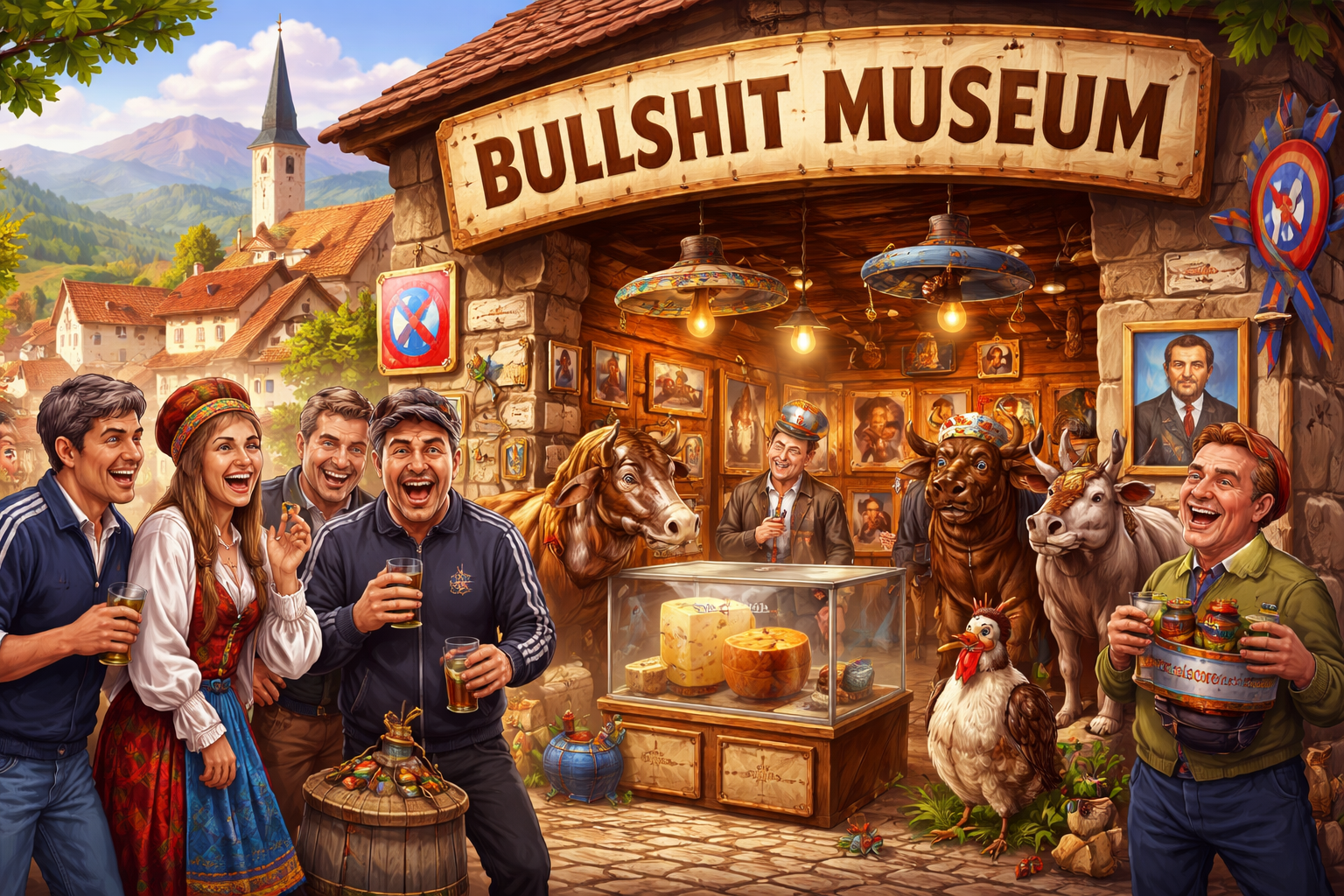
Slovenia’s Bullshit Museum showcases the rich and often contradictory humor of the former Yugoslavia as a cultural bond amid history’s challenges
In the heart of Ljubljana, visitors encounter an unusual welcome: a mannequin with a bucket on its head, embodying the quirky spirit of the new Bullshit Museum. This museum, opened in May, offers a deep dive into the humor of the Balkan region, especially the diverse and sometimes conflicting jokes that thrived across the former Yugoslav republics.
The museum focuses on the cultural glue that Balkan humor provided during the socialist federation days. It uses satire, wordplay, and metaphor to reflect on daily life, war, and identity in countries that once formed Yugoslavia.
As Borut Kokelj, the museum’s founder, explains, there is a line between playful humor and politically charged jokes; the museum carefully curates its content to avoid offense while still presenting sharp observations about the Balkan soul. This nuanced approach invites visitors to reflect on how laughter has shaped and survived the region’s turbulent history, according to reporting from the Guardian.
A Unique Blend of Humor Rooted in History and Language
The Bullshit Museum is not just a collection of jokes but a complex portrayal of the former Yugoslavia’s social fabric. The federation, consisting of Slovenia, Croatia, Serbia, Montenegro, Bosnia and Herzegovina, and Kosovo, shared a common language—officially Serbo-Croatian—yet was marked by vast ethnic, religious, and dialectal differences.
One exhibit playfully reads “A fool is a fool in both the Cyrillic and Latin alphabets,” highlighting linguistic divides: Cyrillic scripts are linked to Serbian and Orthodox Christians, while Latin alphabets connect with other national groups. The museum presents cultural tensions through humor but avoids targeting specific groups with harmful stereotypes.
Everyday Life and Absurdity at the Core of Balkan Humor
Most jokes found at the museum steer clear of ethnic or religious conflict, instead focusing on everyday absurdities and shared human experiences. Visitors can explore jokes that sarcastically reflect on life’s unpredictable nature, romantic relationships, and the ability to laugh at oneself, which remains a vital Balkan trait.
For instance, one popular quip says, “Love is when you look like a sack of potatoes, but she sees you as fries,” capturing sentiment with humor and charm. Such jokes resonate well beyond ethnic lines, offering a common cultural language that once helped unite a fractured region.
The Indispensable Role of Rakija and the Spirit of Yebiga
A central theme uniting visitors is rakija, the famous Balkan fruit brandy, offered to guests upon entry. Defined as the “first aid of every Balkan household,” rakija symbolizes resilience and communal comfort. Alongside rakija, the museum explores the concept of yebiga, a Yugoslav expression roughly translated to “fuck it” or “screw it,” encapsulating the regional attitude of facing hardship with a shrug.
One exhibit sums up yebiga as “the Balkan way of saying: what are you going to do? Maximum feeling, minimum energy,” often accompanied by rakija, a cigar, and a melancholic song. This phrase and its cultural meaning thread through the entire exhibition, illustrating how humor helped people cope with chaos and uncertainty.
A Delicate Balance in Presenting Balkan Humor Today
Kokelj’s careful curation reflects an awareness of the region’s painful history. He admits that including all the “truly ‘Balkan’ jokes,” especially those laden with ethnic or religious tensions, could have prevented the museum from ever opening. The approach taken is respectful and inclusive, inviting visitors to appreciate the complexity of Balkan humor without deepening divides.
This museum stands as a testament to how humor sustained a diverse and conflicted region, offering insight into shared experiences through wit and satire. It preserves a unique cultural legacy while encouraging dialogue and reflection on identity in the Balkans.