

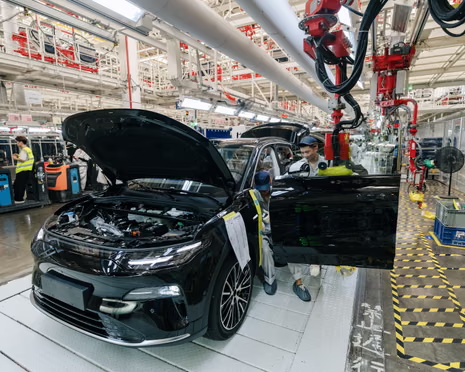
The rapid rise of Chinese electric vehicle sales in Europe has reached a historic peak, fueling intense political friction and calls for stricter trade regulations.
The European automotive landscape is undergoing a massive shift as Chinese electric vehicle sales continue to climb, capturing a significant portion of the market share. This trend is driven by aggressive pricing and a diverse range of models that are increasingly popular with local consumers.
As these vehicles flood the market, traditional European carmakers find themselves under immense pressure to compete. This situation has triggered a fierce debate regarding whether these imports are benefiting from unfair state subsidies, leading to potential new trade barriers.
According to data provided by Schmidt Automotive Research, the influence of these brands is expanding rapidly across the continent, as reported by the latest industry analysis.
Market dominance and the challenge of low tariffs
Recent figures reveal that the share of electric cars sold by Chinese brands reached 14.2 percent in western European markets during the first five months of this year. This represents a substantial increase of nearly five percentage points compared to the same period in 2025, according to Schmidt Automotive Research.
A total of 171,800 units were sold, with major players like BYD, Chery, SAIC, and Xpeng leading the charge. These manufacturers are targeting Europe as a primary export destination, aiming to establish a dominant position in the global electric vehicle market.
This growth persists despite the European Union imposing significant tariffs of up to 35.3 percent on certain Chinese manufacturers, which are applied on top of the standard 10 percent import duty. Critics argue this practice amounts to dumping state-subsidized vehicles to gain an unfair advantage.
The role of the UK and Italy in the sales surge
The United Kingdom currently stands as the largest European market for Chinese cars, primarily because the government has resisted following the European Union in imposing additional levies. The UK accounted for a quarter of all Chinese battery electric vehicle sales in the 18 largest western European markets.
Meanwhile, Italy has seen a notable surge in buyers, though analysts describe the activity there as an anomaly. The manufacturer Leapmotor successfully moved thousands of its T03 electric cars into the country to capitalize on government purchase subsidies.
These incentives were so generous that the T03 was priced as low as 5,000 euros at one point, a figure significantly lower than any competing model from local rivals, making Chinese electric vehicle sales highly attractive to price-sensitive buyers.
Strategic shifts toward plug-in hybrids
Despite the current momentum, experts suggest that the market share for pure battery electric vehicles from China may have reached a temporary ceiling. Matthias Schmidt, founder of Schmidt Research, believes that manufacturers are now hitting a wall regarding pure electric models.
Schmidt noted, I think they are hitting a wall when it comes to pure electric models. He added that companies will likely prioritize plug-in hybrid electric vehicles over the next 12 months, as these hybrids are currently omitted from the extra tariffs placed on pure electric cars.
This shift allows Chinese brands to navigate around current trade restrictions while they wait for their local European production facilities to come online. Once local manufacturing is established, analysts expect the focus to return to pure electric models.
Competitive reactions and the rebound of Tesla
The impact of this surge is forcing European leaders to reconsider their trade policies. Volkswagen chief executive Oliver Blume has publicly called for changes, noting that European plug-in hybrids are currently uncompetitive against their Chinese counterparts.
Amidst this competitive environment, Tesla has experienced a surprising rebound in Europe. After a difficult year marked by political backlash, the US manufacturer saw its sales rise by 60 percent year-on-year, largely due to strong demand for its more affordable Model 3 and Model Y versions.
As the industry moves forward, the ongoing tension between Chinese electric vehicle sales and European protectionist measures will likely define the future of the automotive sector, with new quotas and higher tariffs remaining a distinct possibility for the near future.