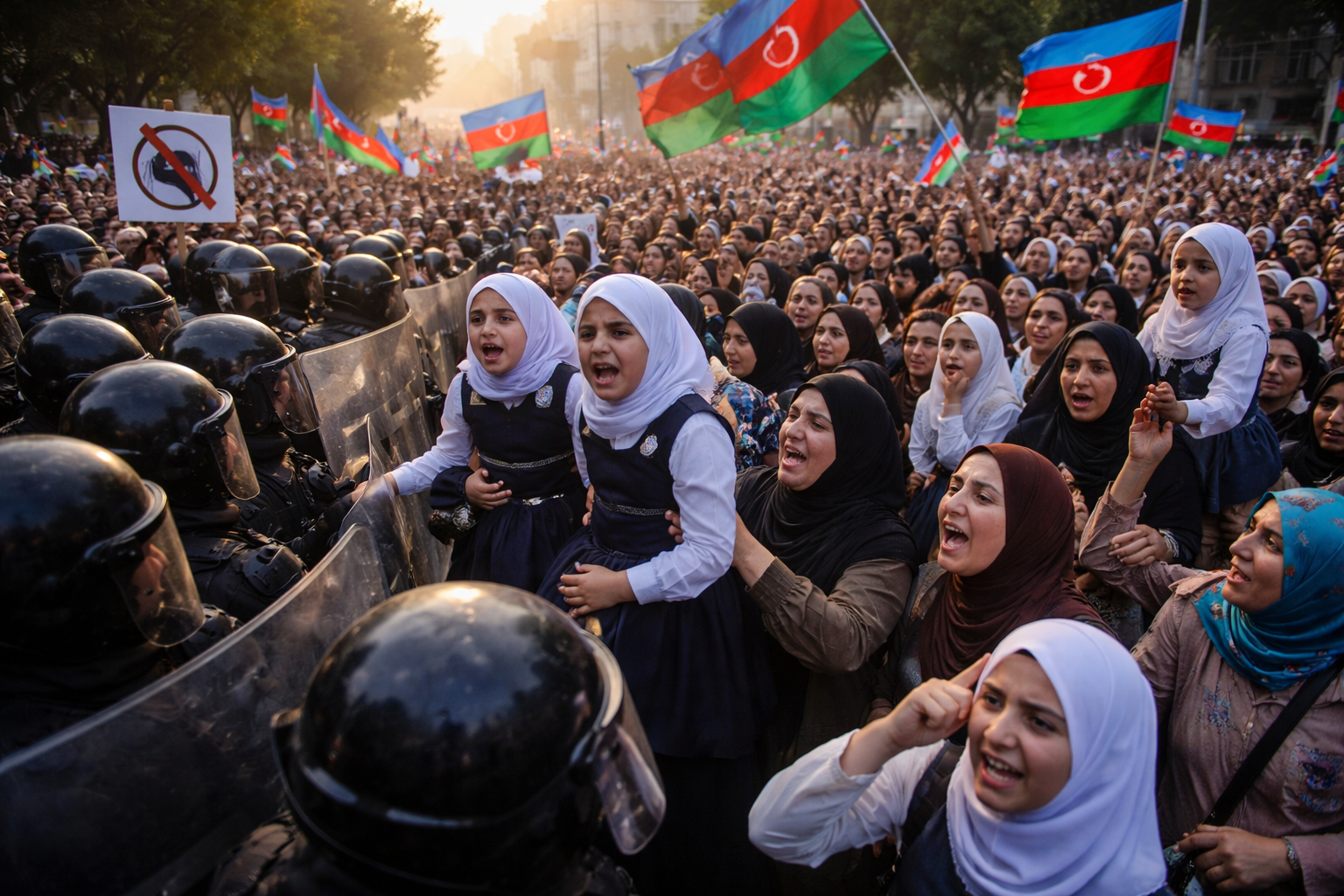
A unique wave of protests involving children has broken out across Azerbaijan following schools turning away girls who wear Islamic headscarves. This development stems from recently tightened dress regulations at Azerbaijani schools, although official government rules do not explicitly ban hijabs. The protests have prompted rare public demonstrations, social media disruptions, and international attention, exposing tensions around religious freedom, education, and state sovereignty.
Since early October, children—including both girls who wear headscarves and boys showing solidarity—have rallied outside schools across the country. Protests involving minors are unprecedented in Azerbaijan, where authorities typically suppress demonstrations. The government reportedly restricted access to Instagram and TikTok as videos of the protests spread online.
School Dress Code Changes and Enforcement
Azerbaijan’s government amended its education law in July to reinforce secular education and introduced Resolution No. 309 in September, which tightened school uniform rules. The resolution bans additional clothing that conflicts with school uniforms or secular education principles, but it does not explicitly mention hijabs. Nonetheless, some school administrators have interpreted the rules as prohibiting headscarves, leading to girls being denied admission to classes or encouraged to remove their scarves.
On October 6, new dress requirements for teachers also came into force, resulting in reports of female educators wearing headscarves being barred from teaching.
Constitutional and Social Context
Azerbaijan is majority Muslim, but its constitution mandates secular state education and guarantees freedom of conscience and the right to education. Opinions on the dress restrictions vary within Azerbaijani society. Some support uniform enforcement to maintain secular education, while others criticize what they see as discrimination against girls for religious attire. The issue cuts across political lines and recalls similar protests in 2010 and subsequent years.
Teachers and parents involved describe significant impacts on affected students. A literature teacher with decades of experience noted that some girls have had to remove their headscarves or study from home. Parents also report varied opinions, with some emphasizing that the dispute is about uniform compliance rather than a nationwide hijab ban.
Authorities’ Response and Political Implications
Law enforcement detained 37 individuals related to the protests, citing allegations of confrontations with school staff and disruptions. No official statement confirmed if minors were among those detained. An artist and activist supporting affected pupils was detained for allegedly disobeying police orders shortly after launching a related educational project.
Government officials have expressed concerns about foreign influences, particularly from neighboring Iran, as a motivation behind the stricter dress code enforcement. Parliamentary committee leadership and religious figures have echoed these worries while calling for peaceful resolutions. To date, no independent verification has confirmed foreign interference claims.
International Reactions and Diplomatic Sensitivities
Turkey, a close ally of Azerbaijan, witnessed protests against the dress restrictions outside the Azerbaijani consulate in Istanbul. A Turkish presidential adviser condemned the denial of education to headscarf-wearing students. In response, Azerbaijani ruling party representatives emphasized that close ties with Turkey do not justify interference in Azerbaijan’s domestic affairs.
Amnesty International condemned the exclusion of girls who wear hijabs and called for releasing those detained solely for peaceful protest activities.
For affected families, the immediate concern remains whether children can continue attending school without compromising their religious expression by removing headscarves.