

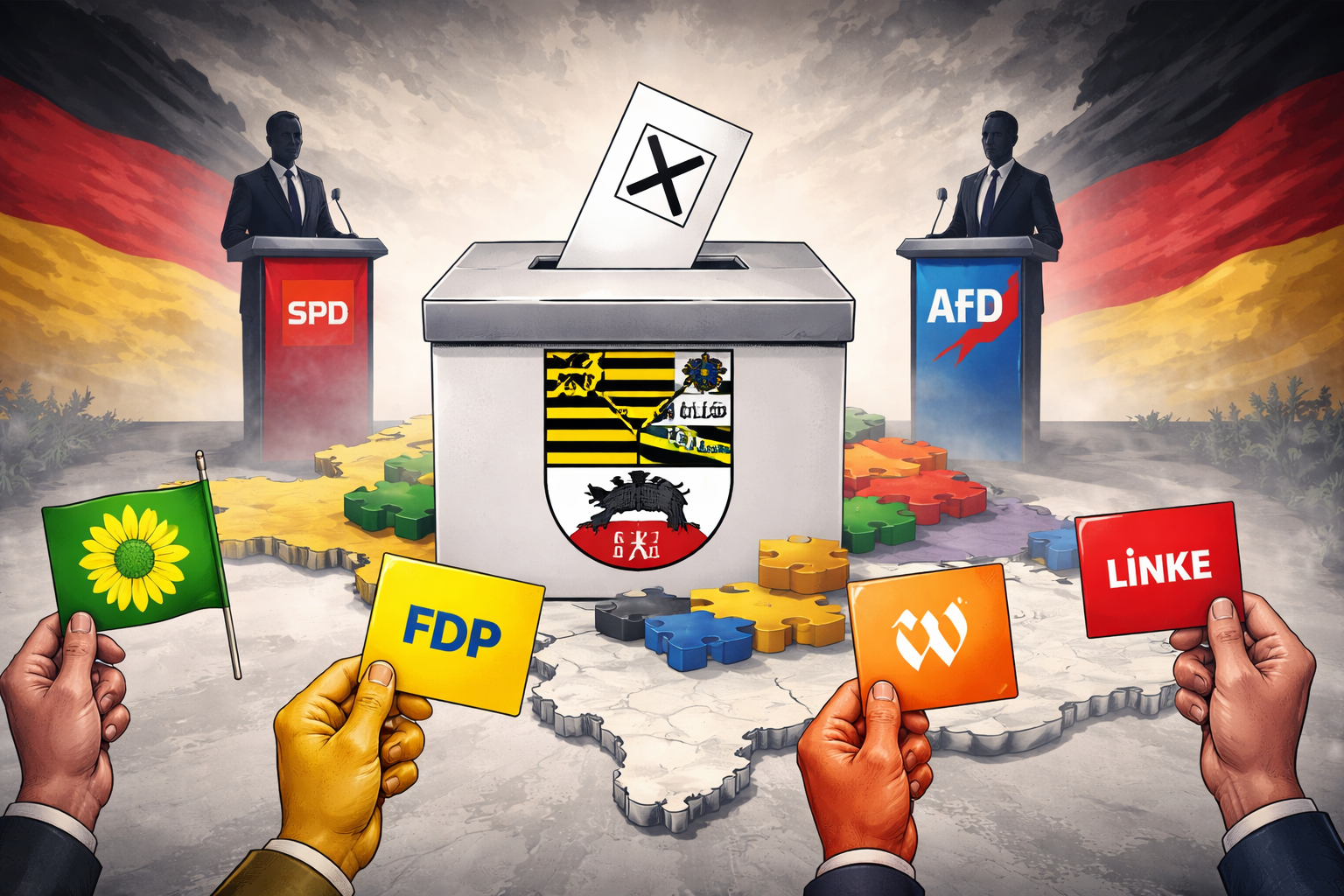
On September 6, 2026, voters in Saxony-Anhalt, an eastern German state, will head to the polls in an election attracting significant media attention. The most notable outcome could be the possibility of the far-right Alternative for Germany (AfD) party forming a state government for the first time in post-World War II Germany, according to the information released.
Currently, the AfD leads polls with over 40% support, a strong indication of their potential to secure a historic win. Ulrich Siegmund, the AfD’s lead candidate, could become the first head of government associated with a party officially classified as far-right by the state’s Office for the Protection of the Constitution since 2023.
Other Parties Likely to Enter State Parliament
Besides the AfD, only two other parties appear likely to cross the 5% vote threshold required for parliamentary representation: the Christian Democratic Union (CDU), represented by current State Premier Sven Schulze, and the Left Party, which has traditional support in eastern Germany.
Several other parties face significant challenges in this election. The Social Democrats (SPD), part of the federal coalition government, are polling below 8%, dropping from their previous results. The Free Democrats (FDP) also face setbacks, expected around 3%, following their previous losses. Meanwhile, the Greens are struggling to sustain support in Saxony-Anhalt, where their typical urban voter base is less influential.
Influence of Sahra Wagenknecht Alliance (BSW)
The Sahra Wagenknecht Alliance (BSW), a party founded in 2024 with economically left-leaning but socially conservative positions, is participating in Saxony-Anhalt’s election for the first time. While they showed promise with 6.2% in the 2024 European Parliament elections, the BSW has since declined and is polling below 5% in this state. Should they gain seats, Sahra Wagenknecht announced their lawmakers would not oppose an AfD-led government, possibly enabling a far-right premiership through parliamentary abstentions.
Complex Coalition Prospects and the Role of Small Parties
The election outcome hinges on whether the AfD can secure an absolute majority. If many small parties fail to reach the threshold, the AfD’s chances of governing alone increase substantially. However, if CDU, Left Party, and SPD all gain seats and together outnumber the AfD, the situation becomes complex due to the CDU’s 2018 “resolution of incompatibility,” which rejects cooperation with both the AfD and the Left Party.
Political scientist Oliver Lembcke of Ruhr University Bochum argues the CDU’s stance may be impractical under the current political landscape and could complicate government formation. The Left Party has expressed willingness to support CDU Premier Sven Schulze to prevent AfD control, as seen in coalition arrangements in other eastern states like Thuringia and Saxony.
Ultimately, Saxony-Anhalt’s election could either lead to a difficult coalition-building process or result in governance by the AfD if smaller parties fail to secure enough votes to block an absolute majority.