

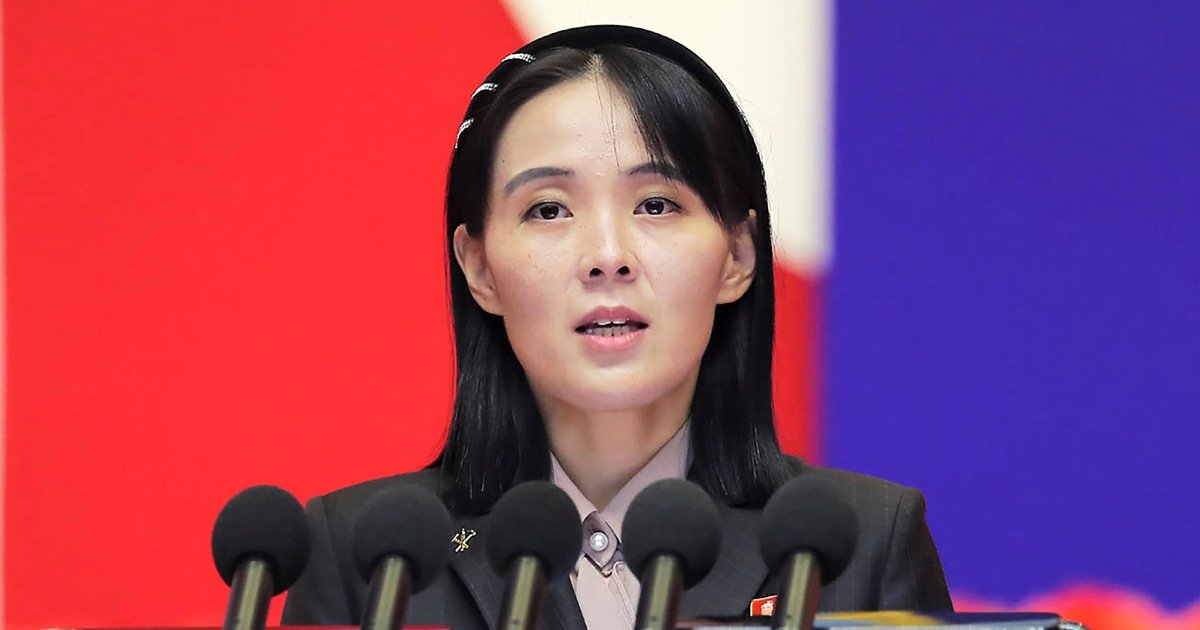
SEOUL, South Korea — North Korea’s Kim Yo Jong, the powerful sister of leader Kim Jong Un, warned on Wednesday that Pyongyang would adopt “additional military options” in response to what she called Japan’s transformation into a military power, after Tokyo test-fired a U.S.-made Tomahawk cruise missile.
In a statement carried by state media KCNA, Kim accused Japan of moving beyond a defensive posture and turning its armed forces into a force capable of pre-emptive attacks and overseas military operations.
She cited Japan’s recent Tomahawk test from the Aegis destroyer Chokai in the Pacific Ocean, as well as test-firings of other missiles and its participation in a U.S.-led joint military drill in the Philippines in May.
00:27
North Korea commemorates its late founder’s birthday
00:0000:00
Kim said that North Korea would respond in ways that made Japan feel that its security has been exposed to greater danger. “We should make it regret,” she said, in some of her strongest rhetoric toward Tokyo in recent months.
Kim also accused the United States of enabling Japan’s military buildup by supplying Tomahawk missiles, modifying vessels for their operation and supporting the missile tests.
“The U.S. is behind such dangerous military moves of Japan,” she said.
Kim, who heads the record-keeping department in North Korea’s ruling party, said Japan’s acquisition of long-range strike capabilities effectively placed North Korea and other neighboring countries within range.
To counter Tokyo’s military activities that may pose a potential threat to the security of North Korea, Kim said Pyongyang “will set up additional military options,” without elaborating.
The statement is the latest in a series of North Korean commentaries criticizing security cooperation among the United States, South Korea and Japan.
Since July, KCNA has published at least six editorials and commentaries denouncing these joint military activities as threatening regional security and raising tensions on the Korean Peninsula.
Analysts said Pyongyang is seeking to portray Japan’s military modernization as a direct security threat to justify its own weapons development.
Yang Moo-jin, a professor at the University of North Korean Studies in Seoul, said Kim’s comments attempt to frame Tokyo’s steps as part of a broader U.S. effort to strengthen its proxy military capabilities to counter North Korea.
The messaging could lay the groundwork for possible future military demonstrations, including missile tests or displays of undersea strike capabilities, said Lim Eul-chul, a professor at Kyungnam University’s Institute for Far Eastern Studies.
See More: https://www.ubirataonline.com.br