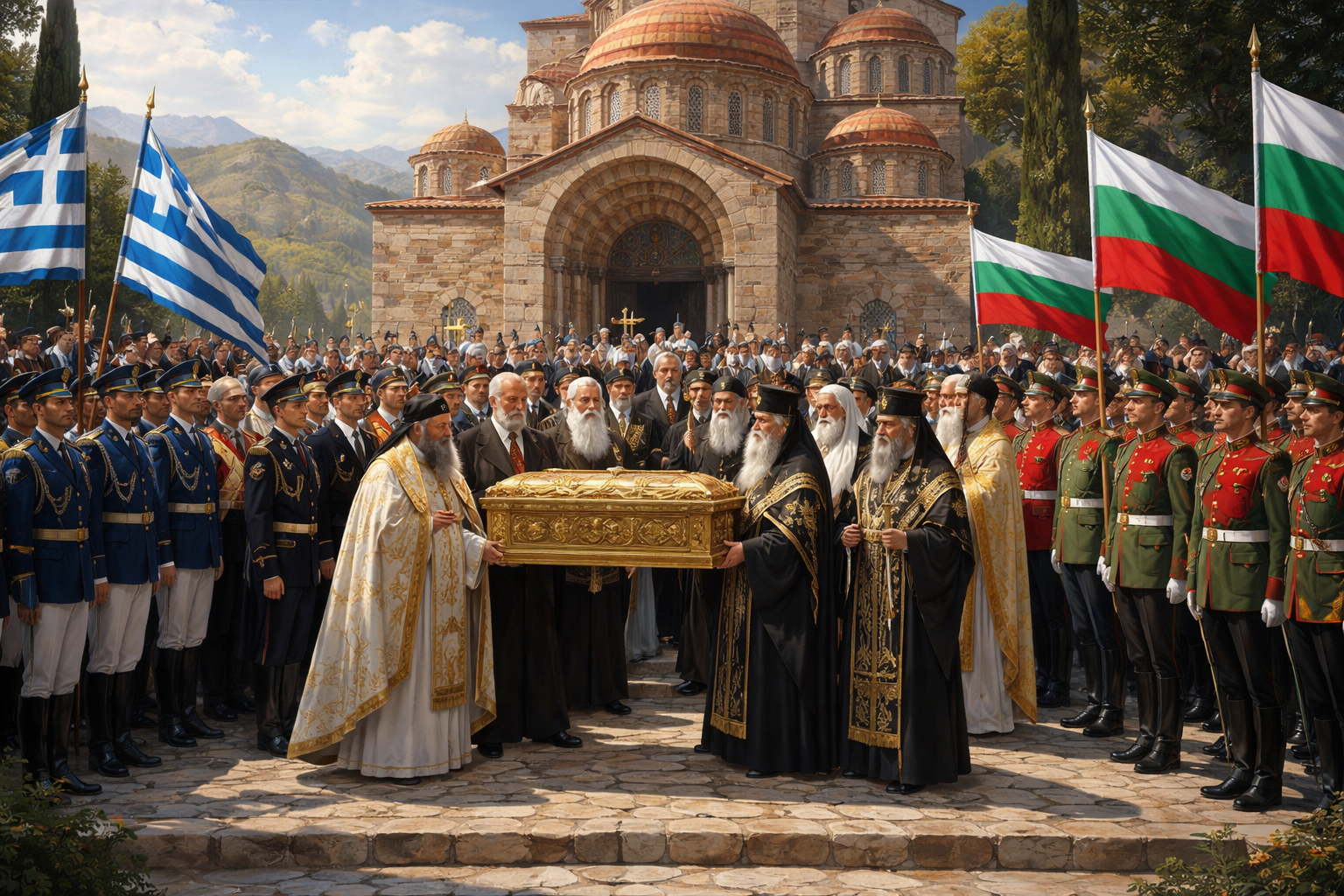

In a significant cultural exchange marked by ceremony and official honors, Greece has returned 48 priceless religious relics to Bulgaria, alongside the remains believed to be those of Tsar Samuel, a medieval Bulgarian ruler. This event highlights ongoing diplomatic efforts to resolve long-standing repatriation disputes and renews Greece’s call for Britain to return the Parthenon marbles.
The handover took place in Thessaloniki and involved religious icons, crosses, and ornate ecclesiastical vessels that were taken by Bulgarian troops from northern Greece during World War I. These items had been kept in Bulgaria’s National History Museum for over a century. The return of Tsar Samuel’s remains, discovered six decades ago in Greece near the border, was honored with full state ceremonies in Bulgaria.
Greek Prime Minister Connects Deal to Parthenon Marbles Campaign
Greek Prime Minister Kyriakos Mitsotakis framed the exchange as a symbol of progress achieved through political will and diplomacy, expressing hope that the agreement would influence Britain in Greece’s campaign for the return of the Parthenon sculptures held by the British Museum.
“Today’s initiative is based on the principle that monuments and historical heirlooms cannot be treated as spoils of war or the result of circumstances following their creation,” Mitsotakis said. He emphasized that Greece’s pursuit of the Parthenon marbles is about restoring the integrity of a universally significant monument, not a vague national claim, nor a challenge to museums globally.
Bulgaria Welcomes Artifacts and Honors National Hero
Bulgaria’s Prime Minister Rumen Radev reflected on the shared cultural memory and bonds between the two nations, noting that Tsar Samuel—once a divisive figure—now serves as a unifying symbol strengthening bilateral relations. The tsar’s remains were transported to Sofia with military honors, including a jet fighter escort and a 21-gun salute, demonstrating the importance of the event.
Context and Broader Implications for Cultural Heritage
The artifacts returned to Greece were taken during a turbulent period in history, spanning more than 100 years in custody. The exchange underscores a broader global reassessment regarding cultural heritage and restitution. Greece insists on the reunification of the Parthenon sculptures to allow full appreciation of the ancient masterpiece, arguing against any arrangement that would imply foreign sovereignty or temporary loans of the marbles.
The Parthenon sculptures were removed on orders from Lord Elgin, the British ambassador to the Ottoman Empire in the early 19th century. After Lord Elgin’s financial difficulties, Britain acquired the sculptures in 1816, and they have been displayed at the British Museum since.