

The air quality index has been upgraded to unhealthy for sensitive groups across Connecticut on Wednesday, according to the state Department of Energy and Environmental Protection.
To the west of Connecticut, parts of New York state are expected to see air quality that is unhealthy, according to DEEP.
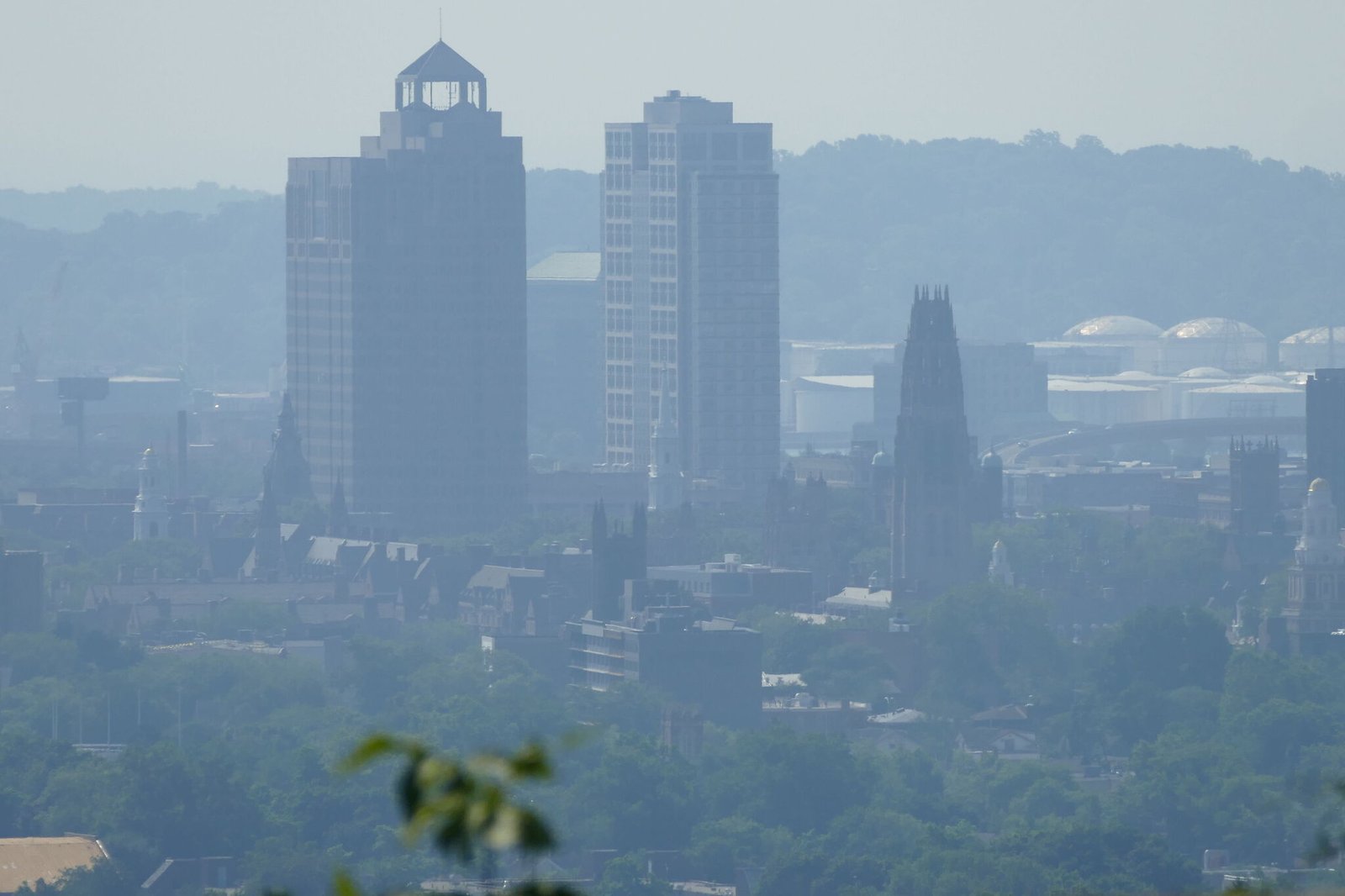
On Wednesday morning, a gray-white haze could be seen over the New Haven skyline from the top of West Rock State Park. A few cyclists and runners milled at a parking lot at the top of the rocky ridgeline, or ran or walked in the stifling humidity. The breeze carried a faint scent of smoke.
Satellite images around 10 a.m. showed a thick layer of smoke drifting southward from the Hartford area.
The declining air quality is driven by particle pollution, the type of air pollution produced by wildfire smoke.
The air quality index is a color-coded scale officials use to measure the air quality. Air that is unhealthy for sensitive groups — such as people with asthma — can experience health effects, though the general public is less likely to be impacted.
For Wednesday, DEEP predicts the air quality index could reach 136 in some cities and towns along the coast — Bridgeport, Greenwich, Stratford and Westport. The number is up from an AQI of 93 predicted for those same communities earlier in the day.
The smog is wildfire smoke that has drifted over the region from fires burning in Canada. While that will instantly trigger memories of the summer of 2023, when heavy concentrations of smoke made the air quality plunge in the northeast, the smoke forecast for Wednesday is expected to be less dramatic.
Ozone, a separate type of air pollution that’s created when pollutants from cars and other source interact with sunlight, is expected to be lower on Wednesday. Concentrations of the gas, which is made up of three oxygen atoms, will be good to moderate on Wednesday. Ozone levels were elevated on Tuesday, particularly for coastal Connecticut.
The air pollution from wildfire smoke, known as PM2.5, contains ultrafine particles. The name refers to particulate matter that is 2.5 micrometers or smaller. Those particles can cause a variety of lung and heart issues, including respiratory symptoms and premature death for people with heart or lung conditions. Besides wildfires, particulate pollution can also form from other sources like unpaved roads, construction and smoke stacks.
Wednesday is otherwise expected to be hot and humid as a spell of hot weather peaks in Connecticut. Scattered showers and thunderstorms are possible in the afternoon and evening.
The weather service’s New York office said the smoke could cause visibility to be reduced late Wednesday. But the smoke may also affect the heat and potential for storms. Surface heating may be “muted,” the office said, while a “a more stable environment could help stave off convection.”
Thursday is also expected to see smoky skies, according to the National Weather Service.
See More: https://www.ubirataonline.com.br