

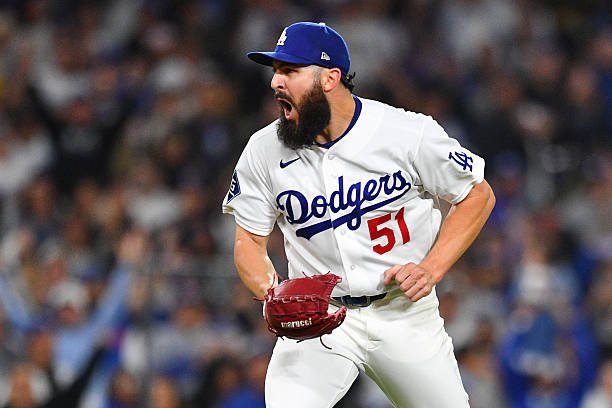
LOS ANGELES, CA — Every championship bullpen needs an emotional anchor—a pitcher who can step into a bases-loaded jam in the eighth inning, induce a weak pop-up, and unleash a strikeout celebration that shakes Chavez Ravine. For the Los Angeles Dodgers, that man has long been left-hander Alex Vesia.
But as the 2026 season unfolds, Vesia’s presence on the mound means much more than high-leverage execution. After a devastating family tragedy pulled him away from the sport on the absolute eve of the World Series, Vesia has returned to the mound to deliver some of the guttiest pitching of his career.
This is a look at why No. 51 remains indispensable to the Dodgers’ pursuit of a historic three-peat—both as a dominant left-handed weapon and as the heartbeat of the clubhouse.
San Diego Roots and the Pioneer Path
Long before he was pumping his fists in front of 50,000 screaming fans at Dodger Stadium, Vesia was grinding through the amateur ranks with very little fanfare. Born in Alpine, California, he grew up in the San Diego area and starred at Steele Canyon High School in Spring Valley. Despite earning All-East County honors as a senior in 2014, major college scouts completely overlooked him, leaving him undrafted and holding just a single college scholarship offer.
He took that lone offer and headed to Northern California to pitch for California State University, East Bay, an NCAA Division II program. It was with the Pioneers that Vesia transformed from an unheralded recruit into a professional prospect.
He burst onto the scene as the California Collegiate Athletic Association (CCAA) Freshman of the Year in 2015 and capped his college career with a dominant senior season in 2018, posting an 8–2 record with a tiny 1.94 ERA. The Miami Marlins finally called his name in the 17th round of the 2018 MLB Draft, validating his relentless Division II grind.
The Steal of the 2021 Offseason
Vesia’s stint in Miami was brief, culminating in a rocky, pandemic-shortened MLB debut in 2020 where he struggled over just five appearances. Sensing an underlying analytical goldmine, Andrew Friedman and the Dodgers front office struck a deal on February 12, 2021. The Dodgers shipped standard right-handed reliever Dylan Floro to the Marlins in exchange for Vesia and a minor league right-hander named Kyle Hurt.
At the time, the baseball world viewed Vesia as a secondary flier. Instead, it became one of the most lopsided trades in recent franchise history:
Alex Vesia: Instantly unlocked his elite velocity deception in the Dodgers’ pitching laboratory, transforming into Dave Roberts‘ most trusted left-handed high-leverage option.
Kyle Hurt: The former USC fifth-round pick quietly climbed the minor league ladder, deploying a devastating changeup-fastball mix to become a vital, multi-inning bullpen piece for the big league club in 2026.
Looking back at the swap, Vesia admitted he had no idea what was in store:
“When I got traded, I thought I was just a secondary piece. I didn’t know I was the main target until I saw it on social media. Coming here forced me to completely trust the Dodgers’ development process, and it completely changed my life.”
The Human Side: Resilience Through Heartbreak
While his baseball journey is impressive, his character away from the field is what truly cements his status as the heartbeat of the clubhouse. On the eve of the 2025 World Series, Vesia stepped away from the active roster due to a devastating family tragedy. He and his wife, Kayla, suffered the unimaginable loss of their newborn daughter, Sterling Sol, at birth.
The tragedy sparked a profound wave of solidarity across the sport, with Dodgers and opposing relievers alike writing “51” on their caps during the Fall Classic. Upon reporting to Camelback Ranch for Spring Training, Vesia delivered an emotional message, thanking the fan base and the organization for being a “source of light” during his family’s darkest hours.
The Dodgers showed their unwavering belief in him by executing his $3.65 million club option for 2026, a move that went beyond analytics to show true organizational loyalty.
The Analytical Edge: Floating Past Gravity
On the mound, Vesia continues to baffle Major League hitters with a profile that completely defies basic radar gun metrics. While he sits in the mid-90s, his four-seam fastball possesses an elite characteristic known as Induced Vertical Break (IVB).
Because of his unique release point and spin efficiency, Vesia’s fastball consistently generates more than 20 inches of IVB. To an opposing batter, the baseball creates an optical illusion—it appears to “rise” or override gravity as it approaches home plate. Hitters routinely swing underneath the pitch, giving Vesia one of the highest strikeout rates in the National League.
Alongside Blake Treinen and his old trade partner Kyle Hurt, Vesia has anchored a lethal 2026 bullpen. When he strikes out the side and storms off the mound pumping his fists, he isn’t just celebrating a hold. He is playing with the raw, unfiltered passion of a kid from San Diego who fought his way through D-II ball, survived trade block chaos, and overcame immense personal grief to remain an elite champion.
More Dodgers Coverage:
Have you subscribed to the Bleed Los Podcast YouTube channel? Be sure to ring the notification bell to watch player interviews, participate in shows & promotions, and stay up to date on all Dodgers news and rumors!

Dodgers Beat Writer covering the intersection of MLB and international talent. An alumnus of both the University of Louisiana and Colorado State University, I specialize in Asian culture and NPB history. Fluent in Japanese, Spanish, and Korean, I provide a unique, multilingual perspective on the Dodgers’ global roster. See whatshoheireallysaid.com or seantcannon.com for more information.