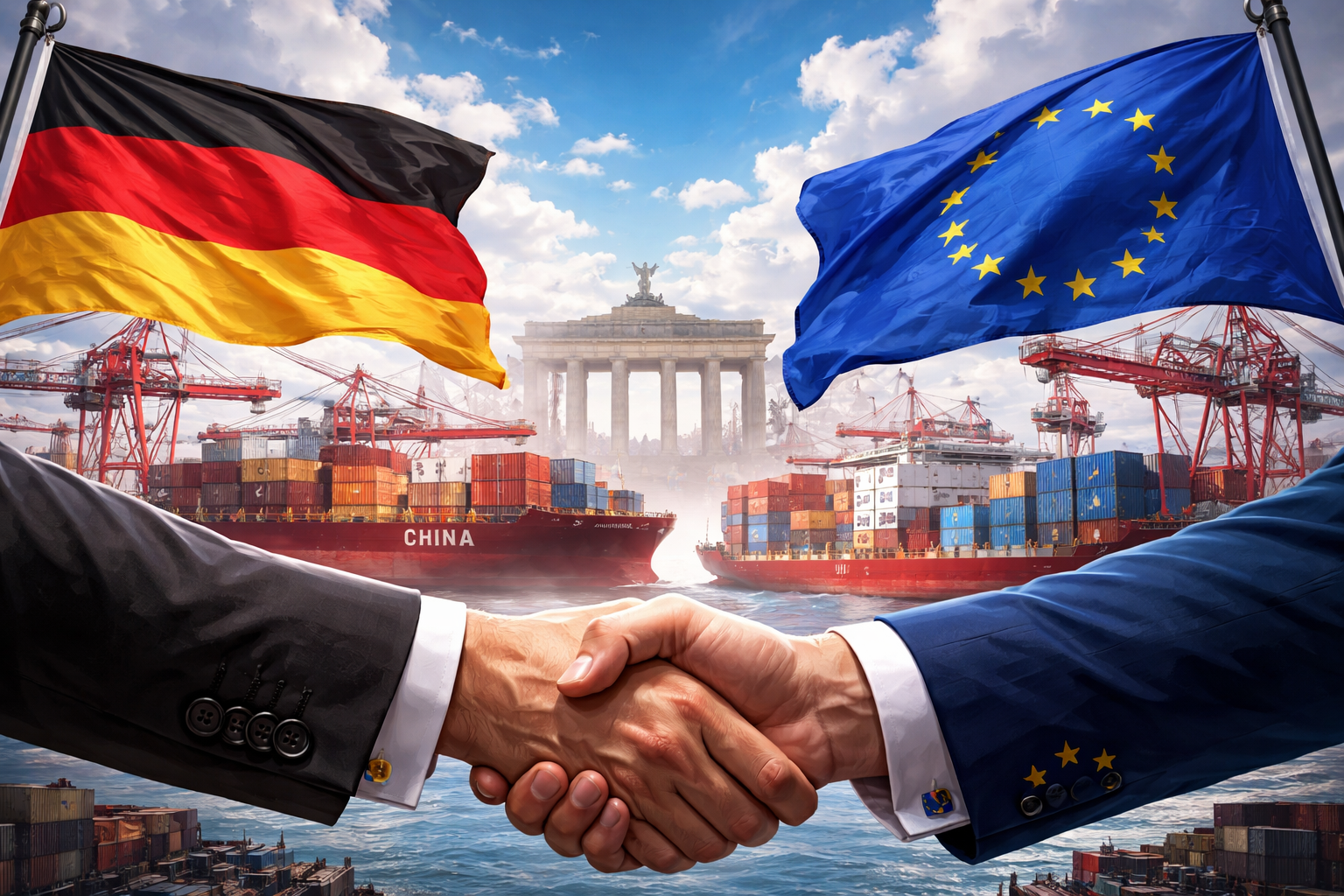
Germany has shifted its stance on how to manage trade relations with China, joining calls within the European Union for firmer defensive measures. This pivot reflects growing concerns over China’s trade practices and their impact on key German industries, especially automotive manufacturing.
Chancellor Friedrich Merz and French President Emmanuel Macron recently petitioned the European Commission to adopt a mechanism to exclude trading partners from the EU’s single market if they persist with unfair trade practices. The proposal targets countries, with China clearly in focus, that “deliberately seek to undermine fair market conditions by political or economic means.”
Economic Pressures Prompt Policy Change
Germany’s longstanding caution stemmed largely from fears of Chinese retaliation that could harm German exports. However, data indicates a steep decline in China’s importance as a German export destination. Once Germany’s second-largest export market, China fell to ninth place by the first half of 2026. Simultaneously, Chinese competitors have narrowed the technological gap and leverage significant cost advantages bolstered by state subsidies.
This shift has notably affected Germany’s automotive sector. German car exports to China plummeted by 66% between 2022 and 2025, while imports of Chinese-made vehicles into Germany soared by 121% in the first seven months of 2026, making up nearly 14% of total vehicle imports into Germany. Rising competition from Chinese electric vehicle manufacturers in Europe has intensified pressures at home, sparking layoffs and potential factory closures.
Industry Lobbying Drives Berlin’s New Trade Approach
Pressure from Germany’s industrial lobby has played a decisive role in reshaping the country’s China policy. Industrial leaders have voiced frustration over what they see as deindustrialization due to unfair foreign measures. Oliver Richtberg from the German mechanical engineering association underscored this sentiment, stating many companies are unwilling to accept current trade imbalances.
The broader EU faces a massive trade goods deficit with China, estimated at around €360 billion ($402 billion) in 2025 and growing into 2026. Despite EU efforts to counter cheap Chinese imports through dumping allegations and industrial policies, initiatives like the proposed Industrial Accelerator Act face resistance from Beijing and complex internal debates in Europe.
Strategic Concerns Over Raw Materials and Market Access
Germany’s concerns extend to China’s dominant position in critical raw materials such as rare earth minerals, essential for automaking, renewable energy, and defense industries. German officials have suggested that the proposed EU “kill-switch” mechanism could serve as a retaliatory tool if China restricts exports of these resources.
EU negotiations with China recently yielded a tentative agreement to cap Chinese exports of hybrid and plug-in hybrid vehicles to the EU, limiting annual imports to 350,000 units with a small annual growth allowance. This deal aims to ease tensions while addressing the surge in Chinese EV exports.
EU’s Leverage and Future Outlook
The European Union’s trade commissioner emphasized the bloc’s stronger negotiating position, noting that Chinese exports to the EU exceed those to the U.S., giving Europe substantial leverage. As Germany aligns more closely with EU-wide trade defense measures, Brussels faces the challenge of balancing assertive protection of key industries without igniting a broader trade conflict with China.