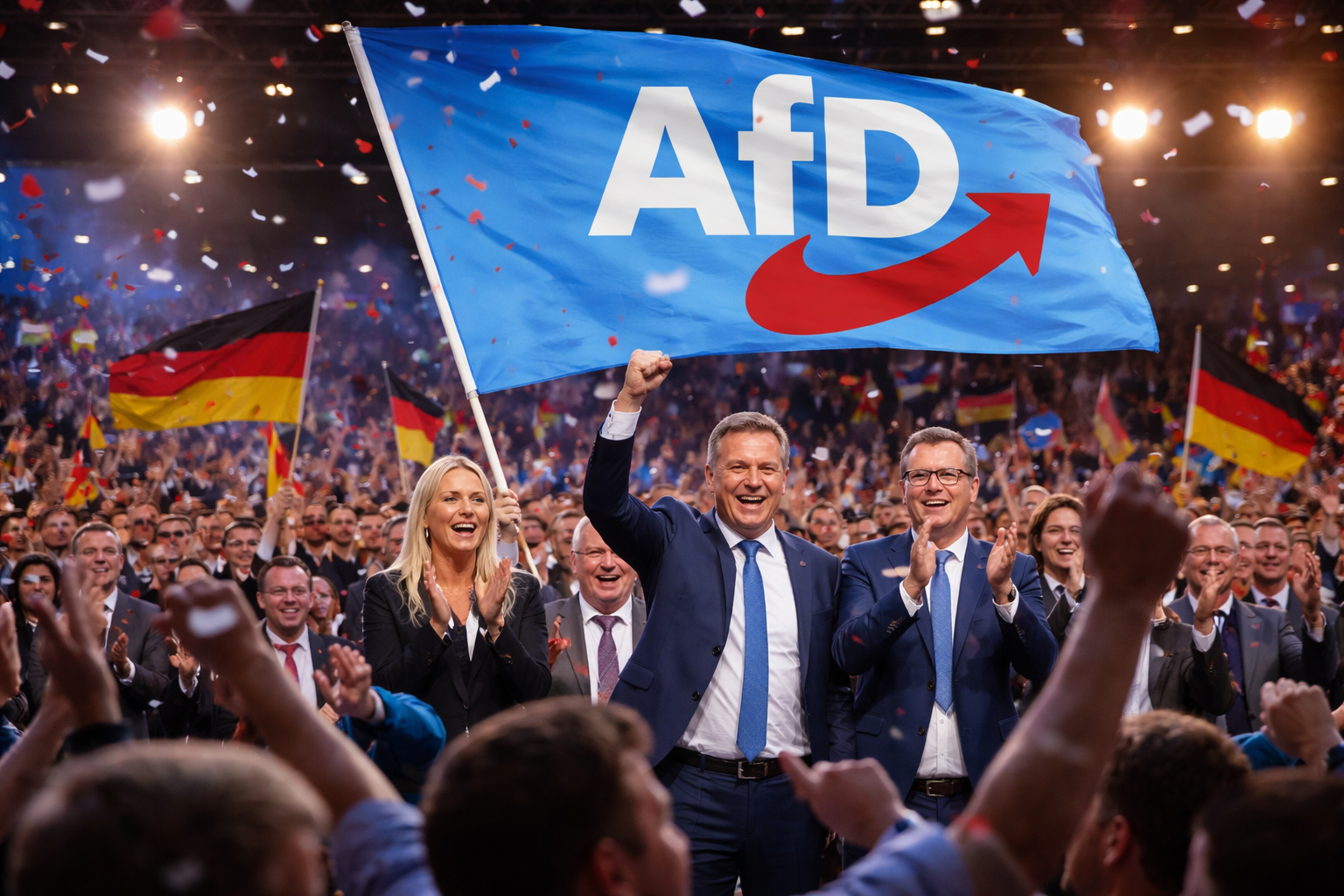

The far-right Alternative for Germany (AfD) has emerged as the largest party in Saxony-Anhalt’s state election, securing 43.8% of the vote according to preliminary official results. Despite this significant lead, the party fell short of a governing majority in the regional parliament, which consists of 83 seats.
This outcome marks a historic shift in the political landscape of Saxony-Anhalt, a state in eastern Germany, where six parties will enter the state parliament. The Christian Democratic Union (CDU) came in second with 17.2%, while other parties including the Social Democratic Party (SPD), Greens, Left Party, and the newly founded Sahra Wagenknecht Alliance (BSW) also won seats.
The election results introduce complex coalition dynamics, as the AfD faces challenges to form a government without clear partners. The CDU, traditionally a leading coalition force, suffered heavy losses, failing to secure any direct mandates in individual constituencies for the first time in the state’s recent history.
Election Details and Party Performance
According to the preliminary data, the AfD captured 39 seats, the CDU 15, SPD 8, Greens 8, Left Party 8, and the BSW 5. The Free Democrats (FDP) did not meet the 5% threshold needed for parliamentary representation, securing only 2.6% of the vote.
Voter turnout reached nearly 78%, the highest in Saxony-Anhalt since German reunification in 1990, signaling increased public engagement.
Coalition Prospects and Political Implications
Ulrich Siegmund, AfD lead candidate in Saxony-Anhalt, described the party’s result as a clear mandate to govern but acknowledged the current absence of potential coalition partners. He left open the possibility that legislative dynamics might shift in the coming days or that new elections could be called.
The only numerical majority excluding the AfD would involve all other parties combined. However, the CDU has ruled out coalitions with both the AfD and the Left Party based on a previously adopted “political firewall” policy designed to block far-right influence. This stance complicates the formation of a stable government and has spurred debate on whether the firewall can hold amid the AfD’s rising strength.
The Sahra Wagenknecht Alliance, which entered the state parliament with 5.3%, declined coalition talks with the CDU but indicated willingness to cooperate with the AfD in some contexts, potentially positioning itself as a pivotal player.
Context and Reactions
Elon Musk, well-known for backing far-right causes, publicly congratulated the AfD on their victory via social media, receiving a response from Ulrich Siegmund who expressed openness to strong cooperation to revitalize Germany as an investment hub.
The election result has drawn attention beyond Germany. French Europe Minister Benjamin Haddad described the result as a serious moment for Europe, urging humility in addressing voters’ concerns behind far-right gains. Similarly, the far-right president of the Czech parliament’s lower chamber congratulated the AfD, attributing their success to dissatisfaction with Germany’s liberal parties.
Despite the historic win, forming a stable government remains uncertain. The previous ruling coalition of CDU, SPD, and FDP ended with this election, though the incumbent state premier and cabinet remain in office in a caretaker role until a successor is elected.
Far-Right AfD’s Policy Agenda and Impact
An AfD-led government could bring significant changes to Saxony-Anhalt’s policies, including stricter migration controls, revised education curricula, and adjustments to social programs. However, several proposed initiatives face potential legal limitations or exceed state authority, especially in foreign policy where federal control dominates.
Observers note that the AfD’s success reflects broader socio-economic challenges in Saxony-Anhalt, such as slower economic growth, lower wages, and higher unemployment compared to national averages, which have fueled voter support for the party’s anti-establishment messaging.