

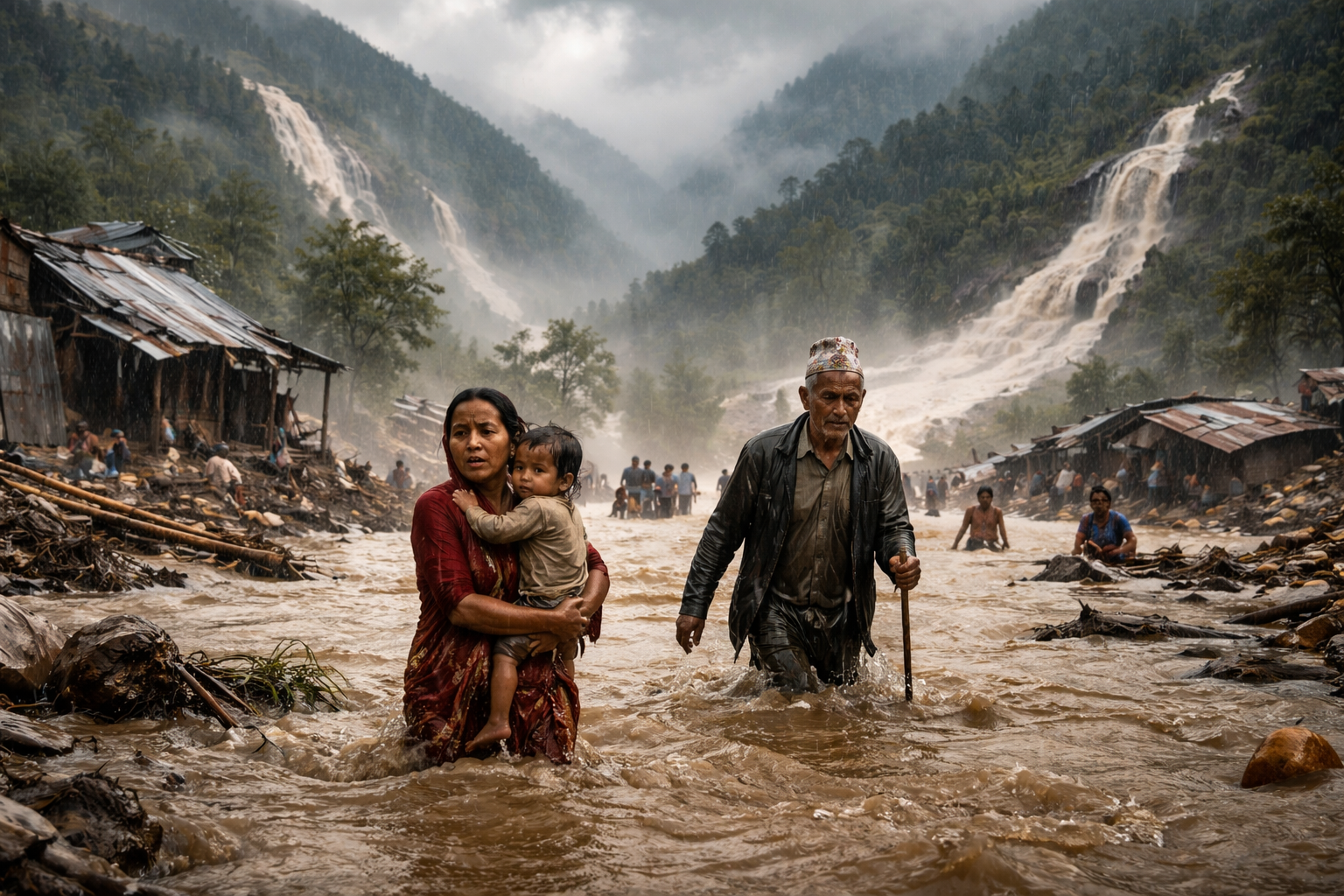
In the aftermath of catastrophic floods in Nepal’s Bhotekoshi-Trisuli river basin, more than 1,250 people have been confirmed dead, with nearly 4,000 still missing. The disaster has destroyed critical infrastructure, including buildings, roads, bridges, and over a dozen hydropower facilities, resulting in estimated damages of $2.6 billion, according to Nepal’s National Disaster Risk Reduction and Management Authority (NDRRMA). Search and rescue efforts continue amid ongoing uncertainty over the full extent of the tragedy.
The floods stemmed from a glacier collapse, a phenomenon experts link to accelerating glacier melt tied to global climate change. While the exact cause of the collapse remains unclear, the event has intensified debate about climate justice, as Nepal contributes only 0.1% of global greenhouse gas emissions yet faces disproportionate climate risks.
Leaders Call for International Climate Accountability
Nepal’s Prime Minister Balendra Shah emphasized that addressing the disaster is a “global responsibility,” questioning how such destruction befell the Himalayan nation given its minimal role in emissions. He expressed that mitigating these impacts requires shared international commitment. Nepal plans to highlight climate justice issues at the upcoming United Nations General Assembly, aiming to build a coalition of climate-vulnerable countries to push for increased support and recognition.
Nepal’s Foreign Minister Shisir Khanal stated the country seeks moral and financial backing to cope with climate impacts, advocating for collective action among vulnerable nations. The government estimates that adaptation efforts between 2025 and 2035 could necessitate $18 billion to $20 billion, funds it hopes to secure primarily through international climate finance.
Climate Vulnerability Despite Low Emissions
Nepal, home to 30 million people and characterized by vast mountainous rural areas, emits roughly 0.5 tons of CO₂ per person annually. Despite this negligible contribution, the region faces acute climate vulnerabilities including floods, landslides, and glacier-related hazards. Previous global appeals by Nepal have highlighted these risks, such as the 2009 high-altitude cabinet meeting near Mount Everest, designed to draw attention to melting glaciers and mountain environmental changes.
Former Foreign Minister Bimala Rai Paudyal described the recent floods as a pivotal moment to press for glacier melting and climate justice issues on international platforms, noting that Nepal now endures direct impacts rather than merely advocating awareness. Experts suggest Nepal’s exposure and diplomatic experience make it well suited to lead efforts among vulnerable countries seeking greater climate resilience.
Global Climate Funds and an Opportunity for Action
Nepal has formally requested help from the United Nations Framework Convention on Climate Change’s “Loss and Damage Fund,” established in 2025 to aid climate-affected countries. However, the fund remains largely inactive and depends on voluntary contributions without binding obligations on major emitters like China, India, and the United States, raising questions about accountability and fairness.
Experts such as Dinesh Paudel from Appalachian State University and Ashok Swain from Uppsala University argue that Nepal can transform this disaster into a rallying point for global climate action. They stress that Nepal should not bear the financial burden of climate crises it did little to cause and that international cooperation must translate into legally binding mechanisms and equitable distribution of responsibility.