
Europe’s divided reaction to the sudden influx of migrants swimming from Morocco to Ceuta reveals political tensions and challenges in unified migration management across the EU
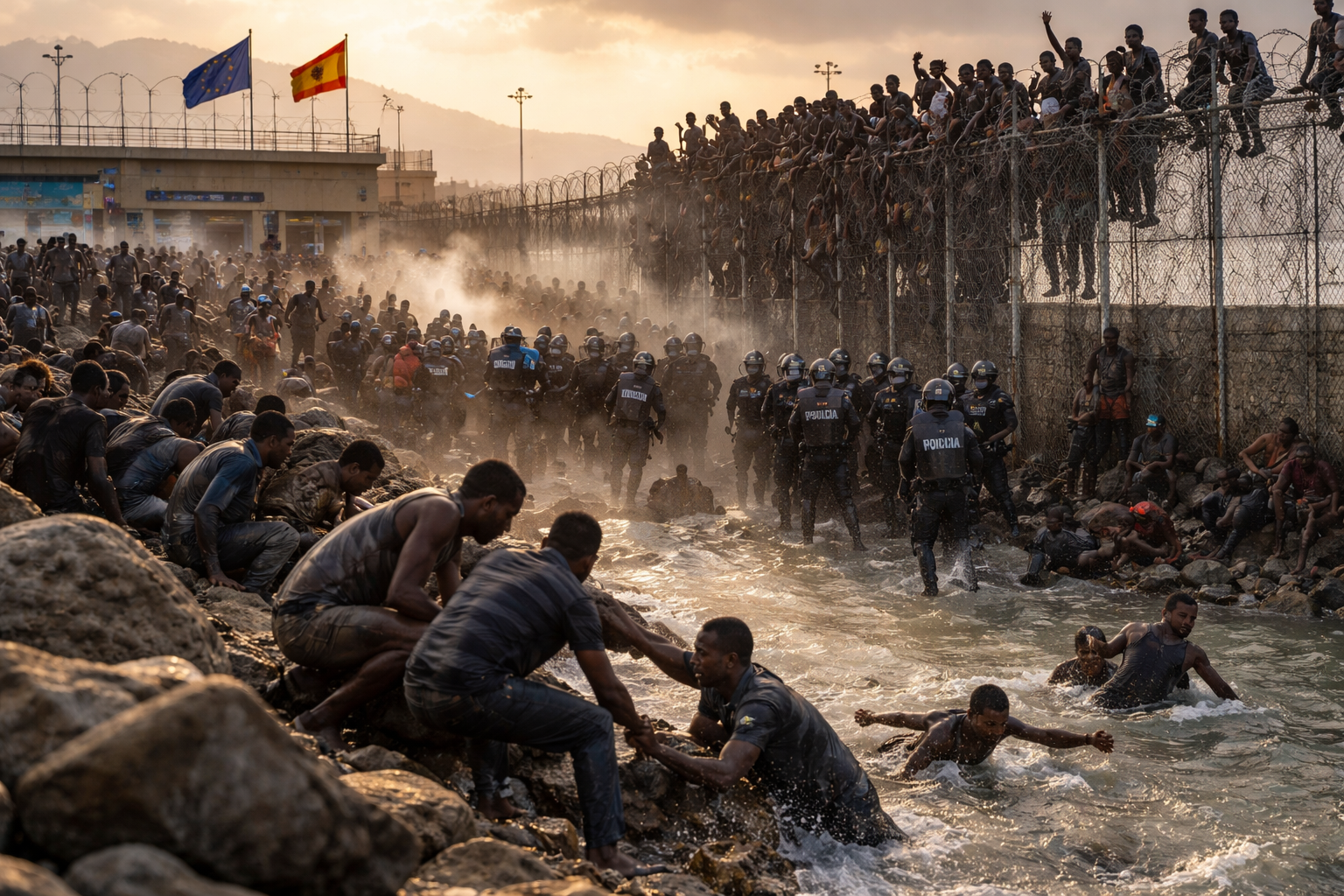
The rapid arrival of tens of thousands of migrants in Ceuta, a Spanish enclave on the northern coast of Africa, sparked immediate criticism, recriminations, and political upheaval across Europe. Within hours of viral social media images showing migrants swimming the short distance from Morocco, 22 European Union leaders, the Trump administration, and Israel were publicly condemning Spain’s handling of the crisis.
This reaction reflects a larger failure to present a united European front on migration issues, fueled by populist rhetoric and fears over border control. The kneejerk blame game between EU members has deepened divisions and weakened collective efforts to manage migration, combat human smuggling, and resist the use of migrants as geopolitical leverage.
According to analysis provided by Paul Taylor, a senior fellow at the European Policy Centre, the Ceuta incident is less a purely migration crisis and more a complex geopolitical event involving multiple actors and motivations, including Morocco’s strategic positioning and intra-EU party politics.
Political Fallout and Hypocrisy Within the EU
Italian Prime Minister Giorgia Meloni, leader of a hard-right party, spearheaded criticism against Spanish Prime Minister Pedro Sánchez, accusing Spain of inviting the influx by offering pathways to legal status for irregular migrants already in the country. This accusation contrasts sharply with Germany and Italy’s own past actions, where hundreds of thousands of undocumented migrants were regularized to fulfill labor demands amid declining native workforces.
Moreover, accusations against Spain were amplified by non-EU leaders such as former U.S. President Donald Trump and Republican politician JD Vance, who used the crisis to attack Sánchez and Spanish immigration policies. This international dimension underlines how migration is becoming a tool of political posturing worldwide.
Double Standards and the Role of Morocco
The EU’s inconsistent responses to migration crises are stark. When Poland and Lithuania faced similar migrant surges allegedly orchestrated by Belarus in 2021, the EU united to impose sanctions on the Belarusian regime. When Turkey pressured the EU with migrant flows in 2020, Frontex border support was deployed. Yet in Ceuta’s case, the EU swiftly fractured, failing to openly confront Morocco’s apparent role in allowing tens of thousands of migrants to cross, coinciding with Morocco’s Throne Day and tensions over Ceuta’s sovereignty.
Anna Terrón Cusí, a senior fellow at the Migration Policy Institute and former Spanish immigration secretary, observed that “in Morocco, nothing happens by chance,” suggesting the event was a deliberate geopolitical maneuver rather than a spontaneous crisis.
Impact on EU Unity and Migration Policy
Following the initial backlash, a hastily arranged EU ministers’ videoconference helped restore some solidarity, but by then the migrants had largely returned to Morocco realizing that entry to Europe was unlikely. Still, the incident triggered retaliatory controls between Italy and Spain, reflecting eroding trust among EU members. Leaders like Russian President Vladimir Putin, Turkish President Recep Tayyip Erdoğan, and King Mohammed VI of Morocco likely noted Europe’s quick unraveling at the sight of migrant landings.
The crisis encapsulates the “prisoners’ dilemma” faced by the EU. While countries share an interest in preserving the Schengen Zone’s open internal borders and coordinated external border management, short-term political incentives drive anti-migration grandstanding that undermines cooperation. The complex balance between legal migration routes, border security, and economic workforce needs remains fragile and politically charged.
As Paul Taylor concluded, Europe’s reaction to the Ceuta crisis reveals how easily migrant movements can be weaponized politically, and how difficult it remains for EU countries to collaborate effectively on migration policy despite their shared interests and challenges.