

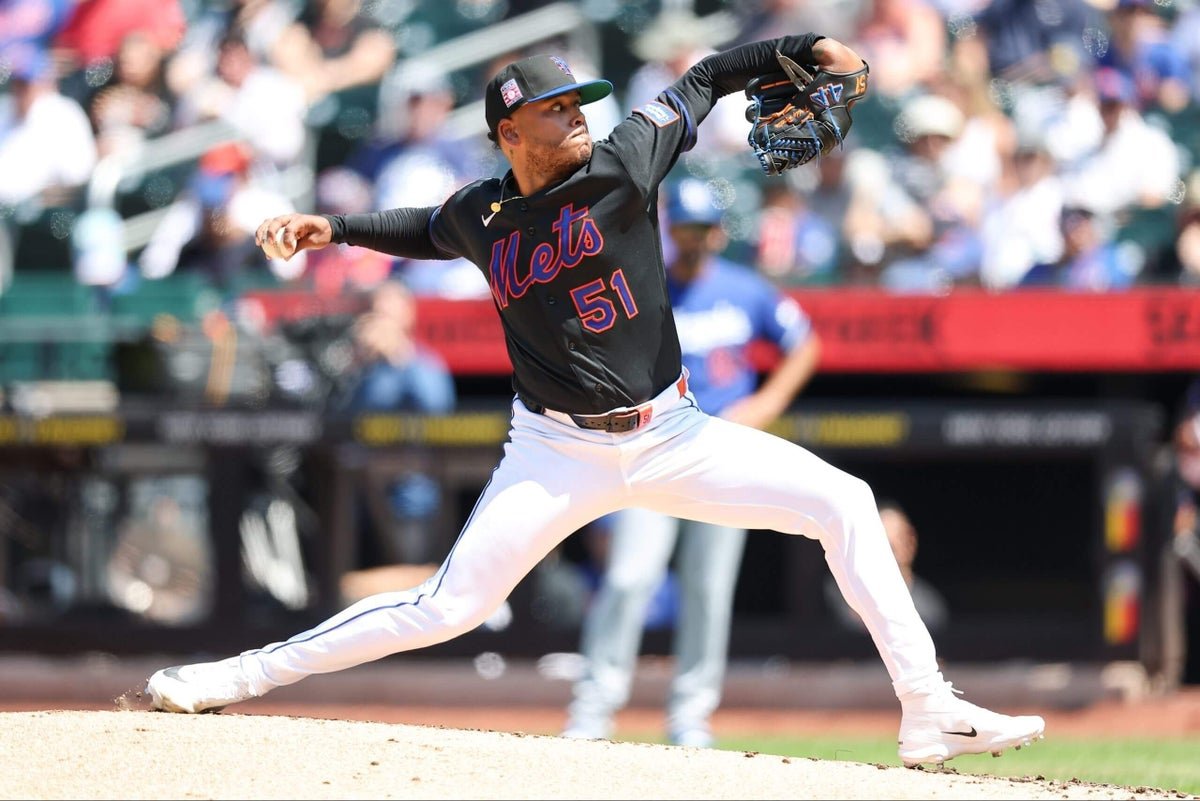
Once Freddy Peralta leaves the New York Mets via trade at some point before the Aug. 3 deadline, will better results follow him?
According to three executives searching for rotation help who were granted anonymity in exchange for their candor: Yes.
“For a bunch of teams, he would start a playoff game,” one of the evaluators said.
A different one added, “Regardless of the results so far, he’s still going to be one of the top three or four starters available.”
Though a lot of teams have checked in on Peralta, the right-hander’s market as of Wednesday night was moving slowly, according to a person briefed on his market who was not authorized to speak freely. Teams might be waiting on the Detroit Tigers to first trade Tarik Skubal.
For some teams expressing interest, Peralta, 30, still possesses the ingredients that previously made him successful despite his 4.99 ERA, his 1.48 WHIP and half of his 22 starts ending before the sixth inning.
Several teams make sense as fits for Peralta. The Tampa Bay Rays expressed interest, as FanSided reported, but according to a person briefed on the club’s plans, Peralta is not at the top of their list. The Chicago White Sox and Chicago Cubs checked in. The San Diego Padres and Arizona Diamondbacks, more teams in the market for pitching, scouted his last start. The Milwaukee Brewers, Texas Rangers and Philadelphia Phillies are among the other teams looking for rotation help.
For the Mets, the feedback on Peralta is good and bad. It’s good in the sense that teams see value in him beyond the $2.4 million owed to him after the deadline (a relatively small sum) and before he hits free agency this winter. It’s bad in the sense that something obviously went wrong with Peralta in New York and other teams are confident they can fix it.
Why haven’t there been many MLB trades yet?
Andy McCullough
Multiple evaluators who scouted Peralta’s most recent outings reported no questions about his stuff or health. Execution and controlling counts, however, are problems. Compared to his previous seasons, Peralta is losing early count leverage more often, and it’s hurting him.
Whether it’s arrogance, desperation, a commentary on modern pitching or a combination of all three, high-ranking officials from multiple teams see Peralta as a puzzle they can solve with usage changes or pitch shape adjustments.
Though two executives said Peralta needed to pitch off his fastball more and use the heater up in the strike zone, another evaluator pointed out that Peralta used his fastball less in 2023 and still struck out 31 percent of the batters he faced with a 7.9 percent walk rate, the lowest of his career. The point is, while the fastball is a big part of his identity, there are ways for Peralta — who is also a tinkerer when it comes to breaking ball shapes — to be effective with a lesser version.
Beyond that, though, as the same evaluator put it, “the metrics are the metrics.” And some of those metrics are not great. Peralta’s extension is down nearly half a foot, which is not something, generally speaking, that is easily fixable during a season. Peralta’s average velocity on his four-seam fastball is also down from 94.8 mph last year to 94.2 mph. Evaluators said Peralta can change some movements for, perhaps, modest improvements. But it’s tough to draw up a clear path toward regaining his fastball.
Thus, some of the belief in Peralta is purely subjective. Teams see the upside in getting Peralta in a more comfortable spot with less media pressure. People who know him well still see a competitor who wants to improve and win. Others point out working with an inexperienced pitching coach, working behind a bad defense and working without a contract for next season as pieces to the puzzle. And yet other scouts said they left his games with more questions than they had when they arrived to see him in the first place.
With less than a week until the deadline, evaluators are still trying to fit it all together.