
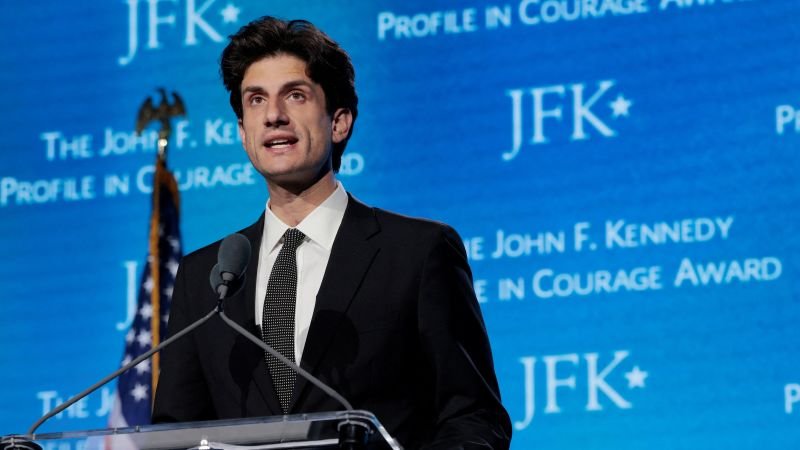
What is there to teach a Kennedy about politics?
According to Jack Kennedy Schlossberg, as his name will appear on the ballot in Tuesday’s Democratic primary: Somehow, pretty much everything.
How brutal New York City machine politics really works. How the press can rip you apart. How far family connections can get you and how far they can’t. How hard it can be to keep a big smile and trademark double thumbs-up in photos while trying to keep loss and pain private. How utterly delicious so many have found his stumbles.
“Our party is just not good at selling our message – and that’s not everything, but it’s a huge part of it. And everyone says that it’s time for a new generation … the Democratic Party has got to learn how to do things differently – until somebody actually tries, and then they don’t want to,” Schlossberg told CNN, sitting at the revived H&H Bagels on Columbus Avenue, trying to stay upbeat.
The core idea of Schlossberg’s campaign to represent much of Manhattan in Congress: In an attention economy, a guy who very quickly turned his lineage into a massive online following and became a star of the last Democratic National Convention could connect with voters who think politics is pointless and their leaders are terrible.

But if multiple polls and the wariness of friends who have been helping him are proven right, Schlossberg is facing not just potential rejection but the prospect of letting down the Kennedy name and all the people who still get excited about it.
He could still emerge from an eight-candidate race for the 12th District that only requires a plurality to win. But rather than readying for the dawn of a new Camelot dauphin, Schlossberg is spending the final days of his campaign talking about the bot armies he believes have been created to astroturf bad comments about him online and having his allies put up “SELLOUTS BEWARE ↑” signs around the posters of his opponents.

CNN spoke to Schlossberg and several of his friends and donors, along with opponents who snipe that he’s barely been campaigning; that, according to people familiar with the matter, he didn’t realize when he started running that New York City’s ranked-choice voting system didn’t apply to the congressional race; that he has flipped out – both on X and in person – at rival consultants and others he’s determined are bad and insincere.
Between chatting with voters on a street corner on the Upper West Side last week, retiring Rep. Jerry Nadler interrupted an answer to another question from CNN to describe Schlossberg as “somebody with no credentials and no anything getting into the race.”
Nadler noted he had not gotten a heads-up from former House Speaker Nancy Pelosi, a longtime Kennedy family friend, when she endorsed Schlossberg to run for his seat.
Friends bemoan that this could have gone differently if someone had figured out how to manage Schlossberg’s charisma and talent, though they acknowledge he’s often made himself unmanageable. To arrange an interview with him, for example, the request goes to his personal assistant because he fired more traditional staff like a press secretary after the first few weeks of his campaign.
“I feel like people cannot accept the fact that I might be a smart, hardworking person who is just really trying, because that’s unacceptable for some reason,” Schlossberg told CNN. “And so, I’ve got to be crazy, I’ve got to be completely unable to function and taking naps because what you see is someone who’s been really effective and taken seriously by the people who support him. And the people who support us are, like, diehard.”

The comment about taking naps is because of a key anecdote in a devastating New York Times story in May that on the day Schlossberg was preparing to launch his campaign, he told aides suddenly that he had to go home to sleep.
What was actually happening on November 12, he has told friends and reiterated to CNN, is that he was going to see his sister Tatiana Schlossberg, who had not yet revealed her terminal leukemia diagnosis, and didn’t trust any of the new people around him not to leak the news. Tatiana Schlossberg’s essay in The New Yorker disclosing her illness was published on November 22. She died on December 30.
Schlossberg, who’s 33, never met President John F. Kennedy. He can recall early memories with his near-doppelganger uncle John Jr., who remains such a fascination that he’s the topic of the Hulu series “Love Story” that just aired, nearly 27 years after the plane crash that killed him, and which the family says is an awful portrayal of them.
Schlossberg and his mother, Caroline Kennedy, have a bond so tight that he shares her laugh, her simultaneously ultimate insider and awkward outsider approach to politics, and her reluctant protectiveness of the family legacy. He also benefitted from her network of influential friends she corralled early into donating to his campaign.

A Jewish Kennedy – through his father, Edwin Schlossberg – might seem tailor-made for a district that has one of the largest Jewish populations in the country.
This is Manhattan, where what’s wrong with the Democratic Party is debated at bodegas and society fundraisers, where teenage girls ask Schlossberg for selfies on the sidewalk, and an older woman last week spent 10 minutes on a street corner talking with him about his family embodying the ideals of Catholic upward mobility.
The night that hundreds of people stood outside the Kennedy Center to watch President Donald Trump’s name being removed from the building because he was chasing his own association with the legacy, Schlossberg hosted a dance party in the district with special guest David Letterman, with whom he became friendly through his parents.
He is still trying to find a way to get an opinion piece published defending him from Ron Klain, the former White House chief of staff who was, he says, a life-changing professor at Harvard Law School.
Schlossberg says he was constantly getting asked in recent years what he thought about Robert F. Kennedy Jr. running for president and then getting appointed to Trump’s Cabinet, or Trump’s moves on trying to rename the Kennedy Center and declassifying certain JFK assassination files. That gave him a platform that he decided to take advantage of, he says.
“I didn’t just say, ‘Oh, hey, I’d like to try politics now after a lifetime of not caring.’ It was like, ‘No, this is all really happening right now, and it’s really important, and I was born into this situation, and I really, really care about, and know my history, and I know the history of our party,’” he said.

Part of that history is a website that leaned into JFK-style iconography, with ideas like counting rent like mortgage payments and making it deductible on federal income taxes, or demanding PACs get out of political campaigns.
But to Schlossberg, those issues are less the point than what he believes he could do and others couldn’t because of his name and social media followers. He argues he could break through on any point. Or, as two friends-turned-advisers put it to CNN and Schlossberg agreed, Trump would never know or care who the other candidates are. (George Conway, the longtime Republican backer turned Trump foil, has tried making a similar argument in the same primary.)
Nadler, 79, is backing Micah Lasher, an assemblyman who has risen through campaign and government jobs since he was the congressman’s intern 25 years ago.
Nadler told CNN that he knew he would back Lasher “the moment I decided not to run – and one of the reasons I decided not to run is I knew Micah could carry on.”
Helped by Nadler’s backing, Lasher racked up many local politician and union endorsements.
“When people say, ‘I just voted for you,’ or ‘I’m planning to vote for you,’ what they’re really saying is, ‘On the basis of not enough information, I’m making a decision to trust you to do the right thing for me,’” Lasher said. “And that is a very heavy thing. And it is humbling and wonderful and sometimes overwhelming.”

Also drawing attention is fellow Assemblyman Alex Bores, a former engineer for the data and AI company Palantir who has become a focal point for huge spending both for and against him from artificial intelligence-focused PACs.
“It’s still very much a local race,” Bores said. “The concerns that people talk about are the housing costs here and other local issues. It’s just the impact that the winner of this race will have goes beyond just directly what they will do in Congress. It’s the message that will be sent to every other member of Congress.”
Asked directly by CNN about their feelings on Schlossberg, Lasher and Bores both demurred. But Lasher in a recent debate implied that the Kennedy legacy was all there was to Schlossberg’s candidacy.
“As someone who grew up enormously admiring the legacy of service in your family, Jack, I say this somewhat sheepishly and mournfully,” Lasher said, “but when we talk about the reasons that each of us are on this stage, I’m on this stage because of nearly two decades in public service.”
Schlossberg fired back: “Do not ever invoke my family name to try to denigrate who I am and the person that I am.”
And Bores recently took a shot at both Lasher and Schlossberg: “I think this district deserves more than establishment or entitlement; it deserves effectiveness.”

After sneering about Schlossberg citing working in Japan when he was there because his mother took him along when she was ambassador under President Barack Obama, associates of both Lasher and Bores are talking about a two-man race on Tuesday, something that was unimaginable when Schlossberg’s campaign was at its height.
Schlossberg was the only candidate in the district to come out against arms funding for Israel — to the frustration of some donors his mother helped line up under assurances he would not, according to people familiar with those conversations.
Then, in late May, Politico reported Schlossberg had told an exclusive private club earlier that month, “I probably would have continued funding Israel’s offensive weaponry within the years following October 7.”
Schlossberg now opposes sending offensive weapons to Israel but backs supplying its Iron Dome missile defense system. He told CNN his own positions evolved – especially after the US and Israel launched the latest war with Iran – and said this was a prime example of how he could be a “bridge” between generations and points of view.
“In the beginning it was like, ‘Don’t touch it,’” Schlossberg said. “I was, like, ‘Why?’ I think we should be talking about these things, and to my surprise, like in person, when I give my answer in person, people say, ‘Wow, that was like a really great answer,’ even if they don’t agree with me 100%.”
“I see this as like a really important thing for the party too because I think we’re getting into some dangerous territory with Israel being kind of how people are making their identity with their campaigns,” he said, adding, “And I think a lot of it is this bot activity.”

For several weeks in late 2008 and early 2009, Caroline Kennedy was trying to be appointed to the Senate seat that Hillary Clinton gave up to become Obama’s secretary of state. Then that all also collapsed amid questions about her experience and a series of interviews where even the number of times she said “you know” became a subject of mockery and a question of whether she measured up to the Kennedy legacy. She eventually withdrew from consideration just after Obama was sworn in.
Schlossberg was 16 then.
“She and I think together a lot, think through a lot of things together. We thought through that. The first was Obama in 2007. Then it was whether or not to endorse Biden in 2020,” Schlossberg said. “I think that sucked for her because she didn’t really get to run a campaign, so it was different.”
He paused briefly. “It all worked out in the end,” he said. “Ambassador was an amazing role for her.”
Kennedy has hardly been in public or even engaging much with friends since her daughter died. But her son’s final ad features her speaking direct to camera about how he is what politics needs. There’s a split screen of black-and-white footage of her playing with her father. In the final seconds, Schlossberg comes into the frame to wrap her in a hug.
“President Kennedy is really, you know, a hero, and I memorized his speeches as a kid and did a lot of work at the Kennedy Library and I see how much my mom and dad have both given up their lives to, kind of, in service of that,” he said. “I think it pushes me to be brave and to have courage and to know what I stand for. I’m not about to say that it’s a bad thing. But it sort of filters how everything is perceived, good or bad.”

He hasn’t started thinking about the morning after Tuesday yet, win or lose.
“The only thing that frustrates me — I can take anything, I’ve heard it all — but when people say like, ‘Oh well, you’re early out and if you don’t win, you’ll do it again,’” he said. “We’re kind of running out of time here to change things up, and we all have no idea what’s going to happen in our lives. Not to be morbid, but something terrible could happen.”
“The time is right now,” he added. “I just really thought people were keyed into the fact that this is a code-red, emergency situation for America and our party.”
See More: https://www.ubirataonline.com.br