
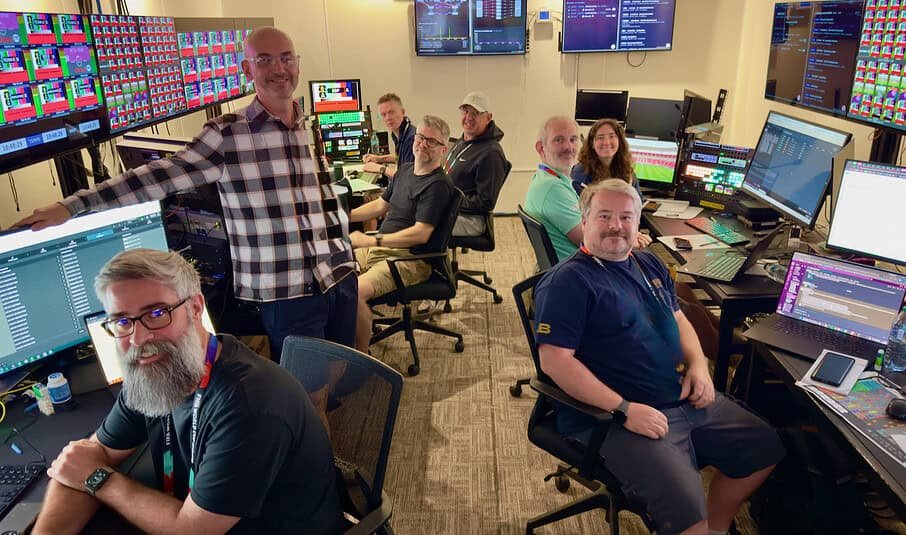
With a World Cup on its home soil, it only makes sense that FOX Sports is centralizing a lot of its operations at its broadcast center in Los Angeles. But there is still a need for a team at the IBC and for Mike Davies, Fox Sports, coordinating technical manager (no relation to the other Fox Sports Mike Davies who is Fox Sports SVP, Technical and Field Operations) and a team of 50 they are still playing a critical role even though there are no production control rooms which were on-site in Qatar in 2022.
“As technology has moved on, remote production capability is enhanced ” says Davies. “HBS likes to manage which providers can deliver IT services between the venue and the IBC, so we must be at IBC to be able to pick up those connections to the 16 match venues without any issues. This is still an essential IT hub for us to facilitate the 6 BRISK kit signals back to the production control rooms in Pico.”
Also helping reduce the footprint? HDR 1080P is now the native format in Pico so there is no need for LUT conversions. And because the frame rate for this World Cup is 59.94 there is also no need for frame rate converters.

The reduced footprint also reflects the nature of IT gear and reliability of fiber transport as well as the general evolution of remote production workflows. The IBC team handles Riedel comms, Sony camera shading, engineering, audio, and IT networking. They receive signals from HBS and Fox remote production teams, manage them, and deliver them onward to Pico where the shows actually get put together.
“This year for encoding we’ve gone with Appear X20 and we have 60 JPEG-XS paths using two 100 Gbps diverse circuits to Pico, two 100 Gbps to our facility in Tempe, AZ, and two 100Gbps between them as well” explains Davies. “We also have a disaster recovery gallery in New York, but key to our resilience is that we were to lose a path between us and Pico our network automatically reroutes the traffic via Tempe.”
Regarding the move to Appear, Davies says they offer more resiliency because if packets are lost on either the red or blue circuits it is not visible to viewers because the signals are using SMPTE 2022-7.
“If a decoder was 2022-6, the re-route would be visible as a half frame of black,” he adds.
There are also 26 Appear HEVC paths to Pico which transport signals for content that can get away with a little bit of latency, with smaller bandwidth.
“Those paths will have a press conference or things like the HBS produced feeds of fan reaction shots or match action replays” says Davies. “In addition to our host feeds operation, Fox have six “BRISK” systems in the field which are 8-to-12 camera systems that are deployed the day before a game at any one of the Match venues.”
BRISK is an acronym for “Broadcast Remote IP Studio Kit” and the concept was developed by Fox Sports VP, Field Operations and Engineering Kevin Callahan and Doug McGee, consulting engineer at Fox, designed by Diversified, and built in-house in the Fox warehouse in Vegas by Lucas Pierce and Aaron Stevens. The BRISK’s are EVS Cerebrum controlled 2110 redundant systems with Arista IP backbone, with Neuron video I/O, Calrec & Direct Out audio equipment with Sony HDC5500 Cameras from Game Creek.
“The production team in Pico can cut between shots from the venue or cameras from other stages from one production gallery, enhanced with the use of reporter cameras at pitch side using LiveU bonded cellular encoders racked remotely with CyanView Rio telemetry,” adds Davies.
Pico can receive up to 48 signals from the BRISK kits, again using Appear encoding, facilitating the Fox Digital services as well as the broadcast shows.
The IBC engineering team, many of whom are British, support the BRISK kits remotely from Dallas, where the team are also handling shading of these Sony cabled and RF cameras using Sony CNA 2 cameranetwork adapters.
“FIFA and HBS are using an enhanced CNA2 firmware version for the high number of cameras and settings they want to manage centrally, we didn’t need those enhanced features, but we did need the CNAs to steer video control easily between multiple sites easily,” explains Davies.
On the audio side, the IBC operation receives MADI streams alongside embedded audio in incoming video, including bespoke commentary feeds and enhanced audio packages from HBS. Two Calrec Impulse cores — main and redundant — handle all audio processing and stream assembly, along with Direct Out Prodigy MX. The philosophy around audio delivery is consistency and simplicity for downstream operators.
“We like to deliver things in multiple ways that would suit each use case when it arrives,” Davies explains. “When they’re coming off the EVS our replay A1 can just push up that one fader and have the 5.1 as it was recorded.”

The signal workflow for a match actually begins the day prior when the circuits at the venues are lit up and made available to rights holders like Fox. Those signals enter the Fox IBC production area via the Fox Sports Jewel Event system. FSJE1 is physically located at the IBC in Dallas, serving as the network hub for all incoming venue signals and the primary engineering and shading operation (a second FSJE2 is in New York). FSJE1 includes TAG Multiviewers, the EVS Cerebrum integration and control platform, the Calrec cores, and the Arista 7508 switches that handle uncompressed SMPTE ST 2110 traffic on both red and blue sides of the plant along with other gear.
The decision to make JPEG XS traffic multicast-capable across the WAN was a deliberate engineering achievement.
“Our network engineering team of Marc Fleury, Armin Vahaian, and Bryan Kolodziej have done a great job,” Davies says. “We’re doing multicast JPEG XS traffic over our wide-area network, which is not a normal arrangement — but it means that the same stream that we make in a BRISK can be decoded not only in Pico, but that same stream can also be decoded by us in IBC for shading and in FSJE2 in New York. The stream from a remote studio just passes through our plant here as network traffic…we aren’t decoding it and re-encoding.”
Signals leave Dallas pre-formatted for their destination: transmission-ready packages go directly to Fox’s transmission facility in Tempe and to Pico, with audio arrangements that suit each facility’s workflow. “We deliver signals directly to the transmission facility in Tempe in transmission format where things are ready to go to air,” Davies says. “But we also deliver production version with bespoke audio assignments which can be ingested in our EVS plant in Pico and used in our production control rooms.”

A newly deployed network monitoring solution from Grafana, gives the engineering team real-time visibility into traffic flows across all interconnected sites — watching the 45 gigabits of red-path traffic to Pico, the links to Tempe, and the connections to the disaster recovery gallery in New York, and ready to flag any circuit loss before it becomes a viewer-facing problem.
“If we had a fiber circuit cut, our network team’s Wide Area Network traffic rules would automatically reroute that content via Tempe and then across our inter-site 100Gb circuits so that we wouldn’t notice on the JPEG XS paths,” adds Davies.
Fox’s IBC operation has 136 outbound, 48 inbound, 4 satellite paths in addition to the BRISK’s 48 paths inbound and 16 outbound with LiveU redundancy, all at 1080P HDR with 5.1 audio, but the philosophy of lifeboat feeds— signal paths that deliberately bypass the primary 2110 infrastructure in the event of an unexpected failure, or via satellite in the event of total circuit loss — runs throughout the design. “Even though we’re 2110, you still can’t get away from some patch cords to move emergency video signals around the kit,” Davies acknowledges.
See More: https://www.ubirataonline.com.br