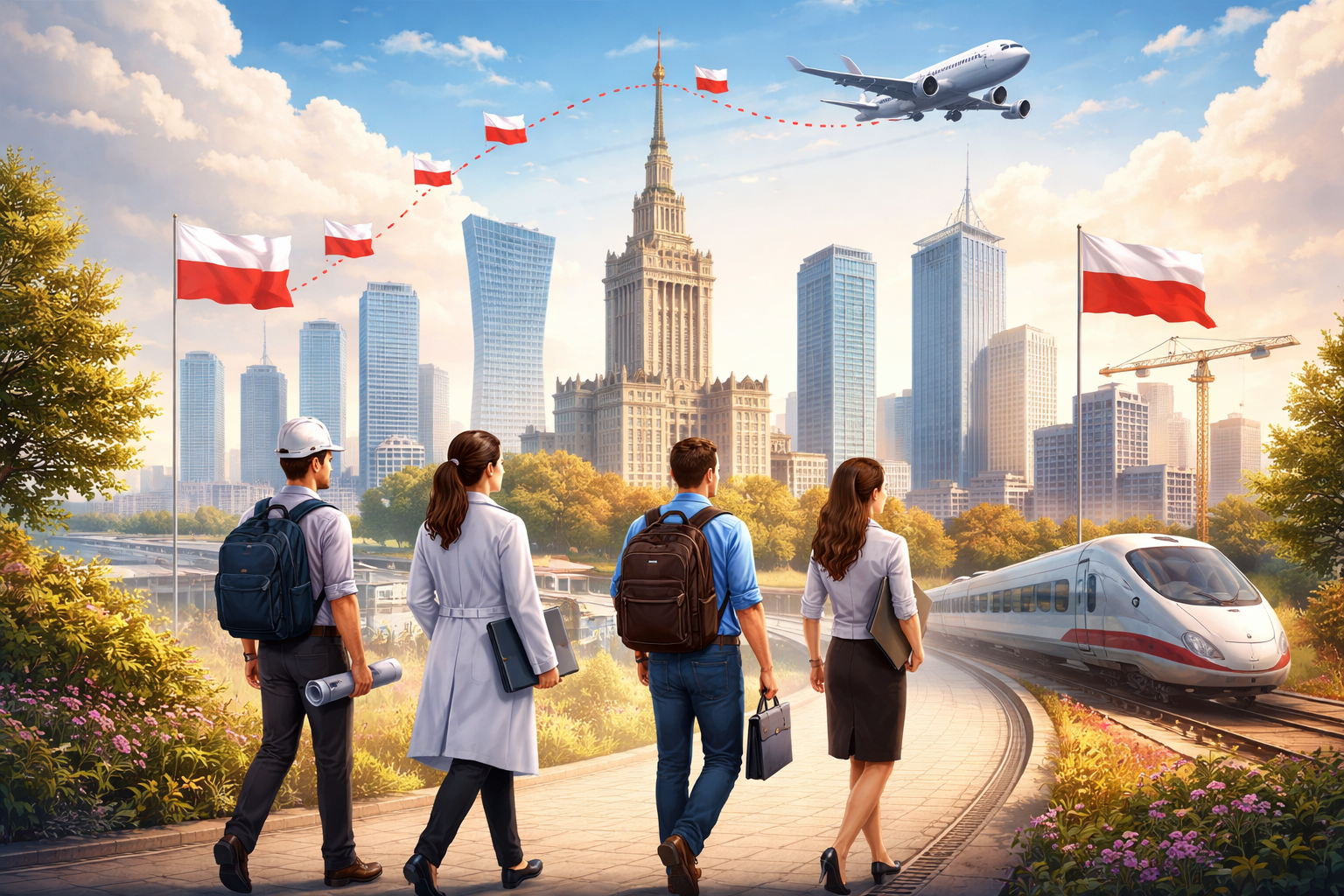
Poland’s transformation from a communist state to one of the world’s 20 largest economies is reshaping the nation’s demographic and economic landscape. The recently completed Varso Tower in Warsaw, standing taller than the Soviet-era Palace of Culture and Science, symbolizes Poland’s rapid ascent and growing confidence.
This symbolic progress, visible from Varso’s observation deck, mirrors a broader national turnaround. Since emerging from Soviet-dominated control in 1990, Poland’s national income has surged past $1 trillion, with income levels converging quickly towards Western European averages. Experts say the country’s per capita income is on track to surpass that of established economies like Japan and Spain, according to International Monetary Fund projections.
Economic Growth and Brain Gain
For years, many skilled Poles emigrated to Western Europe seeking better wages, a trend worsened by European Union membership. Notably, large numbers moved to the U.K., where Polish workers became emblematic of foreign labor in political debates, especially around Brexit. However, recent years have reversed this flow. Since 2021, twice as many Poles have left the U.K. each year compared to those arriving, while Germany has seen more immigrants moving into Poland than leaving for the first time ever.
This reversal is evident at architectural firms in Warsaw, such as the Foster + Partners office in the Varso Tower. Polish architects who once worked in London are returning, drawn by new opportunities and the appeal of raising families in a more affordable, greener city. They now lead major projects including the design of Warsaw’s new airport—the largest greenfield infrastructure development in Europe.
Modernization Amid Challenges
Warsaw’s streets reflect rapid modernization, with electric trams, new constructions, and digital innovations penetrating even traditional establishments. Yet this growth brings social challenges: housing affordability is decreasing for low-income residents, income inequality is high, and political polarization is intensifying ahead of next year’s general election.
Poland’s traditional low-cost labor advantage is diminishing as wages rise. Since joining the EU in 2004, average monthly wages have tripled in nominal terms. Warsaw’s salaries recently surpassed those of Rome and Lisbon, and living costs, including meals and coffee, have increased accordingly. This transition forces Poland to shift focus from low-cost manufacturing to productivity gains and high-value industries.
A Shift Toward Innovation and Knowledge Economy
Prominent figures in Poland’s business landscape emphasize the need for smarter work, higher value output, technology adoption, and regulatory improvements. The country is ambitiously pursuing a role as a regional tech hub, supported by a $1 billion investment fund targeting startups and artificial intelligence companies.
Educationally, Poland performs strongly with top-ranking math scores comparable to the UK and a higher proportion of adults with tertiary education than Germany. This talent base bolsters companies like CD Projekt Red, renowned globally for video games such as The Witcher series. Its leadership notes a generational shift from past inferiority complexes to confident, globally competitive ambitions.
Looking Ahead
Despite growing economic strength and technological promise, Poland faces political divisions and regional security concerns amid Europe’s evolving geopolitical landscape. Analysts caution against expecting quick fixes, urging continued hard work and careful policymaking. With a robust foundation and increasing global integration, Poland’s next phase of development will rely on innovation, productivity, and political stability to sustain its remarkable progress.