
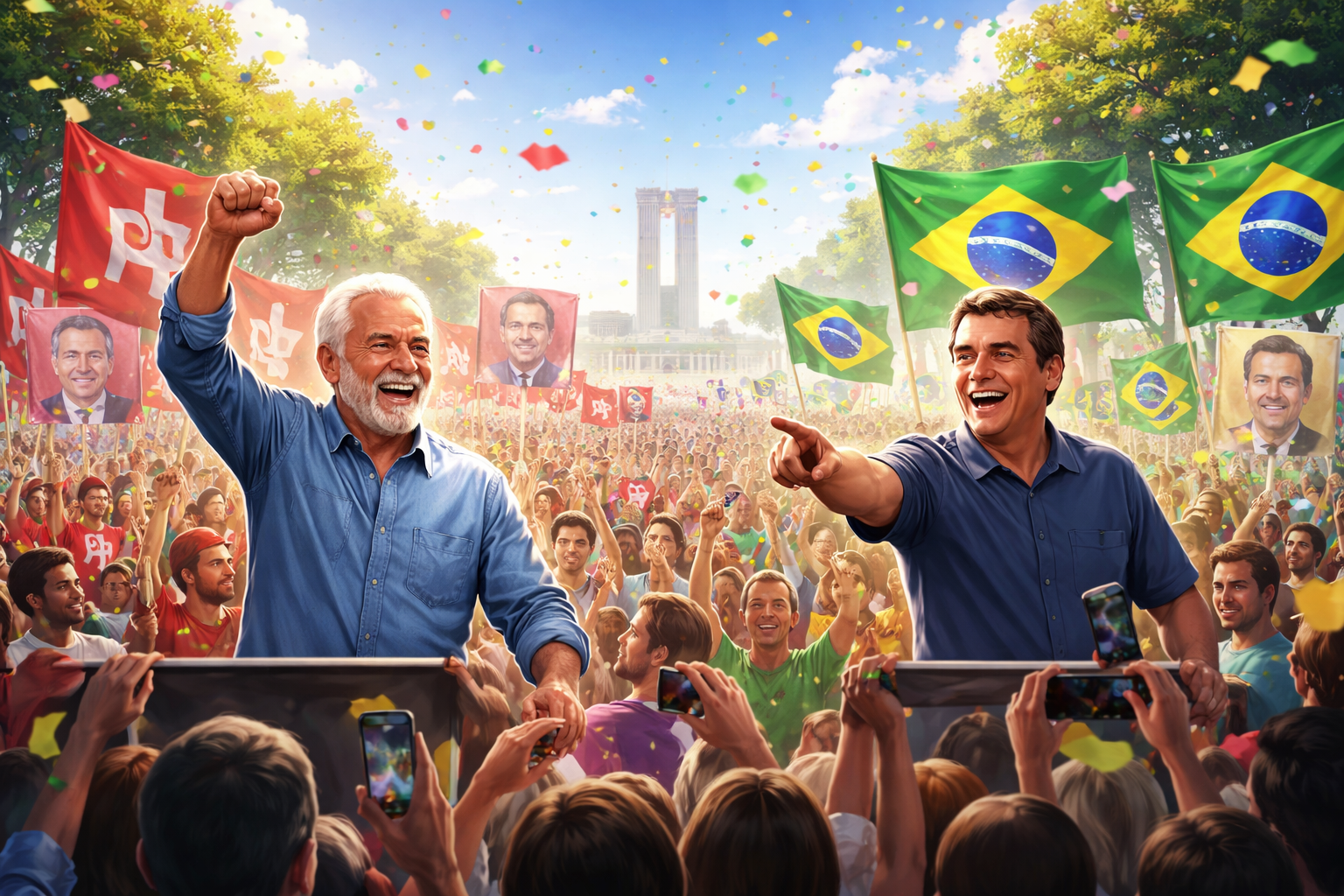
Brazil’s presidential election voting began Sunday in a highly competitive race between Luiz Inacio Lula da Silva, seeking a fourth non-consecutive term, and Flavio Bolsonaro, who aims to continue the political movement initiated by his father, Jair Bolsonaro.
Polls predict a narrow contest with neither candidate expected to secure more than 50% of the vote needed to win outright, potentially leading to a runoff election scheduled for October 25.
Campaigns Conclude with Strong Messaging
On the eve of election day, Lula concluded his campaign tour in Sao Paulo, promising to “defeat the far right.” He framed the election as a crucial choice between “democracy and sovereignty” versus “barbarism and corruption,” with an estimated 150,000 supporters attending his rally in Brazil’s largest city. Lula advocates for the continuation of his left-leaning Workers’ Party platform focusing on welfare programs, state-led development, and income redistribution.
Flavio Bolsonaro, serving as a senator representing Rio de Janeiro since 2019, ended his campaign with a motorcycle parade through the countryside around Sao Paulo. Emphasizing law and order and tax cuts, he criticized Lula’s administration for Brazil’s high cost of living, labeling the former president as “incompetent.” At the event, Bolsonaro supporters chanted “mito,” referring to his father, whose portrait he carried. He expressed confidence in winning the election in the first round.
Political Context and Controversies
This election marks a rematch following the contentious 2022 race where Lula narrowly defeated Jair Bolsonaro by 1.8 percentage points. Currently, Jair Bolsonaro is serving a 27-year prison sentence for an attempted coup aimed at overturning the 2022 election results. Flavio Bolsonaro has pledged to pardon his father if elected.
Lula’s campaign portrays the Bolsonaro faction as a threat to Brazil’s sovereignty, highlighting their connections with former U.S. President Donald Trump, who imposed a 50% tariff on Brazilian imports last year amid the coup-related trial. While Flavio Bolsonaro describes himself as “more moderate” than his father, his policies align closely on issues like relaxed gun laws and skepticism toward human-driven climate change. Trump has not endorsed Flavio but has stated he is watching the election closely.
Polarization and Legal Investigations
Brazil remains sharply divided politically, with campaigns marked by bitter exchanges and rapid dissemination of accusations and rumors through social media, often accompanied by professional videos and AI-generated images. In September, Flavio Bolsonaro became the subject of an investigation into alleged corruption, money laundering, and tax evasion linked to financing a biopic about his father. He has denied all wrongdoing.
Current polling from the Brazilian firm Quaest shows Lula leading with 46% against Bolsonaro’s 45% in the first round. In a potential runoff, Bolsonaro reportedly holds a slight advantage at 44% to Lula’s 42%. Alongside the presidential vote, approximately 160 million registered voters are also selecting legislators, governors, and some senators in this election.