
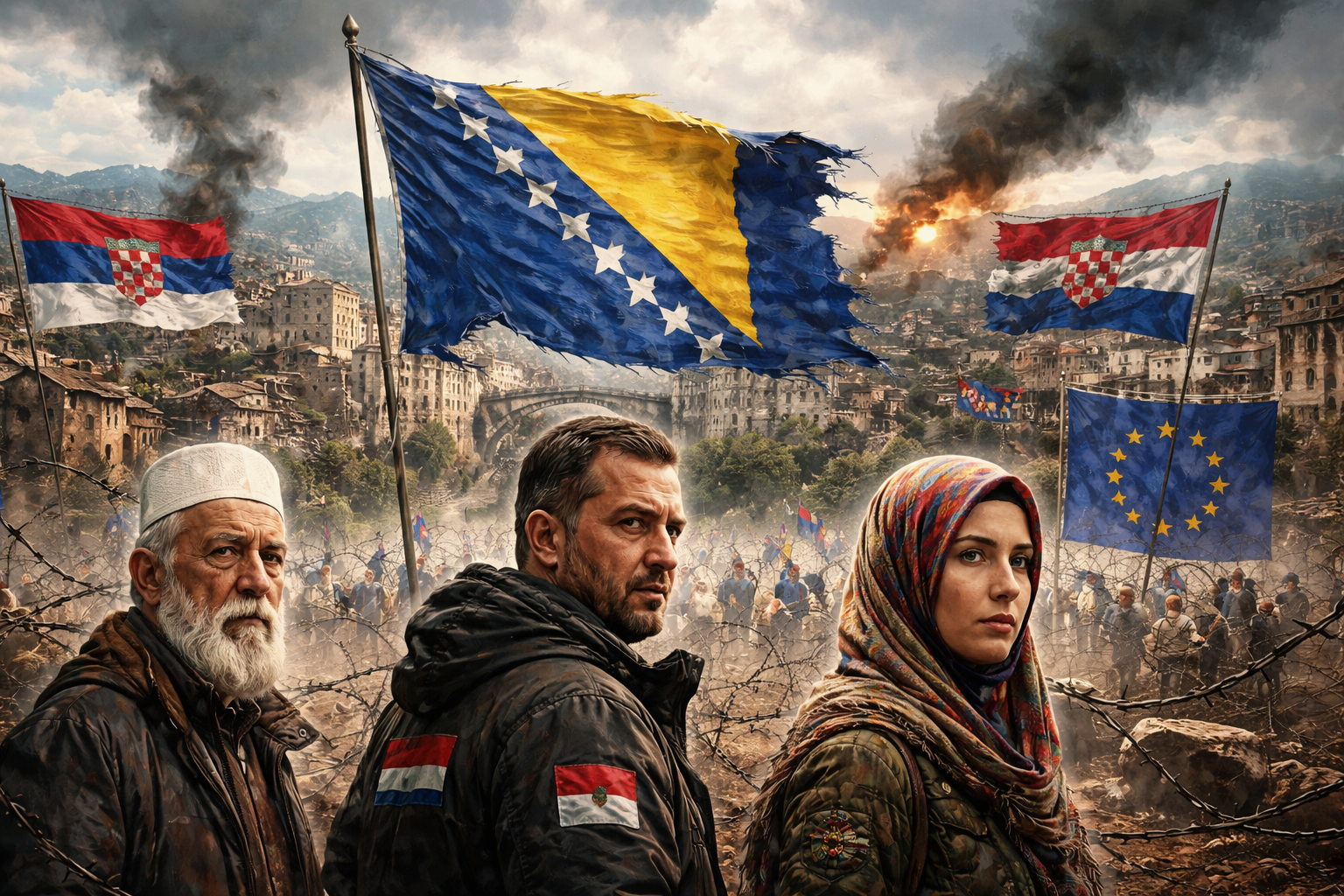
More than 25 years after the Dayton Peace Accords ended the Bosnian War, Bosnia and Herzegovina remains a country deeply divided along ethnic lines, with a complex and often dysfunctional political system. The country’s power is split between a multiethnic central government, the self-governing Brcko district, and two semi-autonomous entities: the Muslim-Croat Federation of Bosnia and Herzegovina and the Serb-dominated Republika Srpska.
This arrangement, intended to balance power among Bosniaks, Serbs, and Croats, continues to shape political life but also contributes to persistent ethnic tensions and governance gridlock, according to analyses of the country’s constitutional framework and political environment.
Ethnic divisions enshrined in political structure
Bosnia and Herzegovina’s constitution formally recognizes Bosniaks, Bosnian Serbs, and Bosnian Croats as the country’s three “constituent peoples,” granting them equal rights in government representation. These groups largely inhabit separate regions: Bosniaks and Croats in the Federation entity, and Serbs mainly in Republika Srpska.
The central government features a rotating three-member presidency representing each ethnic group, while parliamentary seats and key offices are divided along the same lines. This ethnic power-sharing was established by the Dayton Accords in 1995 to end the conflict that erupted after Yugoslavia’s breakup, which left about 100,000 dead and millions displaced.
International oversight and ongoing separatist ambitions
The Office of the High Representative (OHR), created by a UN Security Council resolution, oversees the civilian implementation of the Dayton Peace Agreement. The high representative holds significant authority, including the power to remove elected officials and impose legislation, aimed at maintaining the country’s fragile unity.
However, the role of the OHR has been increasingly contested, especially by Republika Srpska’s political leadership. Milorad Dodik, the entity’s most prominent leader, has repeatedly expressed separatist aspirations, with backing from Belgrade and Moscow, challenging the international oversight and Bosnia and Herzegovina’s cohesion.
Croatian political representatives in Bosnia also seek greater autonomy, advocating for the creation of a separate Croatian entity within the country, a move supported by Croatia’s government.
European Union prospects and regional integration challenges
Amid political paralysis and ethnic divisions, Bosnia and Herzegovina’s leadership broadly supports pursuing European Union membership as a key path forward. The country applied for EU membership in 2016, and negotiations were approved to start in early 2024, contingent on reforms addressing rule of law, corruption, organized crime, and effective governance.
The EU has provided pre-accession financial support since 2007 and has integrated Bosnia into its Economic and Investment Plan for the Western Balkans. Yet, EU funding for Republika Srpska’s infrastructure has been partially suspended due to ongoing separatist rhetoric, reflecting the challenges of fostering regional integration under current political tensions.