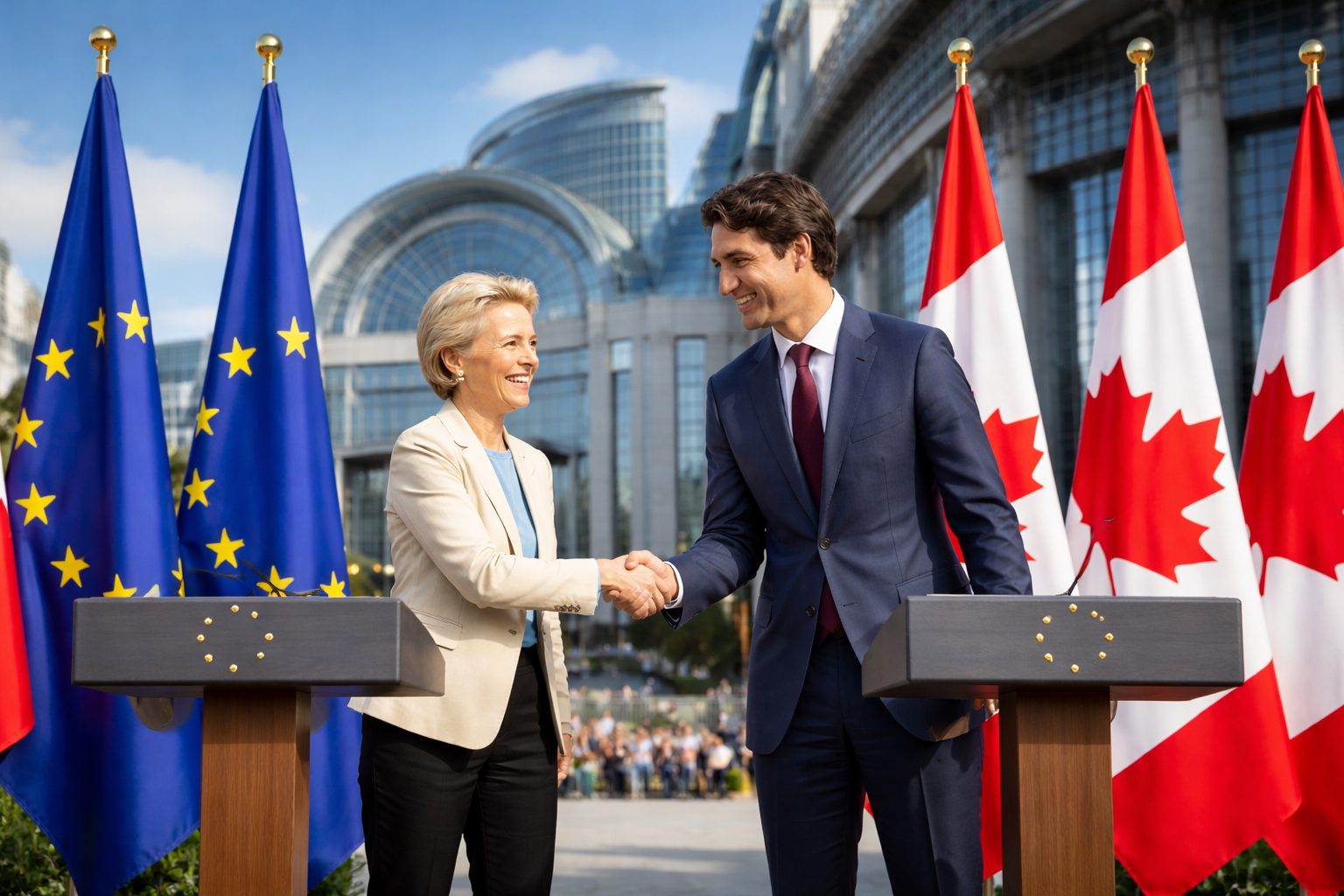

The European Union has extended an unprecedented invitation to Canada to become its first ever associate member, signaling a new level of cooperation between the two allies. The offer was made by European Commission president Ursula von der Leyen during a speech at the European Parliament in Strasbourg, where she spoke alongside Canadian envoy Mark Carney.
Von der Leyen emphasized the strong alignment between the EU and Canada on global challenges, including artificial intelligence, climate change, the conflict in Ukraine, and broader geopolitics. She described the proposal as an effort to “reimagine” partnerships amidst a shifting international landscape and to “bring the relationship with Canada to the highest level possible.”
Expanding Economic and Strategic Cooperation
Currently linked through a trade agreement and numerous bilateral deals, the EU and Canada have been moving closer, especially as trade relations with the U.S. have grown more uncertain under former U.S. administration policies. Von der Leyen announced plans to upgrade the existing trade deal to an “alliance for the future,” aiming to establish a “common prosperity and economic security space.” This upgrade involves cooperation on energy, critical minerals, batteries, cybersecurity, quantum computing, and AI.
Additionally, the two sides aim to form a technology alliance, integrate defense industrial bases, and make Arctic development a flagship joint project. EU officials have shown particular interest in Canada’s natural resources and energy sectors.
Significance and Challenges of Associate Membership
While the EU has close relationships with non-member countries such as Norway, Iceland, and Switzerland through deep economic integration, an official associate membership category does not currently exist. The implications of such a status for Canada’s relationship with the EU single market remain unclear, especially given the EU’s prior stance that no partial membership exists that would allow a country to be “half in and half out” of the single market.
The EU and Canada are scheduled to hold a summit in late October to further explore this new association framework. The proposal also raises questions among other EU allies, including the United Kingdom, which has sought more flexible ties since Brexit.
Reactions and Political Context
Mark Carney, representing Canada, has called for a “unique alliance” with the EU as Canada looks to diversify trade relations beyond the U.S. His recent assertive stance on trade with the U.S. has earned praise within the European Parliament. Spanish MEP Javier Moreno Sánchez highlighted the strength of Canada’s approach, noting that Canada is “the most European people outside Europe,” underscoring the cultural and political affinity between the two.
However, hurdles remain, including the lack of ratification by 10 EU member states of the existing EU-Canada trade deal signed nearly a decade ago. Analysts suggest that the associate membership might involve Canada joining existing EU programs, such as the European Defence Agency, rather than becoming a traditional full member of the Union.