

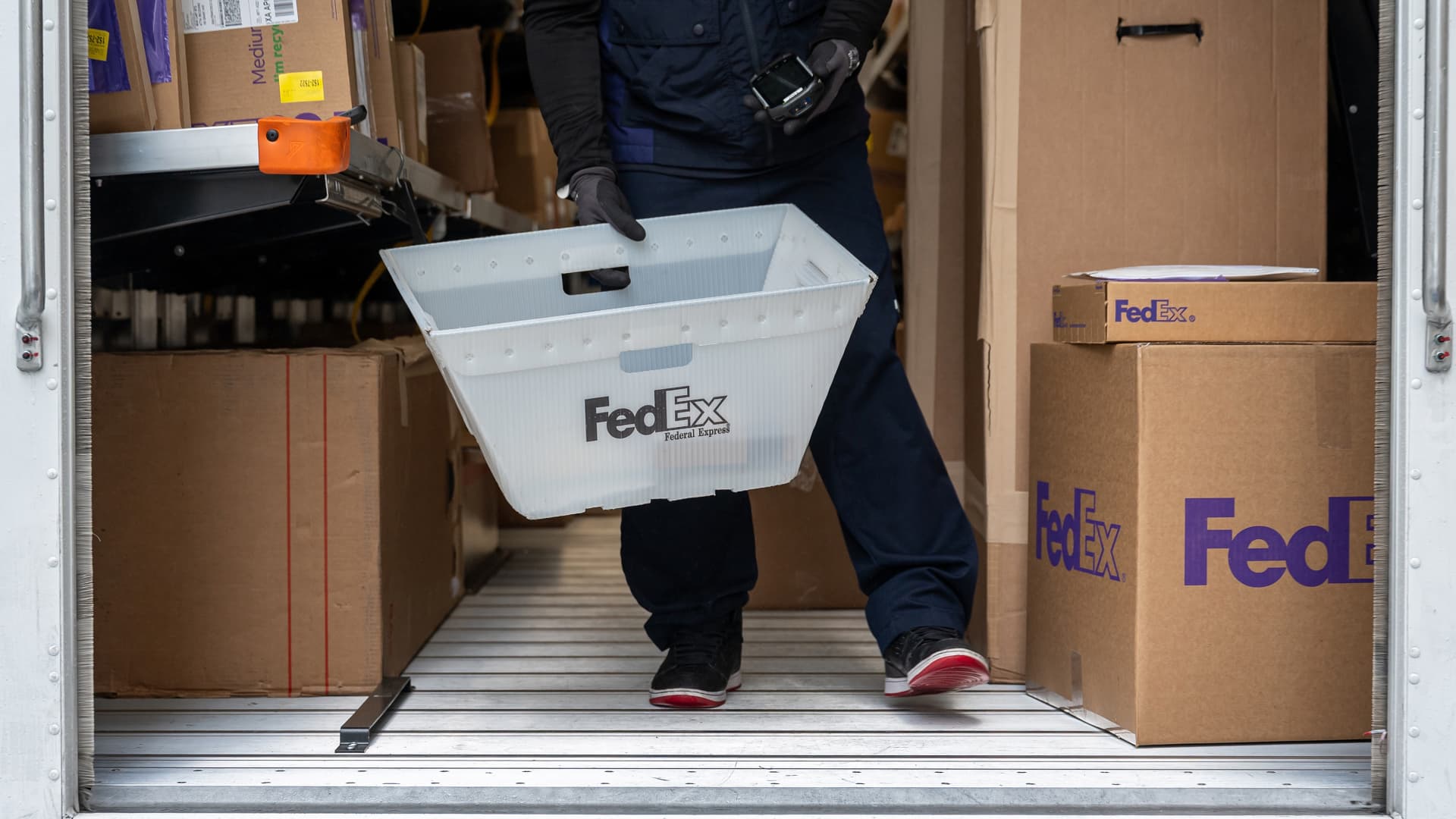
FedEx delivered a strong quarter on Tuesday, but shares of the delivery company are sliding in after-hours trading — which we see as a misreading of the results. Revenue in the fiscal fourth quarter of 2026 was $25 billion, above the $24.04 billion consensus forecast, according to estimates compiled by LSEG. Earnings per share (EPS) increased 4% to $6.31, beating expectations of $5.96, LSEG data showed. FDX 1Y mountain FedEx 1-year return Bottom line In its final quarter as the owner of the recently spun-off FedEx Freight, FedEx delivered exactly what investors want: beats on the top and bottom lines. So why all the after-hours selling? The likely culprits: Investors are dissatisfied with a margin miss and the forward earnings guidance for the rest of the year. Let’s start with the reported quarter’s operating margin of 8.35%, which was short of the 8.44% estimate. While this kind of miss can be disappointing, sellers may be overreacting in this case. Here’s why: FedEx is a transportation and logistics company that passes fuel costs on to customers via fuel surcharges, a dynamic that raises revenue and squeezes margins — but doesn’t affect earnings. When you pass fuel costs through, revenue rises (5 percentage points last quarter), but that incremental growth carries a 0% profit margin because the goal is to recover higher fuel expenses, not profit from them. As a result, overall margins compress even though earnings remain largely unaffected. Members who have followed our coverage of Linde may recognize a similar dynamic, as the company also utilizes contractual energy cost pass-through clauses. The most important takeaway from the conference call was that FedEx is seeing no drop in demand due to fuel surcharges. In fact, the operating margin would have increased year over year if not for the surcharge dynamic. As for the earnings guidance possibly disappointing some investors, it’s worth noting that CEO Raj Subramaniam has historically been conservative (underpromise, overdeliver) in setting estimates. That’s likely even more the case as the company is just getting started at improving operations post-spin of FedEx Freight. Moreover, the company announced a $1 billion stock buyback, which should support further earnings growth. Why we own it FedEx is transforming itself into a leaner, more profitable organization under the leadership of CEO Raj Subramaniam. By spinning off its freight unit, the remaining FedEx is focused on parcel and logistics services, while emphasizing higher-margin end markets. Competitors : UPS Last buy : May 18, 2026 Initiation date : May 18, 2026 Earnings growth will also come from operating initiatives. Management cited its recent formal launch of FedEx Life Science, which provides specialized transportation services for the health-care industry, where packages can be both time- and temperature-sensitive, as well as accelerating growth in artificial intelligence. “The AI and data center space is an emerging and rapidly scaling growth engine for us, delivering double-digit revenue growth,” Brie Carere, FedEx’s chief customer officer, said on the call. “Rather than a narrow vertical, this space represents a horizontal ecosystem. We are capturing demand across the entire value chain from traditional hyperscalers to the industrial and power infrastructure that support these massive build-outs.” Bottom line: We knew this report would be transitional, even messy, given the separation of FedEx Freight and decisions to realign FedEx’s fiscal year with the calendar year. As a result, our focus is on the reported results and management’s commentary on guidance, rather than on the actual numerical guidance. We were happy with what we saw and heard. We are therefore maintaining our 1 rating and price target of $380, which implies roughly 20% upside from Tuesday’s closing price, and 28% from its after-hours close. Commentary On the call, Subramaniam said the company is growing revenue in the most premium areas of the global economy. Revenue growth of 14% in Federal Express Corporation, or “FEC” (the remaining operating segment), came on the back of higher yields and increased volume across nearly all of its services. In the U.S., revenue increased nearly 13% year-over-year, driven by roughly: 14% year-over-year in priority 13% year-over-year deferred 12% in ground In the international export business, FedEx realized a nearly 20% year-over-year increase in priority shipments alongside nearly 9% year-over-year growth in economy shipping. Lastly, in international domestic, which refers to international intracountry operations, revenues increased nearly 6% year-over-year. In the now separated Freight division, the company reported: 17% year-over-year growth in the U.S. 20% year-over-year growth in the international priority business 16% year-over-year growth in the international economy business Guidance Management is forecasting earnings between $16.90 and $18.10 per share, on the back of 11% revenue growth (with 3 percentage points attributable to fuel surcharges), versus a pro forma fiscal year 2025 revenue of roughly $82 billion. We can’t provide an apples-to-apples estimate relative to the forecast due to management’s decision, following the FedEx Freight separation, to change the fiscal year to align with the calendar year, rather than ending on May 31 as has historically been the case. Some Wall Street analysts may find the earnings guidance a tad light. Wells Fargo analysts, for example, stated in a June 17 preview note that they were looking for guidance closer to $18 per share, versus the company’s midpoint estimate of $17.50 per share. However, top-line growth of 11% is solid, and we wouldn’t be surprised to see the earnings guide prove conservative, as noted above. (Jim Cramer’s Charitable Trust is long FEDX. See here for a full list of the stocks.) As a subscriber to the CNBC Investing Club with Jim Cramer, you will receive a trade alert before Jim makes a trade. Jim waits 45 minutes after sending a trade alert before buying or selling a stock in his charitable trust’s portfolio. If Jim has talked about a stock on CNBC TV, he waits 72 hours after issuing the trade alert before executing the trade. THE ABOVE INVESTING CLUB INFORMATION IS SUBJECT TO OUR TERMS AND CONDITIONS AND PRIVACY POLICY , TOGETHER WITH OUR DISCLAIMER . NO FIDUCIARY OBLIGATION OR DUTY EXISTS, OR IS CREATED, BY VIRTUE OF YOUR RECEIPT OF ANY INFORMATION PROVIDED IN CONNECTION WITH THE INVESTING CLUB. NO SPECIFIC OUTCOME OR PROFIT IS GUARANTEED.
See More: https://www.ubirataonline.com.br