
Some of the biggest franchises in gaming history fall into the open world genre. Games like Grand Theft Auto and The Elder Scrolls dominate the conversation, but for every The Legend of Zelda: Breath of the Wild,, there’s a near-perfect open-world game that got buried.
From Dying Light and Mad Max to Gravity Rush 2 and Sunset Overdrive, the open-world games on this list all did something genuinely original and deserved a bigger audience than they got. For some, it was bad timing, while for others, platform exclusivity or a studio that closed before anyone noticed what they’d built did them in.
The Saboteur Let Players Liberate Nazi-Occupied Paris in Black and White

The Saboteur (2009) is set in a version of Nazi-occupied Paris rendered almost entirely in black and white. Players climb buildings, blow up Nazi installations, and wage a one-man guerrilla war across the city. All incredibly fun, but the game’s coolest innovation occurs whenever the player liberates a district. The whole area would suddenly bloom from stark monochrome into full color.
This meant that the visual design itself was a kind of progress meter, and as much as playing in black and white was, watching the world transform to color was one of the most striking art concepts in open-world games. Developer Pandemic Studios had plans for a sequel, but when Australian creative director Morgan Jaffit, who’d been hired to lead it, arrived at Pandemic’s LA office, in his words, he “got the smell of death.”
EA shut down the studio on November 17, 2009, laying off 228 employees. The Saboteur shipped three weeks later as a finished game released by a dead studio. The Saboteur won IGN’s Best Artistic Design at E3 that year, but there was nobody left to build on what it started.
Mafia II Is a Linear Game Wearing an Open-World Coat

Mafia II has an open-world map players can drive around freely, but the missions are completely linear, and there are essentially zero side activities. It’s a linear game wearing an open-world coat, and 2K Czech committed to that tension on purpose. Empire Bay, a fictional amalgam of 1940s-50s American cities, isn’t a sandbox, but a stage set built to serve the story of Vito Scaletta’s rise through the Mafia.
Critics who wanted sandbox freedom called the city empty. But Empire Bay didn’t need activities to justify its existence. Mafia II created one of the most convincing historical settings in gaming, with its snow-covered streets, period-accurate cars, and jazz-era soundtrack. The driving was deliberately heavy, the gunplay lethal and unglamorous, and the story didn’t flinch from consequence.
Dragon’s Dogma: Dark Arisen Is Like an Open World Shadow of the Colossus

Shadow of the Colossus proved in 2005 that climbing a giant creature and stabbing its weak points could be one of gaming’s most thrilling experiences. But Team Ico’s masterpiece was a minimalist art game, with just sixteen bosses, an empty world, and nothing in between. Capcom’s Dragon’s Dogma asked the obvious next question: what if that mechanic was surrounded with a full open-world RPG?
Director Hideaki Itsuno, best known for Devil May Cry, built a game where players clambered up griffins, cyclopes, and chimeras in real time while the creature thrashed and flew and rolled, then dropped back to the ground and continued exploring, looting, and leveling through a massive fantasy world.
The other innovation was the Pawn system. Players created AI companions who learned their combat style and could be shared online — meaning the player’s Pawn would return from someone else’s game with new knowledge about enemies and quests. It was asynchronous multiplayer disguised as a single-player mechanic. Dragon’s Dogma reviewed decently but was overshadowed by Skyrim’s dominance and Capcom’s inconsistent marketing.
The expanded re-release, Dark Arisen, added a massive post-game dungeon and became the definitive version. A cult following grew over the next decade, eventually leading to Dragon’s Dogma 2 in 2024.
Sunset Overdrive Was Insomniac’s Best Game Before Spider-Man

Insomniac Games built Sunset Overdrive as a deliberate middle finger to the grim, self-serious open-world games dominating the market. Set in Sunset City after an energy drink mutates most of the population into monsters, the game was built around a traversal system that treated the entire city as a rail-grinding, wall-bouncing, zip-lining playground.
Standing still was punished, as the game wanted players airborne, chaining movement and gunfire into a continuous loop of chaos. The arsenal was absurd: a bowling ball launcher, a gun that shot teddy bears strapped to TNT, a sprinkler that spewed acid. Sadly, there was one big problem: the game’s platform.
Sunset Overdrive launched as an Xbox One exclusive during the console’s weakest sales period, and Microsoft barely marketed it. Insomniac retained the IP, which was unusual for an exclusive deal, and the game eventually came to PC in 2018, but by then the moment had passed.
Insomniac went on to make Marvel’s Spider-Man, which applied many of the same traversal ideas to a much bigger audience. Players who discovered Sunset Overdrive after Spider-Man found a game that was arguably more inventive, more irreverent, and more willing to let the player break the world apart.
Dying Light Made Nightfall the Most Terrifying Mechanic in an Open-World Game

Techland’s Dying Light split its open world into two games based on the time of day. During daylight, players navigated the quarantined city of Harran using first-person parkour, vaulting fences, scaling buildings, leaping between rooftops with a fluidity that owed more to Mirror’s Edge than to any zombie game before it.
The daytime loop was satisfying: explore, scavenge, craft weapons, complete missions, clear safe zones. Then the sun went down, and Dying Light became a survival horror game. Volatiles, which were fast, powerful, light-sensitive predators, emerged at night and hunted players through the streets. The parkour that felt empowering by day became a desperate scramble for any bit of safety at night.
The day-night cycle wasn’t just a gimmick. It fundamentally changed how players engaged with the open world. Nighttime offered double experience points, rewarding players who pushed into danger, but the risk was real. Getting caught by a Volatile triggered a chase sequence that was genuinely panic-inducing.
Dying Light launched the same month as The Witcher 3 and Batman: Arkham Knight, and was largely overshadowed despite eventually selling over 30 million copies. Techland supported it for years with free content updates and, fortunately, enough copies sold to justify Dying Light 2.

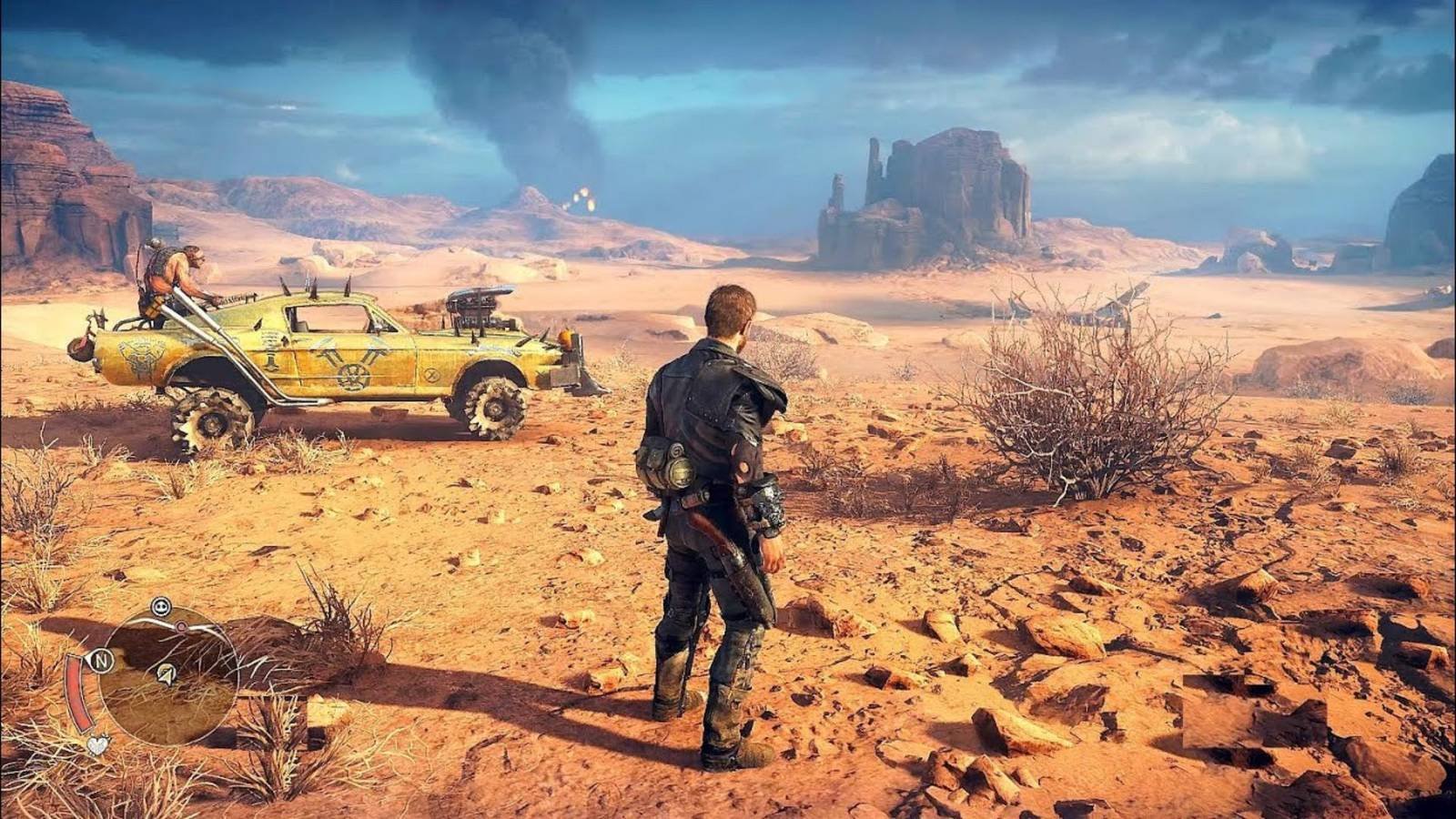
Avalanche Studios’ Mad Max is the best adaptation of a film franchise that almost nobody played. The game captured George Miller’s post-apocalyptic wasteland with startling fidelity. Its car combat was savage, the vehicle customization was deep, and the Magnum Opus (Max’s upgradeable car) felt like a character in its own right.
The game was built around vehicular warfare, with storms that could rip the landscape apart while players fought convoys at high speed. On-foot combat borrowed beautifully from the Arkham series, but the game lived and died in the driver’s seat. Unfortunately, Mad Max launched on September 1, 2015, the same day as Metal Gear Solid V: The Phantom Pain, one of the most anticipated games of the decade.
Metal Gear consumed all coverage and consumer attention. Mad Max was redeemed decently, but was deemed unremarkable, which was partly fair, as the on-foot sections dragged. However, the car combat and wasteland atmosphere were exceptional. Players who found it later discovered a game that understood the Mad Max fantasy better than most licensed games understand their respective source material.
Gravity Rush 2 Let Players Fly Through a Floating City

Keiichiro Toyama, the creator of Silent Hill, spent years building a game about a girl who can shift gravity. The original Gravity Rush started on the PS Vita in 2012, and the sequel, Gravity Rush 2, moved to PS4 and expanded the concept into a full open-world action game with a stunning cel-shaded, anime-inspired look.
Protagonist Kat doesn’t run, climb, or drive, but instead falls in whatever direction the player chooses. The flying mechanic looked less like soaring and more like tumbling ass-backward through the air, which made it feel genuinely disorienting, and incredibly fun to watch. Gravity Rush’s three gravity styles, Normal, Lunar, and Jupiter, gave players different movement speeds and combat weights, turning traversal into a constantly evolving system where the entire city was playable from every angle.
The floating city of Jirga Para Lhao was inspired by the team’s travels through Latin America and Asia. Wealthy districts floated above impoverished settlements, making the class divide literally vertical. The art style drew from manga and the work of French comic artist Jean Giraud.
Gravity Rush 2 launched days before Resident Evil 7 and Yakuza 0, and commercially it never recovered. Sony shut down Japan Studio in 2021, Toyama left to found Bokeh Game Studio, and the IP sits with Sony. No sequel is in development.