Nintendo’s “game + add-on” rereleases have been hard to predict based on that label alone. Super Mario 3D World’s jump to Switch 1 came with Bowser’s Fury, which was essentially an entirely new game, while the more recent Super Mario Party rolled onto Switch 2 with the Jamboree TV expansion that was simultaneously the same as the base game but also totally separate and different in a few odd ways. Now it’s Kirby and the Forgotten Land’s turn, and its Star-Crossed World add-on is a Kirby-sized gulp of fresh air simply because of how easy it is to explain: it’s just a regular ol’ modestly-sized DLC. It might be packaged as an upgrade, but this small collection of fun new levels isn’t anything more complicated than a good excuse to hop back onto the warp star for a few hours, even if there’s not much to it overall.
Let’s get the boring business talk out of the way first: The only ways to access Star-Crossed World are to either pay $20 to upgrade your Switch 1 version of Kirby and the Forgotten Land to the Switch 2 Edition (which also comes with some welcome but inessential performance improvements) or buy the Switch 2 version fresh for $80. You could also buy the Switch 1 version for $60 and skip the added content, but there’s no way to get the Switch 2 enhancements without it. Because those enhancements aren’t very significant, this really does just feel like DLC in a very traditional sense, and as such this review is going to focus on Star-Crossed World alone rather than the bundle it’s being marketed as.
The other reason that makes the most sense to me is because my review of Kirby and the Forgotten Land still holds up exactly the same as when I wrote it, three-and-a-half years ago. I won’t be recapping the basics here, so I encourage you to go read or watch that review if you’ve never played it (a game I still heartily recommend on its own), and then come back when you are considering the DLC itself. Here is what I said at the time:
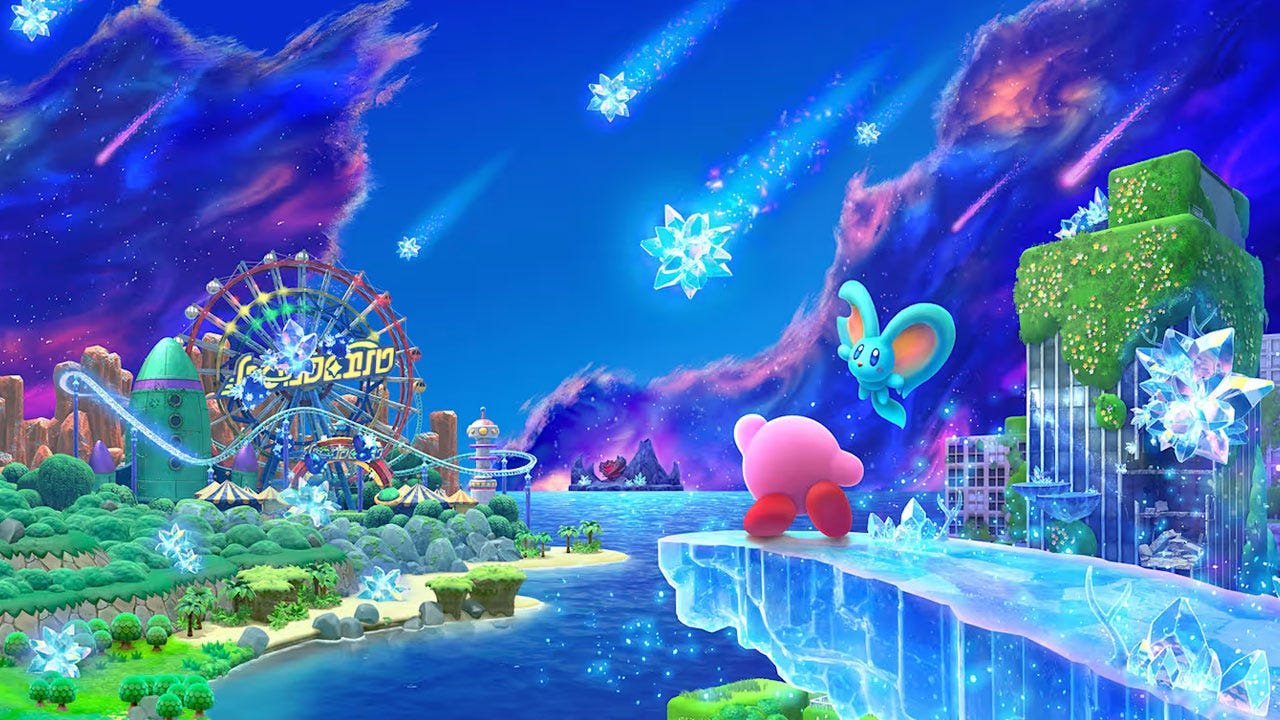
Star-Crossed World weaves a little side story nicely into Forgotten Land’s existing campaign. Immediately after you complete the first world (or just as soon as you load it up if you already have a save beyond that), a mysterious meteor crashes into the ocean and sends chunks of blue crystal all across the map. The story, which is not the reason you are here at all, is predictably thin as a Waddle Dee with a cool beret sends you out to collect the “Starries” that have been scattered across the land in order to reseal the evil being inside the meteor that is prophecized to end all existence. Ya know, normal Kirby stuff.
What that means, practically speaking, is that 12 new “Starry Stages” have been added to the map, two in each of the six worlds from the base game. These borrow locations and themes from the levels they are next to, adding crystal flowers that alter the landscape when you touch them. There are also some brand-new enemies, challenges, and even awesome background songs. I was initially concerned that these stages would just be remixes, but that proved not to be the case – they are made up of almost entirely new areas, and the handful of times you do revisit spots like in the excellent mall level or exciting amusement park, it feels entertainingly referential rather than like a cheap rehash.
There aren’t really any misses across these dozen dungeons, with clever twists put on existing mechanics and plenty of interesting new ones to tease your brain. One standout had me hopping between moving platforms that were coming toward the screen, frantically trying to find the right path to the next one before getting pushed off the edge. Another revisits the very silly “pipe” Mouthful Mode transformation to send you rolling down a roller coaster track that you need to reveal extra pieces of in real time. None of them put up too serious of a fight, since this is a Kirby game, but they are a bit more challenging than the rest of Forbidden Land across the board, making them a nice additional “post-game” option to keep you playing, even though they actually unlock in tandem with the main story.
Speaking of Mouthful transformations, there are three new ones introduced in Star-Crossed World: a spring that lets you bounce up high and then slam down hard, a gear that allows you to roll along walls, and a sign that essentially turns Kirby into a sled for a few high-speed downhill sections. All of them are used to great effect, opening the door to some clever new puzzle ideas – I particularly liked how you’re asked to launch yourself between separated sections of wall as the gear, which is a little bit more mechanically nuanced than I expected from such a simple item.
Many of the existing transformations are revisited in smart ways as well, with options like the stalwart traffic cone getting multiple sections that prove there is more than a little gas left in the tanks. Even the stairs transformation, which in the main game I thought was… well, pretty dumb, is actually used in interesting ways here: there’s a short section where you have to leave your stairs on a moving conveyor belt then hop up elsewhere to complete a task before it falls off a ledge. Neat!
Unfortunately, Kirby’s more traditional transformations didn’t get the same attention – there are no new ones and no new upgrades for any of the existing set. Perhaps more importantly, if you have already beaten Forgotten Land and are returning to this DLC years later like I did, having a maxed-out toolset already can make some of the beefed-up enemies a bit too easy to shred. One new enemy type in particular acts as a fun little recurring miniboss, calling down meteors that you have to dodge as you break away progressive layers of crystal armor – but a charged-up attack from a fully upgraded copy ability can trivialize that otherwise-interesting encounter from the jump.
In that same vein, the failures of Star-Crossed World are less about what it does and more about what it doesn’t. It took me about three hours to finish what’s here, and while the stages themselves are all top notch, it feels slight as an actual expansion beyond that. There are no boss fights across those 12 levels, no new Treasure Road bonus stages (which were a big highlight of the original) even for the new Mouthful options, and nothing really changes back at your Waddle Dee village – although there is a little bit more to see beyond the Starry Stages that I can’t get into here. Even the new star-based currency you collect became fairly uninteresting once I realized that its only use was unlocking a new set of gacha figurines.
It’s not like there’s nothing worthwhile here, and it’s not like I got 100% completion across those 12 stages right away – just like the base game, I didn’t usually make it to the end with every single collectible on my first try, so there’s plenty more secrets left for me to sniff out. But Star-Crossed World can’t help but feel like a drop in the bucket when you compare it to everything that was already available. The levels it adds are great, but that single afternoon of fresh platforming is pretty close to the entire package.
The Nintendo Switch 2 Edition changes don’t do much to entice you, either. You’ll no longer see NPCs in the distance moving at comically low frame rates, but that’s the only change that really jumped out at me. Don’t get me wrong, the higher FPS and resolution are welcome, and it all looks quite nice… but it didn’t really look bad to begin with. Forgotten Land was such a stylized game already, one without any of the real performance issues other Switch 1 games were able to fix in the jump to Switch 2, so the ceiling on how much better it could look without a more substantial overhaul wasn’t too high in my eyes.