
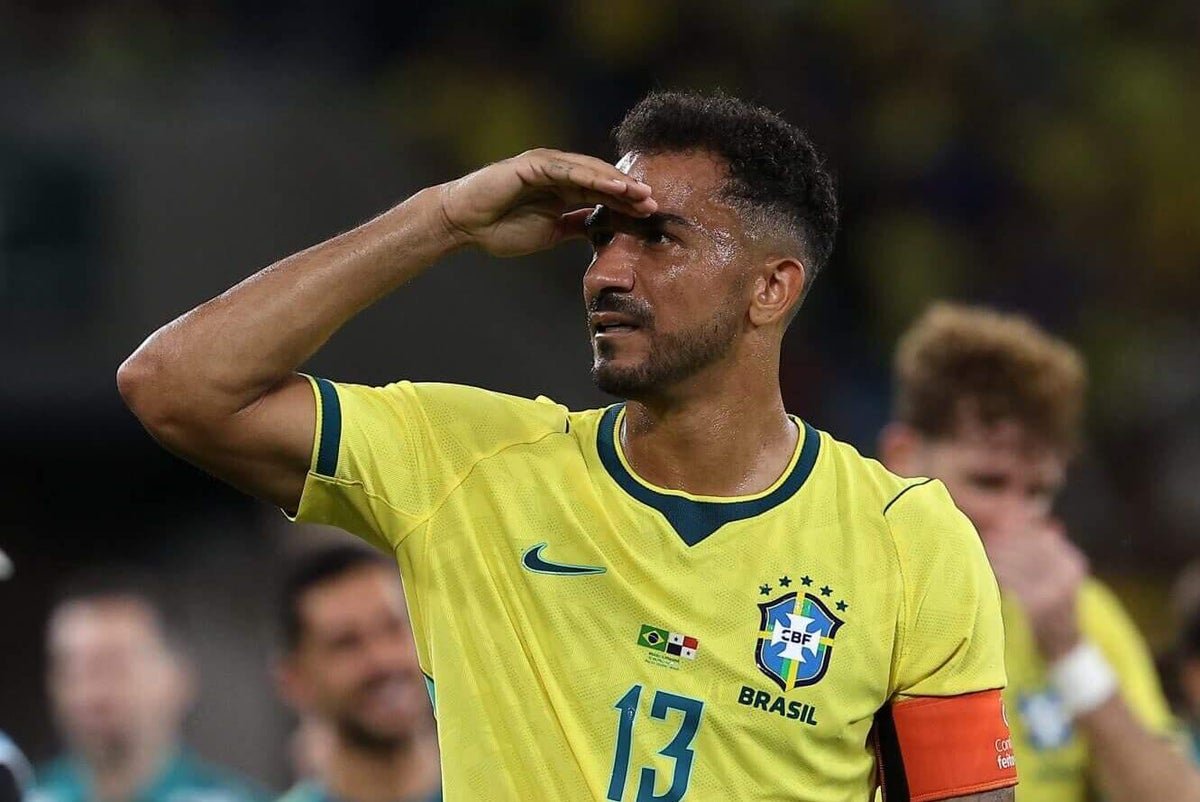
Danilo Luiz da Silva, 34, speaks to The Athletic from Brazil’s team hotel in the United States before friendly games in the build-up to the World Cup.
Best known for his spells at Real Madrid, Manchester City and Juventus, the defender began his professional career at America Mineiro in his home state of Minas Gerais before moving to Santos. His form earned a transfer to Europe, moving to Porto in 2012. After winning Portuguese, Spanish, English and Italian league titles, he returned home to Flamengo in Rio last year. In November, he scored the only goal in the Copa Libertadores final in Lima, Peru.
Andy Mitten speaks to the 69-time Brazil international, who made his debut in 2011, and is set to appear for Carlo Ancelotti’s team in his third World Cup this summer.
Andy Mitten: What have you been up to?
Danilo (in English): After 14 years in Europe, I’m back in my home country and at Flamengo, the biggest team in Brazil with 50 million supporters. It’s kind of a crazy thing because it’s a lot of pressure, a lot of passion in all the games with 60,000-70,000 people in the stadium. I’m near my family again, and they’re all Flamengo supporters.
What was it like to score the winner in the Libertadores final in November?
It was one of the most exciting feelings I’ve felt in my life. When you score in a final like that, Flamengo against Palmeiras, right now the most important teams in Brazil, also in South America, it’s only going to be special. At the beginning of the year (the Brazilian football season is played from January to December), I wasn’t playing too much, like one game in three. I was suffering with a lot of pain in my knee. I had to make a deal with myself to overcome this situation, to play with that pain. But to score the goal, with my family and friends in the stadium, was amazing.

Danilo before the Libertadores final began (Mauro Pimentel/AFP via Getty Images)
How were the celebrations back in Rio?
We arrived in the morning at the airport, then waited two or three hours to go to the streets to celebrate with the people. Flamengo players who’d already won the Libertadores said, ‘You will see how crazy it is if we win’. But I didn’t take that too seriously. But when I arrived there, my friend, it was like, ‘Wow’. I recorded a video that I tried to see everyone in the street, and it was impossible. Too many people. Everyone was crying and going crazy with the players. And some barely saw us because we were on a truck. Proud. So proud.
Why is Brazilian club football so strong now? Or are continental rivals weak? You played Palmeiras in the final, who had Andreas Pereira, signed on good money from Fulham. These aren’t players going back to Brazil at the end of their careers…
You could also add Lucas Paqueta, he’s come back from West Ham United in just the last month. He’s 28. Brazilian clubs have tried to get more structure and be better organised than in the past. Good stadiums after the World Cup, too.
And I’m happy for that because I see a lot of talented players, I see a lot of potential big players, and if the clubs are right now well organised, that’s good because they can develop their talents and become big, big players still playing in Brazil.
In Brazil, people have a lot of issues, a lot of problems with structures in their normal life. And they get football as an anaesthetic to numb the pain, to forget about the issues that they have in life. So they go to the stadiums with a lot of passion and football helps.
And the football players in Brazil, they are like heroes. Important people. We’re just normal people doing our job, but we must take this responsibility with the people, to try to help the people.
What’s the mental pressure of playing for Real Madrid?
You become like a kind of star player, even if you don’t have this type of life, and you must deal with that. It was the biggest difficulty that I had because I always tried to make my life simple and to not be in the media.
It was hard, and that affected me on the pitch. There’s a lot of pressure, a lot of expectations because of the amount Real Madrid paid for me (£23million/$35m in 2015). I didn’t feel comfortable, to be honest, but it was still a nice experience. I won a lot of trophies, and the experience in Madrid made me stronger and was the reason I had success in the next steps.
Where’s the pressure from?
With social media, the pressure football players get is 10 times more than before. Everyone has access to you, everyone can express their opinion, and most of the time they express their opinion with passion. They are happy with the victory, or they are so upset with defeat. You must be responsible with yourself. Don’t let this kind of thing get inside you.
Sometimes you must read or hear something negative, but you must make sure you are working well as a person and as a professional: eat well, sleep well. Don’t let the opinions of others get in your head because it will make you crazy. People don’t have filters. They love you today and hate you tomorrow. It’s impossible to live like this, taking all the opinions in, and so you stay away.
Casemiro was a player who had also gone from Porto to Madrid.
Casemiro’s a friend. When he went to Porto, he almost went to Italy. But I said, ‘Oh come on, you have to come to Porto because the city is amazing, the club is also amazing, and also we have a young team, and you’ll feel comfortable, feel good and it’s the best place to show your potential, to show your abilities’.
And he came, he believed in me, so we did a good year together in Porto and then we went to Madrid. And of course, when we went there, we tried to be together almost all the time. We tried to support each other. I’m proud of the history he’s made in the Real Madrid shirt.
I was speaking with him yesterday about English football, and he said: ‘Every player is strong and fast. To play in England, you must be super fit, physically and mentally because in England the games are crazy. Every team can put you in difficulty if you are not top, top’.
Madrid did well with you there.
I won two Champions Leagues. The first one was hard because we didn’t start the competition well. We changed the coach, Rafa Benitez to Zinedine Zidane, who went and started to win and started to play better. But the second win was more stable. We played well all season. At Madrid, you feel a responsibility to win the biggest competitions, to be the strongest. That helped me as a player. We won trophies because we felt we were the best.
How do you look back at your time in England with Manchester City and what was the influence of Pep Guardiola?
England was amazing. I’d always watched the Premier League on TV and enjoyed the intensity. The games were brilliant, the way they compete. Pep Guardiola changed my mentality about football, the way that I think about it. I’m still playing at this age — and for Brazil too — because of the time I was with him. If I just depended on my physicality, it’s impossible at 35, but Pep helped me to think differently, to think about space and timing and opponents. Two years ago, I was at Juventus and we played Manchester City. I took the opportunity to tell Pep this.
How was English football different from the rest?
I was good in England and Manchester, which isn’t the most beautiful city, but it was really good. You could walk the streets, no problem at all. I lived in the centre of Manchester, and there was no problem going for a coffee, shopping. It was a simple life, a good one. Of course, the weather was not the best, but when you are happy with your work and the people you can make a deal with the weather.

Pep Guardiola taught Danilo a lot at Manchester City (Oscar del Pozo/AFP via Getty Images)
How were you changing as a person?
Aged 22, I bought a car for a lot of money. The car stayed in Brazil for a year, and I drove it twice. After, I thought, ‘What am I doing with my money?’ I sold the car; it made no sense. At this age, I started to think differently about life, about the time that we have in life, about the things that we want to do. Not to go through life thinking what everyone else thinks. You must make your own way and take decisions for yourself, not for what the people expect from you. And I’m glad I did that, it’s important for my kids to see.
When you were in England, who were the most impressive players you played with and against?
Manchester City had a lot of amazing players, everyone knows that. Sergio Aguero, Kevin De Bruyne, David Silva, amazing player. Fernandinho. But one of them, he surprised me. I knew that he was strong, but I didn’t know he was too strong. It was Yaya Toure. He was amazing. Even at 33 or 34, he had so much quality, reading the game. Yet he had feet like a Brazilian. I loved Yaya as a player. I loved Yaya as a person. He was so funny, but he was so strong.
And to play against… Liverpool’s front three of Sadio Mane, Roberto Firmino and Mohamed Salah made me struggle the most.
Why does Brazil produce so many amazing right-backs? Carlos Alberto, Cafu, Dani Alves, yourself?
Most full-backs in Brazil start their career in midfield or attack. Then someone says: ‘OK, you have quality, but not that quality to be there’. So they put people like me on the side, where it looks easier because you have more time. You have more space because every team pressures inside the pitch and leaves the wings a little bit.
And then you went to Juventus.
Everything that I lived before prepared me for that moment. I played for Juventus in between the times that Juventus won a lot and then didn’t win a lot. I was more experienced, calm, focused on myself and football. Juventus was amazing and important because my kids grew up there. I was treated well by the people, I felt loved and tried to give that back. And I played with Gianluigi Buffon, Leonardo Bonucci and Giorgio Chiellini, I learned from them how Italians live and play football, that passion and resilience.
And Cristiano Ronaldo was there too…
Yes, and I’d played with him at Madrid. In Turin, he was more experienced but still scoring a lot of goals, still professional all the time. He pushed you, made you perform at your best in training, in games. People think Cristiano is like an extraterrestrial, but he was a normal guy who would laugh and have a good time with his family. But of course, Cristiano lives for football, in almost everything that he does, to be better every day.
How do you assess the Brazil national side, who only finished fifth in qualifying, and what does Ancelotti bring?
It wasn’t an easy period after the last World Cup because we had a lot of problems. We changed coach three times and we didn’t play well, didn’t get the results. Sometimes football doesn’t make sense. People in Brazil were not so confident with the national team. They expect us to win every game 3-0, playing well. But every team we play prepares well and defends. It’s not easy. But we have a lot of quality players. We have a team that mixes young players with experienced players. We have Carlo Ancelotti. We could get these things together and try to win the World Cup.
Ancelotti is like Cristiano. One of the most famous people in football, yet he lives the days with us like a normal person. He’s humble, and this is one of the most important abilities of champions. He won a lot, but he works as if he has won nothing.

Danilo sees Carlo Ancelotti as a humble coach (Maddie Meyer/Getty Images)
What is Voz Futura that you’re involved with?
It’s a project that I created with two friends just after the pandemic because I was tired to all the time read bad things on the internet and on social media. And I tried to create a space where people could read good things, good histories, where normal people look like important people. We try to tell people’s stories and put some focus on them — to make them like a star and to show that everyone has a good story to tell. And of course, to give people a place where they can read good stories.
What do you do outside of football? What will you do next?
I’m thinking about that, about my future. Maybe to be in football because I am used to this adrenaline. Maybe an assistant coach, a sport director, to be there, to live a little bit more in football because football gives me a lot of things that I must give back. But also I must do some more things with more purpose, you know, to help the people around me, to make society better. So I love communication. I’d love to be a writer.
See More: https://www.ubirataonline.com.br