

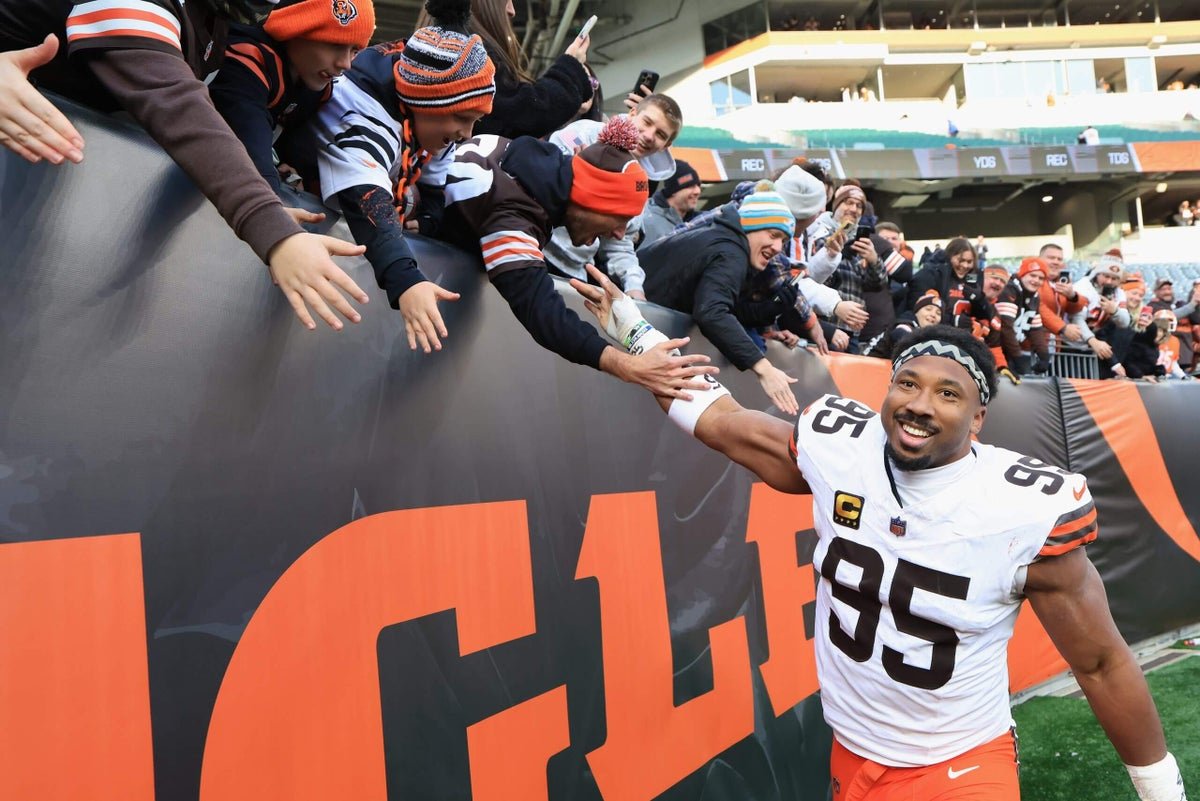
Cleveland Browns defensive end Myles Garrett is a game-changing, weather-changing force who set the NFL single-season sack record in 2025 with 23. Headed to his 10th season, Garrett is at the peak of his football powers and can affect plays — and opposing players and play callers — even when he’s not recording sacks.
But Garrett, 30, has played on just two playoff teams in his nine-year career. The Browns have won a total of eight games over the past two seasons and again are trying to remake and resuscitate their offense. Garrett took a trade demand public in early 2025 before deciding to sign a rich new extension to stay, but a contract modification in March and Garrett’s decision to stay away from the team this spring and stay publicly quiet about his feelings on the state of the team have sparked discussion about a possible Browns decision to trade Garrett at some point either before or during the 2026 season.
Now that it’s June, a trade is possible under the team’s salary-cap parameters. And unless Garrett shows up for mandatory minicamp June 9 and publicly reaffirms his commitment to stay in Cleveland for the foreseeable future, the speculation will continue until the Browns become serious playoff contenders.
Maybe this latest round of Garrett-related uncertainty is much ado about almost nothing; Garrett has never fully participated in the team’s voluntary offseason program in recent years. But maybe something really could be up, and maybe with that contract modification came an acknowledgement from both sides that the Browns’ current timeline might not match Garrett’s. A year and a half after saying he needed to move on and chase championships, might Garrett be having those thoughts again? Let’s explore the situation.
Why is this discussion happening (again) now?
If the Browns wanted to trade Garrett and found a partner willing to pay an exorbitant price to acquire him, Cleveland could do it now. After June 1, the Browns could split the approximately $41 million in dead money they’d incur from a Garrett trade over two seasons on their salary cap. If a trade occurred at any point after Monday, the Browns would carry $15.53 million of dead money on their 2026 salary cap and take on the remaining $25.56 million of dead money in 2027.
All salary numbers here come from Over the Cap, which lists the Browns with about $17 million in available cap space. Garrett’s 2026 cap number is set to be $23.8 million, so a trade would create around $8 million in 2026 cap space. Garrett’s cap number rises to almost $28 million in 2027 and almost $30 million in 2028.
The numbers matter, and they clearly mattered when the Browns got Garrett to sign an extension that included more than $122 million in new guarantees after his 2025 trade demand. But it’s what happened with that contract recently that’s made a potential trade at least somewhat realistic.
In March, the team and Garrett agreed to a contract modification that deferred a total of $29 million in bonus payments due to Garrett over the next three years. The modification created no immediate salary-cap space for the Browns and pushed around $10 million in guaranteed money for Garrett from March to a week before the start of the regular season in September. This means the only real explanation for the modification is that both sides were at least opening a trade window. The Browns weren’t going to pay him more, again, and then trade him.
And though that modification doesn’t mean the Browns will trade Garrett now, the same deferral window applies to the next two seasons. It’s essentially an escape clause for the Browns and potentially for Garrett, who has a no-trade clause that gives him some level of authority on where he’d play next if the Browns decided to move him.
What has been said about a potential trade?
Garrett hasn’t had a public availability with Cleveland reporters since last season ended in early January. Garrett had a strong relationship with former Browns defensive coordinator Jim Schwartz, who was a finalist for the head-coaching job after the Browns fired Kevin Stefanski. But the Browns hired Todd Monken, which led Schwartz to resign and has fueled some of the speculation about Garrett’s being open to a move.
Monken has been asked multiple times over the last several months whether he’s talked with Garrett in person, and Monken has said he has not. Last week, new Browns defensive coordinator Mike Rutenberg said he’s spoken with Garrett but would not share details. Garrett would be subject to fines if he doesn’t attend the team’s mandatory minicamp.
The late-March contract modification came just before the start of the NFL’s annual meeting, where the Browns submitted a rule-change proposal asking owners to allow teams to trade draft picks up to five years into the future. Though that rule change was withdrawn after it was clear it would not pass, meaning draft picks can still only be traded up to three years ahead, the timing of the Browns’ proposal and the opening of the Garrett trade window via the contract modification did not seem coincidental.
In early 2025, the Browns publicly and privately rebuffed almost any discussion of trading Garrett. At this year’s annual meeting, Browns general manager Andrew Berry was asked whether he could “unequivocally” say the team would not trade Garrett.
“Myles is a career Brown,” Berry said. “He is one of the faces of our organization. I think we’ve been very clear both past and present in terms of our goals. I understand all the questions. I’ll be honest, I don’t really want to waste a ton more breath on the topic.”
Since that wasn’t a firm ‘no’ from Berry, where do the Browns stand?
If the Browns believe they’re close to turning things around, they won’t trade Garrett and will continue to let opposing coaches lose sleep over the thought of trying to block him. If the Browns think they’re still in the early stages of an offensive rebuild and need to fully embrace a future-based plan of attack, they could ask for multiple premium draft picks in return and seriously consider trade offers.
It’s a bad trade of their own that explains the last two seasons’ offensive failures. After giving up their first-round picks from 2022 through 2024 in a 2022 trade that’s thus far resulted in quarterback Deshaun Watson’s winning nine starts in a Cleveland uniform, the Browns initiated a youth movement in 2025 by carrying 14 rookies on their active roster for much of the season.
Now the Browns have a new coach and have moved on from four longtime offensive linemen. Cleveland added 10 rookies via the draft in April, four in the first two rounds. Watson is still under contract for one more season — and the Browns still have around $80 million in salary-cap commitments to him after this season.
Watson is competing this spring with second-year quarterback Shedeur Sanders for the starting job. The Browns added developmental quarterback Taylen Green in the sixth round in April, but the team’s search for a long-term answer at the game’s most important position could resume next spring. With almost all of the core pieces from a strong defense returning, maybe the Browns can improve on offense and climb out of fourth place in 2026. But if they win, say, six or seven games and find themselves needing to use major capital to attempt to trade for a quarterback in 2027, they’d likely have to deal almost a full draft class — or Garrett — to do that.
Is there any precedent for a trade like this?
In August, the Dallas Cowboys traded then-26-year-old pass rusher Micah Parsons to the Green Bay Packers for two first-round picks and defensive tackle Kenny Clark. Earlier this offseason, the Las Vegas Raiders and Baltimore Ravens agreed to a trade that would have sent pass rusher Maxx Crosby to Baltimore for two first-round picks, but the Ravens backed out of the deal before it was finalized.
Garrett’s 51 sacks over the last three seasons are the most by any player. Parsons is fourth in that time with 38.5, and Crosby is 10th with 32. Garrett last season became the first player to record at least 12 sacks in six consecutive seasons, and he’s missed just one game because of injury over the last six seasons.
Just before the start of the 2018 season, the Raiders traded Khalil Mack and a second-round pick to the Chicago Bears for two first-round picks and a third-round pick; the deal included a swap of late-round picks. Mack was 27 at the time and was in the midst of a run of four straight double-digit sack seasons. Mack was the runner-up for what would have been his second NFL Defensive Player of the Year award in the 2018 season. Garrett won his second last season.
In their attempt to trade Crosby, the Raiders liked that they were acquiring the No. 14 pick in the 2026 first round from the Ravens. Though multiple teams would be interested in acquiring Garrett’s services, the Browns most likely would be dealing with teams that have immediate Super Bowl aspirations and would thus think they would be surrendering late first-round picks, at least in 2027.
It’s impossible to know exactly what the Browns’ asking price for Garrett might be, but it would be high. The only team that has multiple 2027 first-round picks is the New York Jets, who have three.
Should the Browns do it?
If they can find a team that’s willing to give two first-round picks plus something else of substance, absolutely. Garrett’s value almost certainly will never be higher than it is now, and multiple contending teams might at least explore giving up future assets for a chance to get Garrett now.
Would any of them actually give up three first-round picks? Or two first-rounders plus a young player the Browns covet? That’s hard to say, but interested teams have known of Garrett’s March contract modification since it happened. The biggest hurdle might be the Browns’ actually finding what they believe is maximum proper value for moving on from such a dominant player, but acquiring premium draft assets for 2027 (and potentially 2028 and ’29) would give the Browns necessary flexibility and a clearer road map in their ongoing roster remake.