

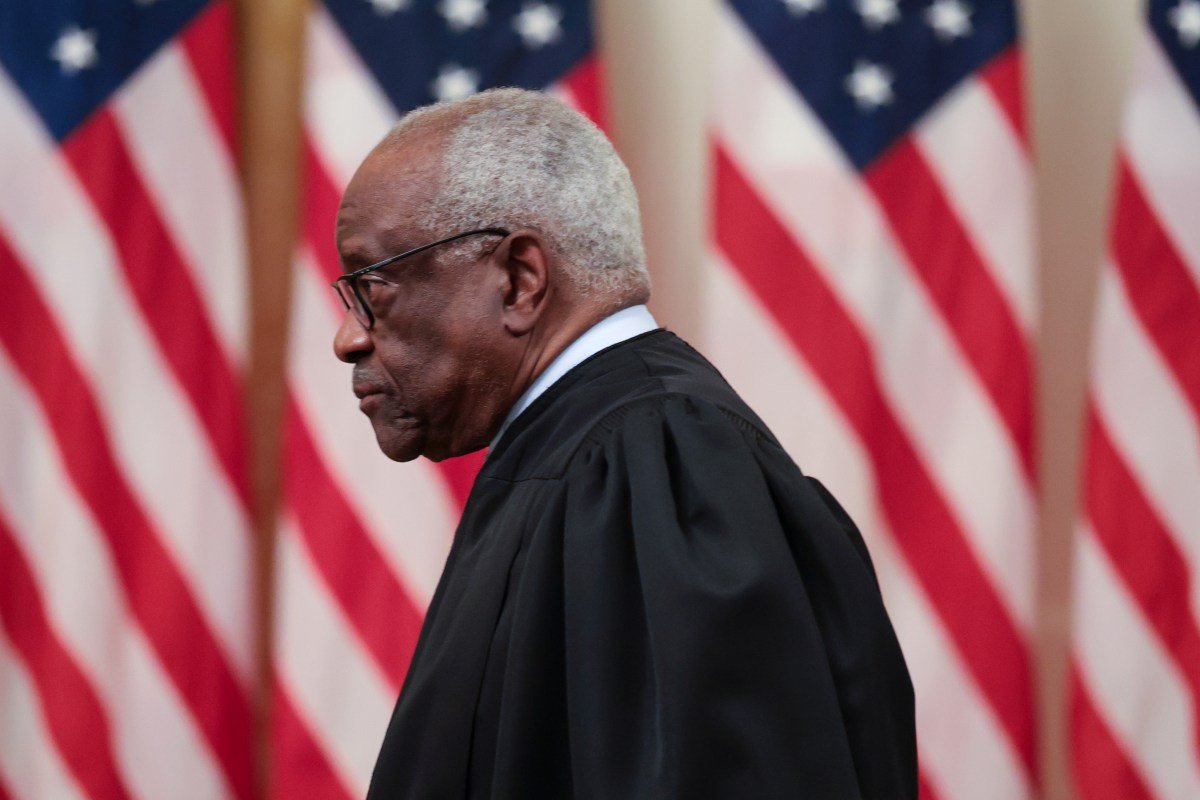
Alabama’s bid to have its redistricting case heard by the U.S. Supreme Court was dealt a blow by Justice Clarence Thomas on Wednesday, as he refused to immediately issue a stay on a lower court’s block on redrawing the state’s congressional map.
Thomas, who has been openly skeptical of the Voting Rights Act provisions used in situations like the one in Alabama, denied the Republican Alabama officials’ bid for immediate relief and asked those challenging the change to explain why the map should not be used.
The redistricting effort has been a long-fought battle in Alabama, but this latest legal hurdle comes amid wider efforts by the GOP to implement new maps in states across the country, ahead of the 2026 midterms, which are critical for President Donald Trump’s party to retain control of the House of Representatives.
Alabama Redistricting: What To Know
A federal three-judge panel issued a preliminary injunction Tuesday over the use of the map, first drawn up in 2023. The state quickly announced a challenge to the decision at the U.S. Supreme Court, which has already weighed in on similar cases, including in Texas.
State Attorney General Steve Marshall said in a press release announcing the challenge Wednesday, “The extent to which there is confusion about the maps which Alabama uses for congressional districts seems to be with the three-judge panel, not the voters. The fact that our State’s conservative electorate has conservative representation is democracy, not an attack on it.”
The District Court ruled on two cases together, saying that Alabama must use the same court-ordered districts that were used in the 2024 election, after attorneys representing Black voters argued the state’s planned map was intentionally discriminatory against them.
“Ultimately, we cannot see our way clear to requiring Alabamians to cast their votes in the 2026 elections under a districting plan tainted by intentional race-based discrimination,” the judges wrote.
The long-running case has moved from the legislature to the district court to the Supreme Court multiple times since 2021, culminating in a landmark 2023 ruling by the country’s highest court that affirmed the ban on the new map under the Voting Rights Act—something Thomas opposed.

An April ruling in Louisiana v. Callais, which reinterpreted how Section 2 of the Voting Rights Act should be applied, reopened the case for challenge, with the justices sending it back to the District Court just a few weeks ago.
In a brief backing Alabama state officials’ current Supreme Court appeal, the Trump administration’s Solicitor General, D. John Sauer, said the district court had paid “only lip service” to disentangling race and politics, and criticized the issuance of an injunction “deep into the election calendar.”
Plans had already been put in place to hold primaries using the planned new map.
“Federal district courts do not have the same license to interfere with election rules at the eleventh hour, particularly on such dubious merits theories,” Sauer wrote.
Thomas’ Skepticism Over Redistricting Challenges
For decades, Thomas has taken one of the most skeptical views on the court toward the use of the Voting Rights Act (VRA) in redistricting cases, repeatedly arguing that federal law should play little to no role in how states draw congressional maps. His position is rooted in a broader constitutional philosophy that emphasizes a “colorblind” understanding of the Equal Protection Clause and rejects the idea that courts should require or encourage race-based districting.
Over time, Thomas has become one of the most consistent voices calling for a fundamental rethinking—and in some instances outright abandonment—of the legal framework used to challenge electoral maps under Section 2 of the VRA.
In a series of opinions dating back to the 1990s, Thomas has argued that Section 2 has been misinterpreted by courts to address “vote dilution” claims tied to district boundaries. He first laid out this position in a 1994 concurrence in Holder v. Hall, asserting that the statute’s text applies only to voting procedures—such as access to ballots—not to the drawing of district lines.
He has reiterated that view consistently, including in more recent cases, writing that Section 2 “cannot provide a basis for invalidating any district” because it governs only “access to the ballot or the processes for counting a ballot,” not “a State’s choice of one districting scheme over another.”
That argument was prominently on display in his dissent in the 2023 case Allen v. Milligan, which upheld the challenge to Alabama’s congressional map and returned to the court in 2026.
In 2023, Thomas criticized the majority for, in his view, forcing states to engage in race-conscious line drawing. He rejected the idea that the VRA requires states to create majority-minority districts to reflect population shares, writing that Section 2 does not demand proportional representation and would be unconstitutional if interpreted to do so.
More broadly, he described the Court’s redistricting jurisprudence as a “disastrous misadventure” that conflicts with the Constitution’s commitment to race neutrality.
Thomas has doubled down on that critique in more recent redistricting disputes, including the court’s April 2026 decision in Louisiana v. Callais. Writing in concurrence, he argued that the court should go even further than the majority and hold that Section 2 “does not regulate districting at all.”
Across these opinions, a consistent theme emerges: Thomas sees the VRA’s use in redistricting as encouraging the very racial sorting the Constitution forbids.
He has argued that modern interpretations of Section 2 effectively treat racial groups as entitled to political representation in proportion to their population, a premise he rejects as both legally unfounded and constitutionally suspect. By contrast, supporters of the current framework argue that Section 2 remains a critical tool for preventing states from weakening minority voting power through district design.
What Happens Next
The attorneys representing those challenging the new map have until 4 p.m. on June 1 to submit their reasoning to the Supreme Court. Sometime after this, the court will decide whether to grant the state’s appeal.
See More: https://www.ubirataonline.com.br