

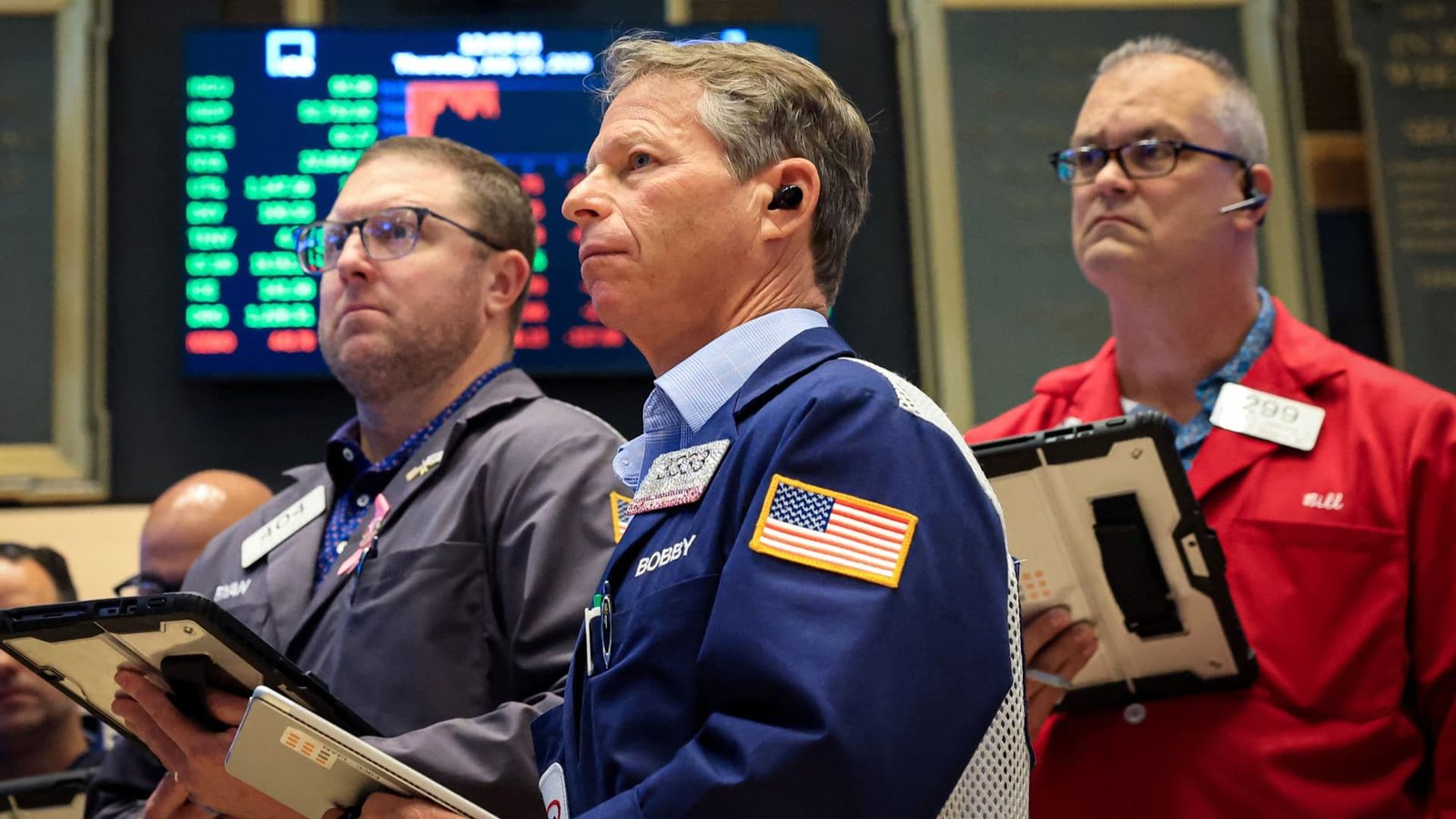
Traders attend the IPO of the Brookfield-backed data center provider Csquare Inc. at the New York Stock Exchange (NYSE) in New York City, U.S., July 16, 2026.
Brendan McDermid | Reuters
Stocks fell again on Friday, with Wall Street on track for a weekly decline, as traders weighed the latest moves in semiconductors along with the latest quarterly reports.
The broad market index lost 0.9%, while the Nasdaq Composite dropped 1.2% as tech stocks came under scrutiny. The Dow Jones Industrial Average traded down 298 points, or 0.6%.
The major stock benchmarks are also down week to date, with the S&P 500 off by more than 1%, while the Nasdaq has slipped more than 2%. The Dow has fallen nearly 1% on the week.
The SMH is on pace for its third weekly decline in four weeks, dropping more than 8% in the period. Semiconductors were hit especially hard earlier in the session, although they have since retraced some of their losses, after Chinese startup Moonshot AI unveiled a new model that it says narrows the gap with the top offerings in the U.S.
“The latest development is competition from open-source models in China, which are reportedly rivaling the performance of leading offerings from Anthropic and OpenAI, raising fresh concerns about the heavy pace of technology spending,” said Angelo Kourkafas, senior investment strategist at Edward Jones.
“We are seeing signs of fatigue, with end-user demand for AI becoming more price sensitive and the market starting to penalize companies that are ramping spending too aggressively,” he continued. “We view this volatility as a signal that the AI theme is likely maturing rather than breaking, which is a healthy part of how transformative investment cycles evolve.”
Alongside chips, shares of Netflix were a major laggard Friday, falling more than 6% as the company’s forecast failed to ease investor concerns that growth is slowing.
Further escalations in the U.S.-Iran war also remained in focus, with oil prices rising in their wake. U.S. West Texas Intermediate crude futures were last trading above $81 per barrel, while international benchmark Brent crude futures were above $86.
Kuwait said on Friday that Iran attacked a power and water desalination plant, and U.S. Central Command said overnight that it had completed its sixth consecutive evening of strikes against Iran, hitting dozens of military targets, including logistics infrastructure and maritime capabilities.
Iranian officials also claimed on Friday to have targeted U.S. military forces in Syria and Bahrain, widening Tehran’s attacks further across the Middle East.
This comes as the fragile truce reached last month has fractured, once again disrupting energy flows through the strategically vital Strait of Hormuz, which typically handles around 20% of the world’s oil traffic.
The latest move in oil is “going to freak people out, but we still remain right in the ballpark of average,” said David Wagner, head of equities at Aptus Capital Advisors. Wagner added he’s optimistic on the broader market even with elevated oil prices, saying, “I’m still bullish, but there might be more volatility moving forward.”
See More: https://www.ubirataonline.com.br