

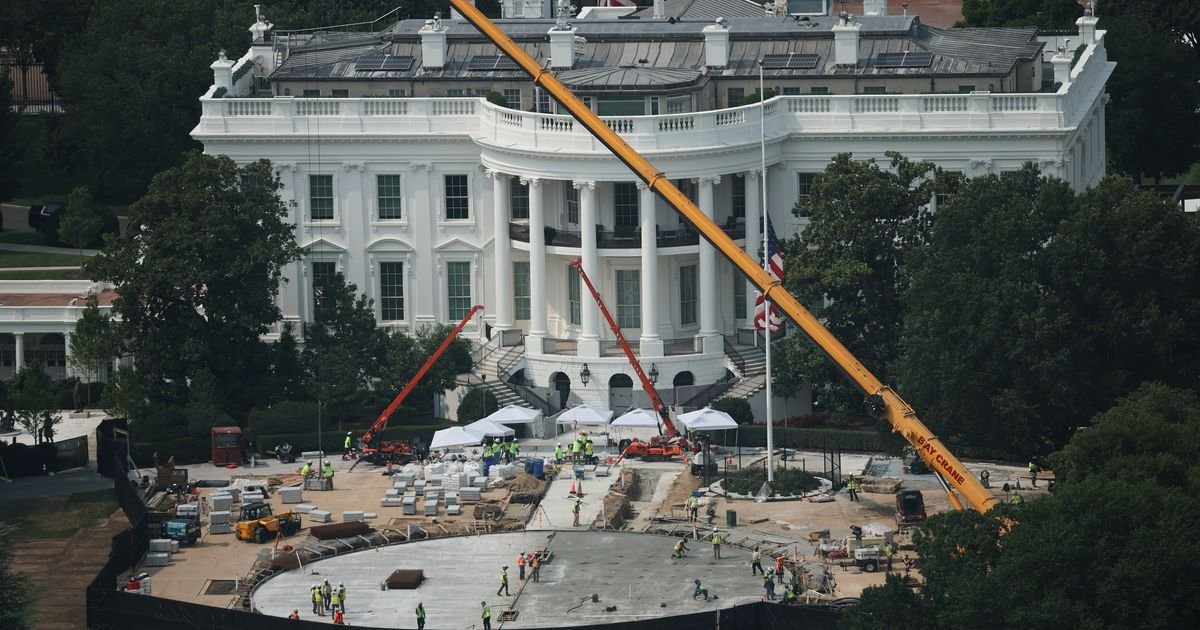

White House helipad construction continues on July 14, 2026.
Photo: Win McNamee/Getty Images
Obviously, constructing a 92-foot-tall, 600-ton UFC arena for the president’s 80th-birthday bash completely destroyed the South Lawn. Donald Trump said this would be resolved one of two ways. Either the Ultimate Fighting Championship would pay $700,000 to restore the lawn or “the Cage” would stay up forever, like Trump’s version of the Eiffel Tower.
It turns out Trump went with a third option he’d never mentioned publicly: seize the opportunity to fulfill his dream of constructing a White House helipad without seeking authorization for this permanent change to the Exeutive Mansion.
Much like the White House Ballroom, Trump’s addition may be justified but his methods clearly are not. Like the planners of the destruction of the East Wing, the organizers of the UFC event did not obtain congressional approval or conduct an environmental review before ripping up the South Lawn to build a massive fighting ring. And in both cases, after the demolition Trump started constructing a permanent addition to the Executive Mansion without asking anyone’s permission.
In days of yore, adding something as minor as a tennis court to the White House campus could take years. And even the planned Mar-a-Lago helipad has undergone a preservation-commission review, multiple public hearings, and votes by the Palm Beach, Florida, town council. But the New York Times reported on Thursday that Trump hasn’t bothered with any of that at the White House:
He has not asked Congress or any review panel, such as the Commission of Fine Arts, to approve the project.
… A White House spokesman said in an email that “operational upgrades to the White House grounds, such as the helipad installation, do not require commission reviews.”
Ongoing lawsuits eventually forced Trump to submit his ballroom plans to several D.C. commissions (which he’d packed with his allies). But at the moment, it doesn’t seem like the White House helipad is getting even a sham review.
Earlier this month, Trump said Pentagon contractor Lockheed Martin was paying roughly $5 million for the new helipad. Sikorsky, a subsidiary of Lockheed Martin, won a contract to upgrade Marine One helicopters more than a decade ago. But as The Wall Street Journal reported, it’s unclear when the company donated the money for the helipad:
A Lockheed Martin spokeswoman said the company donated the funds to the National Park Service as part of “a long history of supporting projects in both the Washington, D.C., area and across the country.”
The spokeswoman didn’t say when the donation was made. “Our engagement with the federal government is guided by rigorous ethics and compliance standards and conducted in full accordance with all applicable laws and regulations,” the company said.
Unlike with many Trump vanity projects, there is an actual need for a White House helipad. Helicopters used to transport the president and vice-president previously landed on portable aluminum pads placed on the South Lawn. The Navy has been looking to upgrade its decades-old Marine One fleet since the Obama administration. It purchased VH-92A Patriot helicopters years ago and has been testing them for years; Joe Biden was the first to use one in 2024, when he headed to the Democratic National Convention in Chicago. But the more powerful VH-92A can’t land at the White House without scorching the lawn.
Still, maybe Trump should have let some commission look over those helipad plans before construction started. This platform needs to support a 15,500-pound aircraft carrying the president, his family, and his advisers. Trump’s Reflecting Pool renovation isn’t looking so hot, and all it needed to do was hold water.