
On 26 January 2015, Hugh Grant entertained an unusual guest at an exclusive venue in one of London’s most affluent neighbourhoods. A few weeks earlier, the disgraced former tabloid journalist Graham Johnson had been contemplating starting the year behind bars. Now, he found himself opposite the Hollywood actor in the rather more comfortable surroundings of the KX Gym in Chelsea, which doubles as a private members’ club where fees cost more than £600 a month.
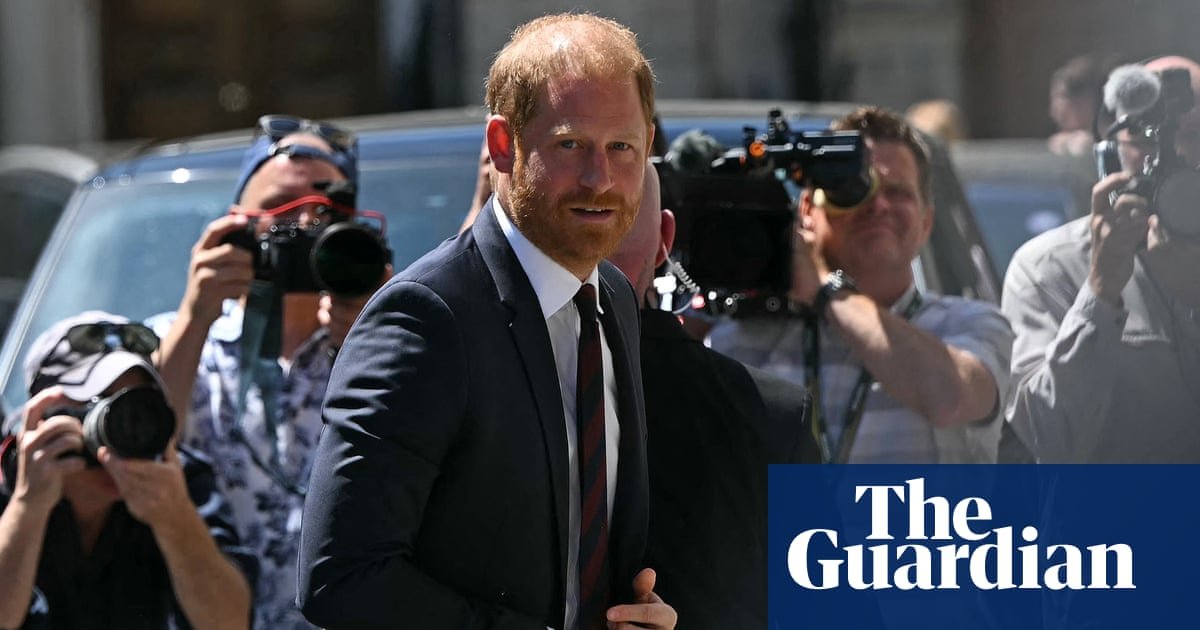
It was on that day, 11 years ago, that one of the seeds of Prince Harry’s doomed court battle with the publisher of the Daily Mail was sown.
The privacy action brought by the prince and six others, including Elton John and his husband, David Furnish, the actor Elizabeth Hurley and Doreen Lawrence, would probably never have made it to the high court had it not been for an unlikely alliance. It was one forged between Johnson – a self-confessed “professional liar” who had regularly fabricated stories for the tabloid press – and Evan Harris, a former Liberal Democrat MP who once served as executive director of Grant’s Hacked Off campaign group.
Shortly before he met Grant, Johnson had received a two-month suspended sentence after admitting hacking a soap actor’s phone while working at the Sunday Mirror. He avoided jail by turning himself in to the police, after they had begun to arrest his former colleagues.
His shot at redemption had come via Harris, who approached him when he appeared at Westminster magistrates court with an intriguing proposition: did he want to change sides and help to expose press wrongdoing?
Johnson took up the offer and the two men spent a decade courting a cast of dubious characters who formed the bedrock of the claim against the Daily Mail, which was rejected by the judge, Mr Justice Nicklin, on Tuesday.
Taking down the Daily Mail
Johnson’s route on to the prince’s legal team came through the endorsement of other stalwarts of the press reform movement, who were seemingly willing to overlook his long history of dishonesty.
Among the blots on his copybook was a resignation from the News of the World in 1997 for a fake a sighting of the Beast of Bodmin, a mythical black cat that had been a tabloid obsession in the 90s.
The meeting between Grant and Johnson was first revealed by Channel 4 Dispatches, in a documentary broadcast in December. Sources confirmed to the Guardian that it took place at the Chelsea club just six weeks after Johnson’s last court appearance.
Until then, the phone hacking scandal that had led to the closure of Rupert Murdoch’s News of the World had been concentrated on the behaviour of the red top tabloids. Journalists from the News of the World and the Mirror were arrested and their publishers forced to pay compensation to thousands of victims.
Under the stewardship of its long-serving editor Paul Dacre, the Daily Mail had escaped criminal investigation. Three years earlier, at the Leveson inquiry into press ethics, Dacre defiantly asserted that he had never published a story known to have originated from voicemail interception.
But Grant had become aware of a damaging rumour: the Daily Mail had allegedly offered payments to Ian Huntley, later convicted of killing the 10-year-old girls Holly Wells and Jessica Chapman in Soham in 2002. Johnson had a proposal: would Grant pay him to investigate this claim? Grant agreed.
The Soham tip did not appear to bear fruit and Grant later insisted to Dispatches that, if it had gone anywhere, it would have been a matter for the police and not the civil courts.
However, the die had been cast. At the Daily Mail’s Kensington HQ – a mile from the Chelsea gym – Dacre and his senior executives were planning the next day’s paper. They were blissfully unaware that Johnson and Harris were set to embark on a decade-long crusade that would culminate in Harry’s court showdown with the newspaper.
Operation Bluebird
With the Mail in their sights, the pair began discussions with other wealthy backers who might throw their weight behind an investigation into wider allegations of wrongdoing at the paper. Their project was codenamed Operation Bluebird.
Soon, they were trawling copies of old newspapers and approaching private investigators in an attempt to find evidence of stories obtained illegally. They also wanted to sign up their high-profile subjects, who might be persuaded to take action.
Few could argue against the idea that the actions of some journalists working for the Daily Mail and its stablemate, the Mail on Sunday, were unpalatable. They ran endless speculation on the paternity of Liz Hurley’s son and the state of Harry’s relationship with his ex-girlfriend, Chelsy Davy. The Mail on Sunday’s former diary editor Katie Nicholl obtained details of Sadie Frost’s ectopic pregnancy, though the newspaper stopped short of publishing them.
This week Nicholl, who was a witness in the case and wrote extensively about Harry’s private life, admitted to feeling uneasy, looking back, at some of her work through the lens of 2026. Speaking to BBC Radio 4’s Today programme, she said: “Am I proud of every single story? No, I’m not. Certainly some of them were intrusive and veered into deeply private territory. It doesn’t mean they were gotten illegally. They were not.”
However, Johnson and Harris went to great lengths in their attempt to prove that a legal line had been crossed by Nicholl and her colleagues. Johnson sourced funding from the families of the late privacy campaigner Max Mosley and the playboy and self-described billionaire James Stunt, frequently the subject of Mail investigations owing to the opaque source of his supposed wealth.
Some of this money allowed Johnson to pay private investigators who had worked for newspapers, several of whom had criminal convictions. Some later provided witness statements in the case against the Mail.
Although Johnson claimed the payments were for journalism purposes – for articles on his website Byline Investigates, book deals or participation in documentaries he was working on – this suggestion was rejected by Nicklin. “The contemporaneous documents do not provide any support for that distinction,” the judge said. “Rather, they demonstrate a single course of conduct, pursued over time, which combined both journalistic and litigation objectives.”
Harris, for his part, was courting his old parliamentary colleague Simon Hughes, whose sexuality was the subject of feverish tabloid speculation in the mid 2000s. Harris believed that, in 2006, Hughes could have been targeted by a private investigator working for the Mail on Sunday.
Harris suggested that Johnson could publish a story on the Byline Investigates website that could be used as the basis for Hughes launching a claim, which he later did, against the newspaper to get around the issue of limitation (in England and Wales, privacy actions must be brought within six years of a claimant discovering a potential breach). Nicklin said in his judgment that this was an “improper and dishonest proposal” on Harris’s part.
after newsletter promotion
The key witness
Yet perhaps the biggest mistake of all was the recruitment of Gavin Burrows. Johnson appeared to have struck gold when, about six years ago, he began a dialogue with Burrows, a former private investigator who was apparently willing to confess to a breathtaking catalogue of crimes aimed at gathering information about celebrities for the Mail newspapers.
His alleged targets included Hurley, Frost, Elton John and – crucially – Harry. Harry was “astounded and very troubled” to learn Burrows had apparently put a hardwire tap on his friend Guy Pelly’s phone and intercepted the voicemails of his teenage girlfriend.
When Hurley was told that Burrows had recorded her phone conversations and placed a bug on the window of her London home, she felt her “nightmares” were “becoming a depraved reality”. She told Elton John and Furnish that Burrows allegedly tapped the landline of their Windsor mansion when she was staying there after the birth of her son. The couple said this claim broke their hearts.
Burrows was rewarded handsomely for his cooperation: he was paid a monthly retainer of £5,000 to help Johnson research alleged Fleet Street skullduggery. Yet the most incendiary allegation of all was yet to emerge, in an apparent conversation between Burrows and a fellow private investigator, Jonathan Rees.
Burrows reported that Rees had been part of a team tasked by the Mail to conduct illegal surveillance on Lady Lawrence, while the newspaper publicly campaigned for justice for her murdered son, Stephen. It was alleged that journalists instructed private investigators to bug a cafe she frequented.
In 1997, Dacre said he had risked prison by accusing five men of killing Stephen in one of the most audacious front pages in British newspaper history. Two, Gary Dobson and David Norris, were later convicted. Lawrence, who had once said she was “indebted” to the Daily Mail, was blind-sided when Harry contacted her to tell her he had learned some information about the newspaper that she ought to know.
Lawrence met lawyers who advised her that the paper might have been spying on her all along. With a starry list of claimants, Operation Bluebird, it appeared, was about to take flight.
Cracks in the case
Before the claim was formally lodged in October 2022, cracks were beginning to appear between the claimants and their key witnesses.
Johnson and Burrows had fallen out and were embroiled in a row about money. Johnson was beginning to doubt the quality of Burrows’s research, despite the crucial role it played in the case.
Neither he nor Harris had managed to get Rees to commit his apparent Lawrence claims to a witness statement. Rees, who did not give evidence in the trial, told Dispatches that he had not bugged Lawrence and did not think the Mail had acted illegally.
Burrows then switched sides, giving a statement to the Mail’s lawyers saying his confession was forged and based on conversations he had had with Johnson when he was drinking heavily. In a new statement, he claimed he had never worked for the Mail at all. Nicklin said Burrows’s credibility was “comprehensively undermined”.
Despite reports of a last-minute scramble for a settlement, Harry, Lawrence and the other claimants took the case all the way to trial and lost on every count.
Harry was rumoured to be on the verge of tears when he learned that the final battle in his long war with Britain’s tabloid press had ended in humiliating defeat, after previously securing payouts from the publishers of the Sun and the Mirror.
Although Nicklin did not assert that Johnson and Harris had set out to mislead the court, he noted inconsistencies in their evidence and ruled that it should be approached with caution. Harry and the other claimants may be entitled to wonder why they were trusted with the bungled attempt to bring Fleet Street’s biggest beast to heel.
It remains to be seen where the press reform movement goes now. Hacked Off appeared to distance itself from Johnson on Friday, releasing a statement clarifying that he had never worked for the organisation. Grant has strenuously denied paying Johnson to gather evidence for the claim brought by Harry and his co-claimants.
The group’s call for a public inquiry into the historic conduct of the Mail is widely expected to fall on deaf ears. A more pressing concern might be who will foot the newspaper’s enormous legal bill.