

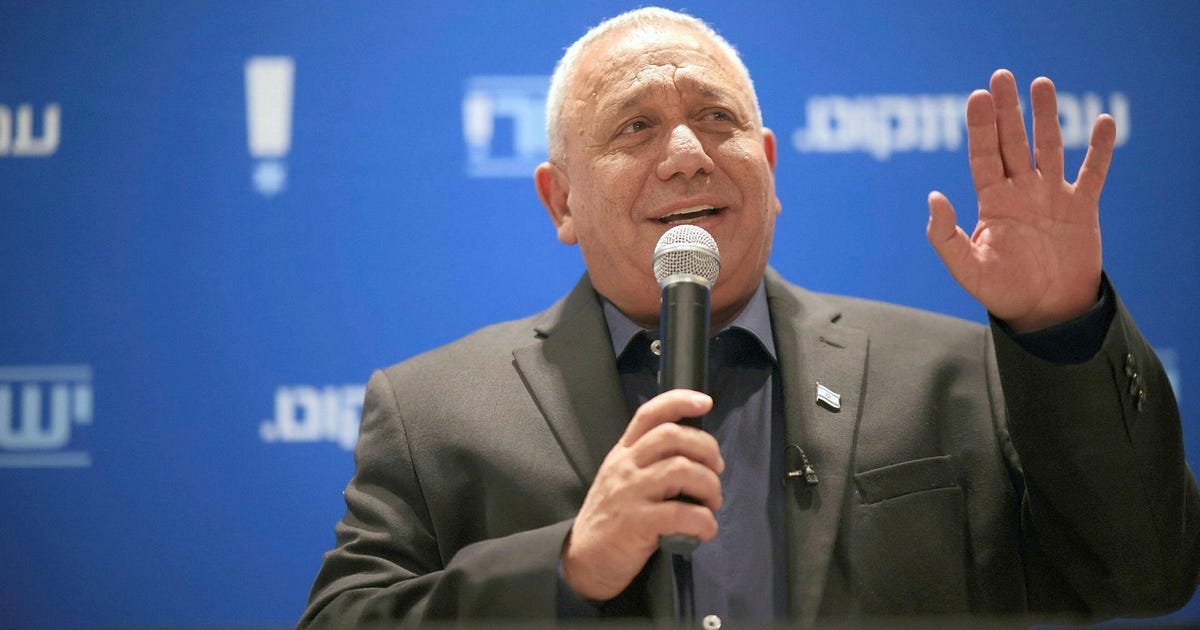
A Channel 13 poll published Wednesday evening projects that Gadi Eisenkot’s Yashar party is set to be the largest party in the next Knesset, if a general election were held today.
While this is the first time that the former IDF Chief of Staff overtakes Prime Minister Benjamin Netanyahu’s Likud in the polls, the Jewish opposition parties still find themselves three seats short of the 61 needed to form a government.
To form a governing coalition, a bloc has to comprise a majority of 61 of the Knesset’s 120 total seats. A party needs to receive at least 3.25 percent of the vote for a seat in the Knesset.

Haaretz Podcast
‘We need allies, not just more security cameras’: Reform movement head Rick Jacobs on the growing ‘isolation’ of U.S. Jews
total— : —
According to Wednesday’s Channel 13 poll, Yashar would win 23 seats if the election were held today – two more than in the channel’s previous poll. Netanyahu’s Likud party is close behind with 22 seats, gaining one seat from last week’s poll.
Click here for Haaretz’s Israel 2026 election poll tracker
While several parties gain or lose seats, the poll does not indicate any change to the voting blocs. Parties currently in the coalition are projected to hold 51 of the Knesset’s 120 seats, while the opposition parties would win 69, including 11 for two Arab-majority parties.
As a long line of recent polls has shown, Jewish opposition parties do not have a majority without the Arab parties.
Despite early election polling positioning former Prime Minister Naftali Bennett as a leading candidate to replace Netanyahu as the next prime minister, recent polls position Eisenkot as the new leading candidate, with a Monday Channel 12 News poll showing Yashar and Likud neck to neck. On the question of suitability for the premiership, Eisenkot also surpassed Netanyahu.
Along with Eisenkot’s meteoric rise in the polls, Likud campaign officials have also shifted the campaign’s focus from former Prime Minister Naftali Bennett to Eisenkot.

Last month, Israeli Education Minister Yoav Kisch said he would not rule out a scenario in which the Likud party joins a government led by Gadi Eisenkot. Referring to Netanyahu’s statement at a Saturday press conference calling for a broad coalition after the next election, Kisch urged opposition parties to reconsider their stance.
“I know that [the opposition parties] are boycotting the Likud and the right, but maybe they’ll change. I hope,” he said.
Kisch’s remarks came shortly after Gadi Eisenkot accused the Likud of racism over a campaign video mocking his English-speaking skills. The Likud’s jab at Eisenkot’s English was meant to highlight Netanyahu’s own fluency in the language, a familiar touting point for the prime minister’s supporters over the years.
“They’re scared, I see their fear,” Eisenkot said, hinting that his surge in recent polls was the motivating factor behind Likud’s attack.
In an interview with Ynet, the Yashar leader said, “I ask myself, where was Netanyahu’s excellent English on October 7? Did it help us with anything? It didn’t. How does his excellent English help strengthen Israel-U.S. relations, which are at a low point?”
In Wednesday’s poll, Bennett’s Together party, formed earlier this year following a merger with Yesh Atid’s Yair Lapid, is projected to be the third-largest party in the next Knesset, with 15 seats.

The poll also projects that two additional opposition parties – the center-left Democrats headed by former deputy IDF chief Yair Golan and Yisrael Beiteinu, led by nationalist hardliner Avigdor Lieberman – would win 10 seats each.
The ultra-Orthodox Shas and United Torah Judaism parties, and the far-right Otzma Yehudit party, led by National Security Minister Itamar Ben-Gvir, are all tied for second-largest among the coalition parties, with eight seats each.
The Arab-majority Hadash-Ta’al and United Arab List are projected to win six and five seats, respectively, while far-right Finance Minister Bezalel Smotrich’s Religious Zionism would win five seats, according to the poll.
The poll also found that several parties would fall short of the 3.25 percent electoral threshold needed to gain entry to the Knesset. The Reservists’ Yoaz Hendel, who earlier this week announced he would run for office together with ex-Kahol Lavan MK Chili Tropper, received 2.2 percent of the vote, according to the poll.
Former Prime Minister Benny Gantz’s Kahol Lavan party, which at its peak won 35 seats, is projected to receive only 2.1 percent of the vote. Palestinian nationalist party Balad would be well shy of the threshold, according to the poll, with a mere 1.7 percent of the vote.
The Channel 13 poll was conducted by Hamadad (Shmuel Rosner and Noah Slepkov), in partnership with Project Hamidgam (Dr. Ariel Ayalon), Askaria (Dudi Dror) and Stat-Net (Yosef Maklada). The number of respondents and the sampling error were not specified.